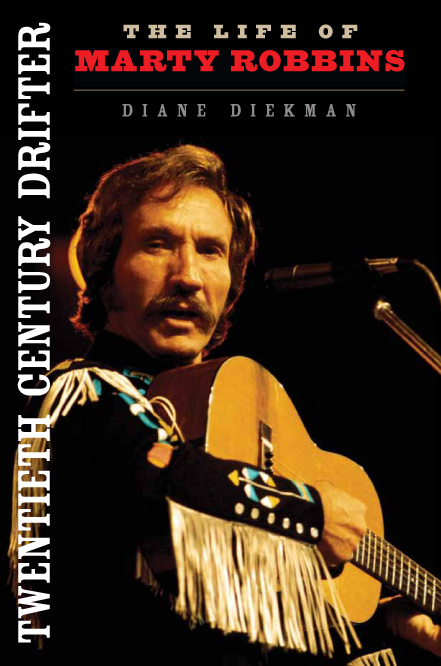
Order: TWENTIETH CENTURY DRIFTER: THE LIFE OF MARTY ROBBINS
Marty Robbins placed 94 songs on Billboard’s Country Singles charts in a thirty-year career, four of them after his death. Beginning with the autobiographical “I’ll Go On Alone” in 1953, 16 songs topped the charts. They included “Singing the Blues,” which held the number one spot for 13 weeks in 1956, and the pop-sounding “A White Sport Coat (and a Pink Carnation)” in 1957. Marty’s Hawaiian songs, rockabilly hits, teen ballads, gunfighter ballads, pop standards, and dozens of songs of various tempos showcased his versatility. He starred in western, country music, and racing movies and hosted television shows, including The Marty Robbins Spotlight. The Academy of Country Music honored him with its Man of the Decade Award in 1970, and he received two Grammy awards, the first in 1960 for “El Paso” and another in 1970 for “My Woman, My Woman, My Wife.” Marty raced in spite of a heart condition. He suffered a major heart attack while on tour in 1969, and his triple bypass surgery in January 1970 was one of the earliest in the world. (An earlier heart attack went undiagnosed.) Following another decade of singing and NASCAR racing, he had a second major heart attack in 1981. He was 57 years old when a final heart attack took his life on December 8, 1982, two months after his induction into the Country Music Hall of Fame.
DIANE DIEKMAN TALKS WITH THE UNIVERSITY OF ILLINOIS PRESS:
Q–Why did you write the Marty Robbins biography?
Diekman– In August 2005, doing research for Faron Young’s biography, I was watching a tape of the Marty Robbins Spotlight television show, when realization of Marty’s amazing talent hit me. He was already one of my favorite singers, which made me eager to learn more about his music. His NASCAR and Navy connections were additional topics I would enjoy researching. I decided he would be the perfect subject to write about after I finished Live Fast, Love Hard: The Faron Young Story. No one had yet written a book on his life, and I wanted to be the one to tell his story.
Q–In Marty didn’t you have a multi-layered talent to cover?
Diekman– Oh, definitely, both in music and other facets of his life. He’s a member of the Country Music Hall of Fame and the Nashville Songwriters Hall of Fame. He was a successful businessman who built publishing and recording companies and invested in real estate. Most of his hits were his own compositions. Love songs and western songs were his favorite to sing, and his passions were music and racing, “Ranger Doug” Green of Riders in the Sky says, “For anybody that sings western music, the Gunfighter Ballads and Trail Songs album is seminal. It’s part of Cowboy 101. It’s just a must listen.” Marty’s record albums included Hawaiian songs, rockabilly, teen ballads, western music, pop standards, and straight country songs. He hosted television shows and starred in movies about country music, cowboys, and stockcar racing. NASCAR’s Bobby Allison says Marty “started out being a singer driving a race car, but he became a race car driver who could sing.”
Q–In your research did you learn anything new about Marty?
Diekman– A lot! I didn’t know much about him when I started, other than that he had many hit songs and drove in NASCAR races. I’d known from news reports about his heart attacks and his racing mishaps. I remember being shocked at his death because I thought he was too tough to die. Early in my research, and being used to hearing wild stories about Faron Young, I was surprised to hear only positive things about Marty. But no one is perfect, and I eventually learned about his hot temper and insecurities and standoffishness. Band member Jeff Chandler recalls, “I thought he was trying to rule us with an iron fist so we’d behave ourselves. Now that I look back on it, I think he was insecure and that was the wall he put up. Because he didn’t want to let you too close; he didn’t want you to see the real Marty. So that’s how he kept you at arm’s length. He was an intimidating and imposing figure. I was nervous around him.”
Q–Speaking of research, didn’t you get to talk with Marty’s friends, former band members and family members? Who were some of them?
Diekman– It was fascinating to meet all these people, and I’m grateful for the relationships we developed. I had several long visits with son Ronny Robbins and talked to daughter Janet on the telephone. I conducted telephone interviews with most of Marty’s surviving band members. I had lunch with Joe Babcock and Jim Glaser. Joe helped me arrange a band reunion in 2009. That’s where I met Jack Pruett, Earl White, Haskel McCormick, and bus driver Okie Jones. I already knew Joe Vincent from writing Faron’s biography, as he played steel guitar for both Faron and Marty. Ralph Emery gave me copies of taped interviews, Bill Anderson provided a photo for the book, and both described for me their interactions with Marty.
Q–How long did it take you to write the manuscript?
Diekman– I submitted the first chapter to my online writer’s critique group in March 2008 and the last chapter in February 2010. Everything I write goes to the Internet Writing Workshop, because I value the advice of other writers in improving my work. After completing the first draft, I revised the manuscript, sent it to a friend to review, revised it again, and sent it to the publisher in November 2010.
Q–What role do you think Marty’s childhood played in him becoming such an overwhelming success?
Diekman– He spent his life searching for security and approval. Those two needs, in my opinion, drove his every action. He grew up in poverty on the Arizona desert, wore donated clothing to school, and tried to avoid his abusive father. That memory was expressed by the line “despised and disliked by my father” in the song, “You Gave Me a Mountain.” Marty’s flamboyant stage personality covered up his deep shyness. When asked in 1981 if he had everything he’d always wanted, the country music superstar replied, “No, no. I want security. I don’t have it yet.”
Q–Don’t you think his background in music, his on-stage personality and racing career means there will be a broad interest in this book?
Diekman– The NASCAR connection should expand the reach of this book past Marty’s existing fans and introduce him to NASCAR fans who don’t already know about him. The book offers history concerning the Nashville music industry of the mid-20th century and the earlier days of NASCAR. Those interested in songwriting will learn from Marty’s songwriting philosophies and efforts.
Q–For fans who never met Marty or who came along after his death, what do you hope they take away from this book?
Diekman– I hope they will want to hear more of his music and will spread the word about this great and timeless talent. I hope learning about Marty’s courage and struggles in overcoming his insecurities will make readers dig deeper to understand and be tolerant of the people in their personal relationships. Most of all, I hope they will enjoy reading Marty’s story.
January 8, 2012
To order an autographed copy of Twentieth Century Drifter: The Life of Marty Robbins, send an email to: di***@**********an.com