
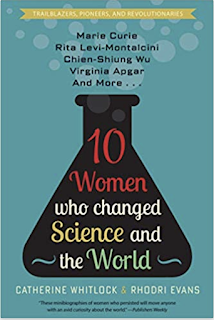
10 Women Who Changed Science and the World
By Catherine Whitlock & Rhodri Evans
The remarkable scientists profiled in 10 Women Who Changed Science and The World include both famous and obscure, some rewarded with the Nobel Prize and others ignored. The authors, Dr. Catherine Whitlock and Dr. Rhodri Evans, who both hold PhDs, bring us ten minibiographies as a small sampling of the many worthy candidates. “It’s not easy to narrow down to a list of ten,” they write, “even in the relatively small pool of influential female scientists.” To easier bring their subjects’ achievements into focus, they chose women no longer living.
A common characteristic of these women was an insatiable appetite for learning, from an early age. Many suffered exile—from their countries, within their countries, from their male counterparts in labs and classrooms. They were sometimes forced to work alone in inadequate and uncomfortable facilities. But they persisted and succeeded–in following their passions and making great discoveries, sometimes solo and sometimes with long-term partners.
Marie Curie, the first woman to win a Nobel Prize and the only person to be awarded Nobel Prizes in two different fields of science, and Rachel Carson, author of Silent Spring, are the two most famous women in the book.
Virginia Apgar was an American medical doctor and a pioneer in the field of obstetric anesthetics in the 1950s. She developed the Apgar scale, still used today to measure health at birth. Her work with birth defects and her stewardship turned the March of Dimes into a nationwide organization. The authors note, “She helped people understand that babies with birth defects were not just private family tragedies but an important health problem.”
Dorothy Crowfoot Hodgkin, as a college student at Oxford University in 1931, researched the use of X-ray crystallography. She continued her research at Oxford after graduation and marriage. In 1938, she was the first woman to receive paid maternity leave from Oxford. When she earned the Nobel Prize for Chemistry in 1964, for revealing the structure of penicillin and vitamin B12, a British newspaper announced, “Oxford housewife wins Nobel.”
Lise Meitner, born a Jew in Austria in 1878, had to wait until age 22, when the country lifted restrictions against high school for women, to get her diploma. She earned a PhD in physics in 1906 and moved to Germany where she discovered how to split the nucleus of a uranium atom, which led to the atomic bomb. Although she later became known as “the mother of the atomic bomb,” the 1944 Nobel Prize for Chemistry went to her collaborator but not to her. By that time, she had escaped from Nazi Germany.
Chien-Shiung Wu disproved an accepted law of physics, the Law of Parity. The Nobel Prize for this discovery went, not to her, but to two men who explained the concept. Gertrude Elion shared a Nobel Prize in Physiology and Medicine for developing designer drugs. Henrietta Leavitt died before she could receive a Nobel Prize for ranking stars’ magnitudes, but Leavitt on the Moon is named in her honor. Rita Levi-Montalcini earned a Nobel Prize for her work with nerve growth factors, after hiding out during World War II as a European Jew. Elsie Widdowson was a British nutritionist who, with her partner, designed the healthy World War II ration diet.
The authors state, “We hope that by turning a spotlight on these ten women’s experiences of science, and the differences they made to the world, this book will serve as a reminder of what is possible for women in science, with determination, direction, and focus.”
Considering the enormous challenges faced, these women possessed extraordinary passion for their quests. Although not thinking of themselves as role models at the time, several later spent their retirement years encouraging young women to go into the sciences. Perhaps this book will lead to uncovering some of the many other untold stories. Perhaps it will catch the attention of today’s students who are seeking to fulfill a passion for science.
These ten memorable portraits carry their subjects from cradle to grave, telling their stories while including explanations of scientific discoveries and achievements. I highly recommend 10 Women Who Changed Science and The World, for both readability and information.