All Other Nights
By Dara Horn
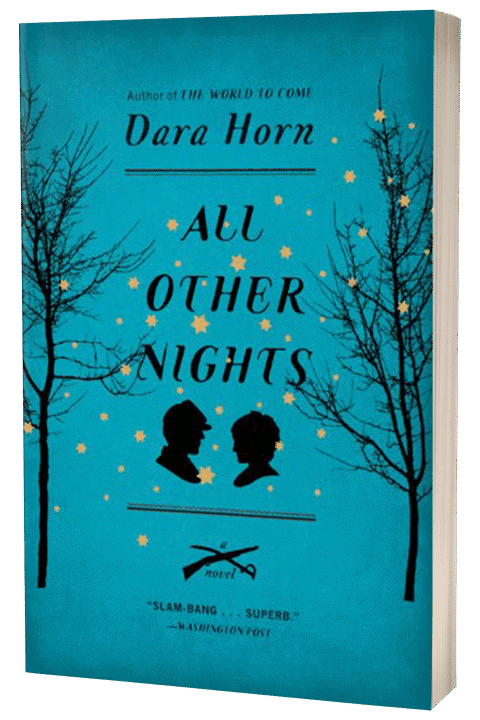
It is Passover 1862 and Jacob Rappaport is in New Orleans to murder his uncle. Once unable to rebel against his father’s orders, he is now helpless to refuse the orders of his Army superiors. A 19-year-old who escaped from an arranged marriage and joined the Union Army, Jacob has been sent to New Orleans because his uncle intends to assassinate President Lincoln.
The author, Dara Horn, does a masterful job of using fictional characters to describe the lives of American Jews during the Civil War. The largest concentrations of the 130,000 Jews in the United States in 1860 were in New York City and New Orleans, two of the main settings of the novel. All Other Nights is Horn’s third novel. Her previous two, In the Image and The World to Come, both won the National Jewish Book Award.
All Other Nights opens with a blend of well-crafted action and background and holds the pace of good storytelling throughout. One pacing technique that works well is the use of unattributed dialogue by the three Union officers whenever Jacob stands in front of them. We don’t know which one is speaking, and the disembodied voices increase our understanding of Jacob’s confusion and frustration. But we never get to know Jacob. He comes across as a wooden character, without much depth in his internal conflict between personal desire and patriotic duty. He seems to be in a haze most of the time.
Jacob’s second assignment, again because of his family connections and Jewish heritage, is to travel to Richmond to marry a Confederate spy. Eugenia Levy is a beautiful young woman, an actress, contortionist, and magician–a Houdini. Jacob lives in the Levy home and becomes a trusted employee as he makes periodic reports to his Union supervisors.
The author describes a Passover seder where the first of the traditional Four Questions recited is, “How is this night different from all other nights?” She draws a parallel between Egyptian slavery of the Hebrews and slavery in the Deep South: “Jacob wondered if there could be anything stranger than sitting down to a Passover seder, the feast of freedom, with every part of the meal served by slaves.” The guests, avoiding eye contact with the servers of the meal, sing Hebrew hymns of thanks for being freed from bondage.
Books that teach history through the experiences of fictional characters usually hold my interest. What I especially like about All Other Nights is the author’s note at the end of the book. Horn explains where she got her inspiration for some of the scenes and characters, and she describes what happened to the real characters after the war. To portray the unfathomable experience of a slave auction, she has Jacob witness an auction in which the dialogue of the pleading slaves is taken from an 1859 newspaper article written by a man who attended such an auction.
An important character in the book is the historical Judah Benjamin, who was Secretary of State for the Confederacy and previously a U.S. Senator from Louisiana. Horn makes the connection by having Jacob, who has been discharged from the Army because of injuries, return to his role as a Union spy and become an office clerk for Benjamin. This allows readers to experience the burning of Richmond near the end of the war.
Horn uses the same technique to tell the story of General Grant’s 1862 order to expel all Jews from the Department of Tennessee, which included Kentucky and Mississippi, because “The Jews, as a class violating every regulation of trade. . . .” The Army has sent Sergeant Rappaport to Holly Springs where he befriends a tavern owner who is later jailed as a result of the order. According to the author’s note, the order was rescinded by President Lincoln three weeks after its issue.
Although Jacob eventually settles on an identity for himself and his future, the universal questions raised in this story must go unanswered. Which is more important when in conflict, family or society? How do our values and loyalties determine our choices in life?
“While I have tried to remain loyal to my fact-checking past,” Horn writes, “I can only hope that true Civil War buffs will do me the great honor of respecting my imagination as well.” In my opinion, she succeeds on both counts.