
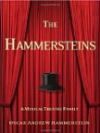
The Hammersteins: A Musical Theatre Family
By Oscar Andrew Hammerstein
The Hammersteins: A Musical Theatre Family, by Oscar Andrew Hammerstein, commemorates the author’s grandfather and great-great grandfather, the first two Oscar Hammersteins. Oscar I turned the future Times Square into the theater capital of the world. Oscar II gave us some of our best-known musicals, from Showboat to Oklahoma! to The Sound of Music.
Oscar Andrew Hammerstein, who teaches graduate level New York City theatre history at Columbia University, has devoted much of his life to preserving his family heritage. His book treats its subjects objectively, with no mention of his personal connection. The sense is of distance in family relationships. One telling comment is the caption, “note the body language,” on a photo of Oscar II’s family. While the others (including the author’s father as a teenager) have their arms around each other, Oscar II stands alone, with hands in pockets.
Interspersed throughout are photos of theatre personnel, copies of sheet music covers and musical programs, blueprints and photos of various theatres. The well-researched book contains a treasure trove of musical theatre facts and is more historical reference than family story. Its highlight for most readers may be learning the origins of favorite musicals.
The Hammersteins: A Musical Theatre Family begins with 16-year-old Oscar Hammerstein arriving in New York City from Germany in 1864. He brought with him a passion for opera, “bred to the bone, nurtured by a loving mother, and sharpened at the Muse Conservatory of Berlin,” according to the author. This passion “propelled the Hammerstein family’s three-generation narrative.”
Oscar married four years later. His wife died in 1879, soon after giving birth to their eighth child in eleven years. Three sons survived, and Harry, Arthur, and Willy all worked for their father as adults. By the time of Rosa’s death, Oscar had registered numerous cigar patents and was the publisher of a successful tobacco trade journal.
He became a real estate speculator who constructed houses and apartment buildings in Harlem. In 1888 he built the Harlem Opera House on 125th Street, followed by another four years later on the same street. In 1894 he sold his patents and refinanced his Harlem theatres to obtain enough money to purchase three lots near Broadway and Seventh Avenue, in the heart of vice-ridden and debris-covered Longacre Square. For opening night at his 6,000-seat Olympia Theatre, built between 44th and 45th Streets, he sold 10,000 tickets. The resulting mob scene marked the beginning of the theatre district later known as Times Square.
His efforts in making opera available to the general public paved the way for future theatre talents to develop the American musical. A photo taken in 1916 shows him surrounded by American composers, including Irving Berlin and John Philip Sousa. “Most of the men surrounding Oscar at the piano knew the debt they owed him,” the author states. “He had created, to a great degree, their stage, their theatre district, and their audience.”
The first six chapters of The Hammersteins describe Oscar’s up-and-down fortunes as he built and lost theatres and opera houses, partnering with and fighting with various individuals and opera companies. He responded to a letter from his bank by writing, “I am in receipt of your letter, which is now before me, and in a few minutes it will be behind me. Respectfully yours, Oscar Hammerstein.” Several days after the Olympia Theatre was sold at a foreclosure auction, he somehow managed to borrow enough money to build the Victoria Theatre at Seventh Avenue and 42nd Street. “Give him a plush red curtain, and he’ll build a theatre around it,” son Arthur later said.
Oscar’s son Willy managed the theatres, hiring such future stars as Will Rogers, W. C. Fields, Al Jolson, Mae West, and Houdini. Willy “remains widely regarded as the best vaudeville manager America has ever produced,” the author states.
Willy died in 1916, after making his own son (Oscar II) swear never to go into theatre. It was a deathbed promise Oscar II could not keep. When Oscar I died in 1919, Arthur assumed the business. Seeing the theatre passion in Oscar II, Arthur offered his nephew a job as assistant stage manager.
The remaining two-thirds of The Hammersteins tells the story of Oscar II’s successes and failures as he became the most successful lyricist of all time. The groundbreaking Showboat in 1927, with Oscar II’s lyrics and Jerome Kern’s music, became “inarguably the most important and influential play in the history of American musical theatre,” according to the author. Its American themes and characters broke the existing pattern of musical comedies and fairytale operettas. Arthur called it the perfect show. “My decision to take Oscar into show business has been justified,” he said. “Tonight I knew that I did right by Willy after all, even though I broke my word. I am a happy man.”
The following years brought limited success and frequent failure to the prolific Oscar, who wrote for theatre and movies, expanding to London and Hollywood. His next smash hit finally came in 1943, when he paired with composer Richard Rodgers on Oklahoma! It raised the bar on musicals by weaving together all production elements–words, music, dance, plot, characterization, and staging.
Carousel, State Fair, Allegro, and South Pacific followed. When Mary Martin suggested shampooing her hair onstage during South Pacific, Oscar wrote the song, “I’m Gonna Wash That Man Right Outa My Hair.”
Then came The King and I, Flower Drum Song, and Cinderella. The final Rodgers and Hammerstein collaboration, The Sound of Music in 1959, would become the most successful show in Broadway history, with 1,142 performances and numerous awards. Its movie version in 1965 became the most popular film in history. Oscar didn’t live to see this success; he died of cancer in 1960. As had happened at his grandfather’s death in 1919, the lights in Times Square were dimmed in his honor.