
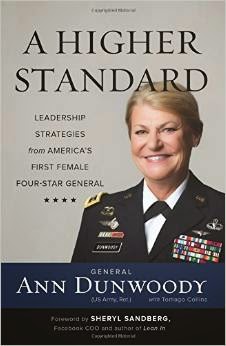
A Higher Standard: Leadership Strategies from America’s First Female Four-Star General
By Ann Dunwoody, with Tomago Collins
A Higher Standard: Leadership Strategies From America’s First Female Four-Star General is the story of General Ann Dunwoody, United States Army (retired). As a retired U.S. Navy captain myself, I found her impressive and someone I would enjoy knowing. We were both commissioned in 1975, and she summarizes our experiences well: “To be honest, as a woman, I felt there was more expected of me in order to gain acceptance and respect in this man’s Army.” She earned her first star in 2000 and her fourth star—the first woman in the U.S. military to be promoted to full general—in 2008.
Dunwoody, daughter and granddaughter of career Army officers, had no desire to follow in their footsteps. Her dream was to be a physical education teacher and coach. She joined the Army Reserve in college to get $500 a month, in return for spending two years on active duty after graduation. Then, at her first assignment, her life was changed by Wendell Bowen, her platoon sergeant. He promised to make her the best platoon leader in the Army. “He made it clear to me that I should never settle for less than my best,” she writes. “By removing gender from the discussion, I would never use it as an excuse. . . . Bowen gave me my first chance at being a military leader. A seasoned vet, he could have easily bullied or hazed a rookie female platoon leader.”
Bowen and Dunwoody worked together to clean up a supply platoon and account for a million dollars in equipment. “It was an experience that made a profound impact on me early in my career,” Dunwoody recalls. “Accountability—whether it involves people, property, or actions—would become a founding principle of every assignment I had, from 2nd lieutenant to four-star general.” She was on her way to fulfilling her coaching dream in a far greater way than she could have imagined—coaching thousands rather than one sports team.
That early assignment gave her a foundation. She was one of the first to attend Army Airborne School when it opened to female officers. “I was more than capable of meeting the exact same standards as the men, both physically and mentally,” she says. She eventually earned a command in the 82nd Airborne Division. Then, as a two-star general, she was the first quartermaster officer ever selected to command the Military Traffic Management Command. Her promotion to four-star general and commander of the U.S. Army Materiel Command placed her in charge of 69,000 soldiers and civilians.
A Higher Standard is written in a conversational tone, with chapters devoted to each of General Dunwoody’s eleven leadership principles. Five of these principles, which apply to civilians as well, are:
- Live to a higher standard. The military requires soldiers to meet the standards, and it rewards those who exceed them. “This sounds practical and reasonable,” she says, “but how many organizations really encourage people to ruin the curve? . . .[They say,] Just do your job.”
- Never walk by a mistake. “Far too often, we let little things slide,” Dunwoody writes. “Recognizing when something is wrong, big or small, and holding people accountable can save industries billions and citizens their lives.” When you walk by a mistake, “then you just set a new, lower standard.”
- Believe in yourself. “I’ve walked, crawled and skipped through many open doors and even had to kick in a few,” Dunwoody says. “With each new opening comes the challenge of proving I can handle the job.” She certainly did her share to overcome the perception that existed when she joined the Army: “Old-school folks assumed that all women enlisted for one of two reasons: they wanted to be a man or they were trying to get a man.”
- Recognize your advocates, Janus-faces, and detractors. Dunwoody reminds us to be aware of how others influence our lives—strong supporters who intercede for us, back-stabbers who offer fake support, and detractors who openly undermine us. In the Acknowledgments section, she tells her advocates, “Thank you for taking a chance on me, for standing up for me, and for giving me opportunities I would never have had without your intervention.” About the detractors, she says they “invariably believed that every good job or assignment I received was because I was a woman, not because I was best qualified.”
- Build your bench. Developing leaders is one of the most important jobs of a senior leader. Dunwoody and I share this passion for leadership, and here is my favorite Dunwoody quote: “Our greatest accomplishment will not be how many parachute jumps we made, how many wars we fought in, or how many medals we’ve earned. Our legacy will be measured by the depth and quality of the leaders we develop.”
“Life is full of choices,” Dunwoody says, “and we all make them.” A tradeoff for her successful military career was that she never had children. Her husband, Air Force Colonel Craig Brotchie, spent his career with Army Special Forces. He was passed over for brigadier general (one star) by the Air Force the same year the Army promoted her. He retired from active duty and encouraged his wife in her career. After she retired, the couple worked for two years on A Higher Standard before bringing in writer Tomago Collins to help them finish it.
A Higher Standard tells the story of a dedicated individual who strives and succeeds. Although the lack of chronology might sometimes be confusing to readers, a career timeline and an index are provided to answer questions. I highly recommend this enjoyable and easy-to-read book to anyone interested in improving leadership skills or seeking encouragement to stretch toward a goal.