
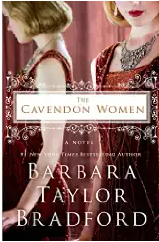
The Cavendon Women
By Barbara Taylor Bradford
The Cavendon Women, the thirtieth novel of Barbara Taylor Bradford, takes place in the mid-1920s and is the sequel to Cavendon Hall, which covered the Great War of 1914-18. Bradford, born and raised in England, was inducted by Queen Elizabeth into the Order of the British Empire in 2007 for her literary achievements. She now lives in New York.
Cavendon Hall, located in Yorkshire, England, is home to the aristocratic family of Lord Charles Ingham, the Sixth Earl of Mowbray. Since the earldom was created in the mid-1770s, Swann family members have taken the oath, “Loyalty binds me,” and have served the Inghams faithfully.
There has never been a failure in the longstanding relationship. When the Inghams have problems, the Swanns provide resolution. When Ingham jewelry is stolen, the Swanns help to recover it. When scandal threatens the Ingham family, the Swanns cover it up. When financial disaster looms, the Swanns produce solutions.
The current Cavendon women are Cecily Swann and Charlotte Swann, along with the four Ingham daughters, Diedre, Daphne, DeLacy, and Dulcie Ingham. This cuteness of “the four Dees” causes the reader to struggle while trying to remember which D is currently on the page. The sisters all have blue eyes and prefer to wear blue dresses, as the author frequently reminds us: “The four Dees insisted on being Cecily’s matrons of honor, and much to her amusement they all wore blue frocks to match their eyes. It was a family joke she had always enjoyed.”
Charlotte is in love with Charles Ingham, and Cecily loves his son, Miles Ingham. Love affairs between the Swann women and Ingham men had always been illicit relationships. “The Ingham men and the Swann women were irresistible to each other,” Cecily notes. “It was meant to be.” As Charlotte contemplates her wedding to Charles, the author tells us, “After more than one hundred seventy years of close ties between them, a Swann was marrying an Ingham for the first time. She knew only too well from the record books that there had been a lot of intermingling of the two families in that time, but never a wedding.” The ancient rules that separated the aristocracy from the other classes were crumbling, largely because of changing beliefs and financial devastation produced by the Great War.
Bradford teases us with dire warnings about her characters’ misfortunes: “And Charlotte now believed everything would be fine, would work out the way she had hoped. All would be well with the Inghams. She was wrong. Things were not going to be fine, storm clouds were gathering over Cavendon and trouble was brewing.” And this one: “Bad times were coming, Hugo knew that. 1927 and 1928 had been the boom years. He did not like to think of what was coming next. Nor did he wish to discuss it with anyone. Why spoil Christmas?”
I enjoyed the story and the characters, although repetition of blue dresses and loyalty oaths and unfulfilled warnings made it longer than necessary. Point of view bounced from one character to the next, showing the thoughts of all major and minor characters. I hesitate to suggest an internationally best-selling author might need a new editor. Her regular readers probably disagree with me.
Will each Cavendon woman find her true love? Will she be wealthy? Will Cavendon Hall survive? The Cavendon Women is a light historical romance for readers who like satisfying endings.