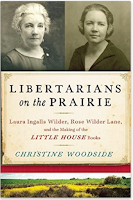
Libertarians On The Prairie: Laura Ingalls Wilder, Rose Wilder Lane, And The Making Of The Little House Books
By Christine Woodside
Libertarians on the Prairie: Laura Ingalls Wilder, Rose Wilder Lane, and the Making of the Little House Books is the story of “two strong women creating literature and crusading for their fervent beliefs,” says author Christine Woodside. It chronicles the relationship between Laura Ingalls Wilder and her adult daughter, Rose Wilder Lane, while writing the Little House series of children’s books in the 1930s. It also describes the rise of the Libertarian movement in United States politics.
“I steeped myself in Laura’s philosophy of life,” Woodside says about her four decades of research and her fascination with Wilder’s books. “I had once believed that the simple yet poetic Little House books told Laura’s true story and outlined America’s frontier history,” she writes in the introduction to Libertarians on the Prairie. But in pursuing the full story, she says, “I’ve collided with the surprising reality that the Little House books idealized Laura’s life.”
I had also once believed the books were nonfiction stories of Laura’s childhood. It was only after coming across The First Four Years, published three years after Rose’s death, that I became aware of changes from Laura’s original voice. Rose’s contribution to those changes have been detailed in the 2015 publication of an annotated edition of Laura’s memoir, Pioneer Girl.
Now readers have Libertarians on the Prairie, for which Woodside combed through letters and diaries to show the two women behind the enduringly popular Little House series. Rose Wilder Lane was Herbert Hoover’s biographer, a novelist, and a well-known writer of magazine articles in the 1920s. She and her mother collaborated on the eight books that came out of Laura’s hand-written and unpublished memoir, “Pioneer Girl.”
After the stock market crash of 1929, the family needed money, and Laura wrote her memoir during the winter of 1930, two hundred pages on a lined tablet. When Rose could not find a publisher for the memoir, she and Laura turned a small piece into a fiction story, Little House in the Big Woods. It was published in 1932, and the Little House series was born. The eighth book, These Happy Golden Years, was published in 1943. By then, Laura was a famous and well-loved children’s author, and Rose’s income and popularity had declined. Still, she never acknowledged her role in rewriting her mother’s stories. Both women carried the secret of their partnership to their graves.
Rose was born in 1886 on Almanzo and Laura Wilder’s tree claim near DeSmet, South Dakota. The family moved to Mansfield, Missouri, in 1894. Laura lived there until her death at 90, in 1957, nine years after Almanzo’s death at age 92. Rose died in Connecticut in 1968, on the eve of her planned departure on a three-year world tour.
Laura was a storyteller in the folk tradition, and Rose was a modern writer and public philosopher. She changed the stories to third person and added the novelist’s touch. As an example of the difference in style, here is what Laura wrote in her memoir:
“And there we saw that the cloud was grasshoppers. . .. They were dropping to the ground like hail in a hailstorm faster and faster.”
Rose’s revision for On the Banks of Plum Creek said,
“Plunk! Something hit Laura’s head and fell to the ground. She looked down and saw the largest grasshopper she had ever seen. They came thudding down like hail.”
It is Woodside’s theory that the two women incorporated their political beliefs and anti-New Deal attitudes into the books: “With their simple, cheerful tales of self-sufficiency, the Little House stories advance ideals of maximum personal freedom and the limited need for the government. In their essence they illustrate libertarian ideals, and in this they reflect the attitudes of both women at the time they were writing the books.” Rose is considered one of three women who inspired the Libertarian movement, and she named as her heir Roger Lea McBride, who would run as a Libertarian candidate in 1976 for President of the United States. Woodside insists, “The books have inspired conservative thinkers because those thinkers found in them libertarian ideas about limited government.”
Rose, according to Woodside, “blamed her money troubles on the fact that she’d had to pay taxes on her earnings.” For years, she claimed her parents as dependents so she could file as head of household. Laura, even when earning royalties, supported this fiction when she wrote to her daughter, “Even if we move back to the other place, you can still be head of the household and we can keep it up for you.”
Woodside opines, “Rose’s libertarian ideology shapes the Little House books not because Rose hoped to sneak in political lessons but because to her this interpretation of her mother’s life was one that captured their achievement in being pioneers.” An example is a scene from Laura’s manuscript where she visits a woman on a homestead claim. In These Happy Golden Years, it is expanded to show the woman complaining about overly restrictive government rules. Woodside says Laura wrote about her family as “taciturn homesteaders who made do,” and Rose added “stories of independence, courage, and free market beliefs.”
Libertarians on the Prairie is not a book for Little House fans who want to retain the warm fuzzy feeling of the books as reality. It is a book for those interested in the details of writers’ lives and writing. It also offers a simplified history of the Libertarian movement. All things considered, this well-researched and well-written book is a worthwhile read, and I highly recommend it.