
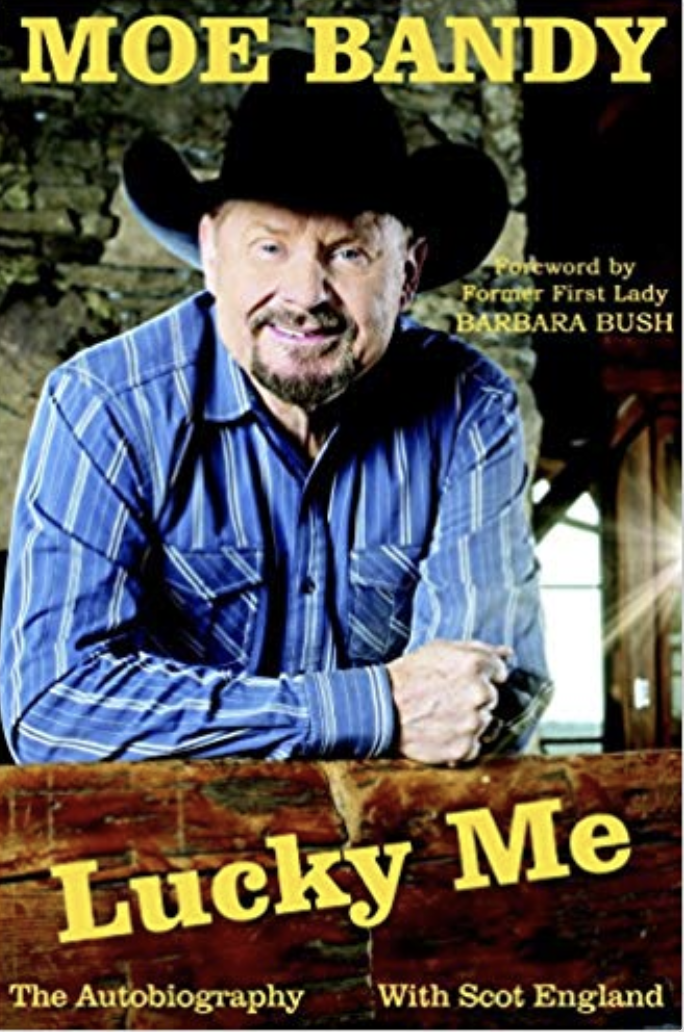
Moe Bandy, Lucky Me: The Autobiography
With Scot England
Moe Bandy has been one of my favorite entertainers since his music first hit radio airwaves in the early 1970s. A genuine Texas cowboy, he sang songs that made me want to dance. So I was excited to receive a copy of Moe Bandy, Lucky Me. I looked forward to connecting his life to mine, through my memories of his songs.
While the autobiographical story is told in Bandy’s words, the actual writer is music biographer Scot England. The relationship is explained in the final chapter, “Parting Song,” where England covers his role as author. This only becomes a distraction when England has Bandy make comments such as, “In the spring of 2017, as I was starting to write this book . . .”
Bandy grew up in a musical family, with five younger siblings, a sweet mother, and a father who was an abusive alcoholic. His mother played piano in church; his father played guitar in local bands. From the time he was six, his parents entered him in talent contests, where he began learning to sing in public. He also learned street fighting as a child. His dad told him, “You do whatever you need to do to beat the other guy. There is no such thing as a fair fight. Always remember that if someone whips you at school, I’m gonna whip you when you come home.” Bandy’s childhood dream of being a rodeo star ended at age twenty when he broke his collarbone for the second time while riding a bull.
Music quickly replaced rodeo as his passion. He bought a guitar and practiced playing and singing. He and his friends started working gigs in local bars and at weddings. “It was just an unbelievable feeling to get paid (no matter how small the amount) to play music,” Bandy says. To earn a living, he worked with his dad in a sheet metal company in Temple, Texas.
Married to his high school sweetheart when both were nineteen, Bandy and his wife fought constantly about the money he spent on pursuing a recording career. In the second chapter, “From Sheet Metal To Stardom,” he recalls the struggle. He was twenty-nine when, he says, “I went for broke. I put everything I had on one last recording session.” He used his furniture as collateral for a loan to pay for the 1974 session that included “I Just Started Hatin’ Cheatin’ Songs Today.” It hit the national charts, as did his next four releases. Moe Bandy was on his way.
“The next thing I knew,” he says, “I was out on the road, opening for all of my heroes.” He was soon a headliner. Although it would be years before I saw him in concert, I enjoyed hearing his songs on the radio.
Lucky Me describes Bandy’s rise, along with the problems of stardom. “There was a lot of drinkin’, fighting and cheatin’ in my songs,” he writes. “If I’d have done all the cheatin’ I sang about, I’d have probably been shot! Fighting? Yeah, I more than lived up to all the fightin’ I sang about. And drinking? Yeah, I did do all the drinkin’ that I sang about.” In 1983, he went through alcohol rehab and never drank again.
After the release of “Americana” in 1988, Bandy received a call from the campaign manager of George H. W. Bush, who was running for President of the United States. The song was being used at Bush rallies, and Bandy was invited to join the campaign. That began a long friendship with George and Barbara Bush, detailed in the chapter, “The President Is Calling.” Barbara Bush wrote the Foreword for Lucky Me.
Bandy was one of the first entertainers to have his name on a theater in Branson, Missouri, where he opened the Moe Bandy Americana Theatre in 1991. Lucky Me provides a good description of the rise and overgrowth of the Branson entertainment industry. The small town of Branson exploded after a Sixty Minutes piece in late 1991. “Traffic was bumper-to-bumper,” Bandy recalls. “You couldn’t get a hotel room. You couldn’t get a seat at a concert unless you booked them many months in advance. It was crazy.” The number of theatres increased from six to over a hundred in the next decade, destroying the original profitability. When I visited Branson in 2006, it was a thrill to sit in Bandy’s theatre and finally watch him perform. He and his current wife, Tami, whom he married in 2008, are now retired and living in a large cabin near Branson.
Moe Bandy, Lucky Me: The Autobiography is a well-told story of the life of Moe Bandy. For most of the book, chronology and topic are balanced. Toward the end, it moves into a compilation of contributions from fans, band members, and family members lavishing praise on Bandy. Country music lovers, Bandy’s many fans, and music historians will appreciate and enjoy this engaging book.