
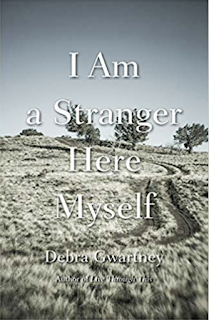
I Am A Stranger Here Myself
By Debra Gwartney
Debra Gwartney’s memoir, I Am A Stranger Here Myself, opens with her driving away from her hometown of Salmon, Idaho, at age 55, after the funeral of her last remaining grandparent. She writes, “For reasons I have yet to decipher, I can’t seem to make peace with the place I’ve loved best on this earth.” A professor in graduate-level writing programs at Pacific University, she is taking with her a book she found in her grandfather’s house: “A biography of Narcissa Prentiss Whitman, a woman I remembered learning about in grade school and who my four daughters learned about when they played the Oregon Trail video game at school in the ‘90s.”
After reaching her home in western Oregon and reading the book, she becomes fascinated with Whitman, the first white woman to cross the Rocky Mountains and the first to give birth on the frontier. Narcissa and her husband, Marcus Whitman, were missionaries killed in an 1847 massacre by the Cayuse Indians they were trying to convert to Christianity.
Gwartney sees a parallel between her life and that of the pioneer woman. Both were tough women who felt they didn’t truly belong in the patriarchal American West. Gwartney hopes to understand herself by learning to understand Whitman.
Throughout her memoir, she inserts stories about her grandparents and great-grandparents, as well as her parents and siblings. She describes herself as “the child born to children still in high school, and not all that welcomed, I suspect, by either set of grandparents.” Her sixteen-year-old parents married before her birth and raised four children before they divorced. Gwartney, at age 22, repeated her mother’s experience of being pregnant on her wedding day. Knowing she didn’t want to marry an abusive man, she laments, “But like Narcissa, I stayed. I did what was expected of me.”
I Am A Stranger Here Myself reads as if the manuscripts of Gwartney’s life and Whitman’s life were cut into pieces and stirred together to form a whole. The book is then divided into four sections that serve no noticeable purpose. The lack of dates, other than a mention of her 1979 wedding while a senior in college, adds to the difficulty of establishing a sequence of events in the author’s life. For example, when Gwartney refers to her husband, the reader must decide whether she’s talking about her first or second husband.
In the third section, she recalls being ten years old when Grandma Lois got her out of bed and put her in the backseat of the car. They drove to a bar. “Grandma Lois stormed into the bar,” Gwartney writes. “I stayed in the car and waited. And waited. Finally, here she came again, pulling my great-grandfather by the arm. Her father-in-law.” They took the old man to his house. Gwartney concludes she was brought along to learn a lesson from “a Woman of the West who might have been trying to shape me into a proper Woman of the West.” At another point, she writes, “As a kid I lived in dread of letting down the men or failing to meet the standard of women carved into me like a talisman.”
The reader eventually learns the history of the Whitmans, who married for the purpose of traveling to the West for missionary work. Unfortunately, the first thing Marcus Whitman did upon arrival in 1836 was cut down the grass that allowed the Cayuse to thrive. He plowed and planted the ground, hoping to encourage the Cayuse to change from nomads to settlers. The Whitmans provided a waystation for travelers, as well as offering a home to abandoned children, such as those orphaned during wagon train journeys. The missionary couple failed to convert even one Cayuse member to Christianity. In spite of the Whitmans’ hospitality, their presence was unwelcome. In 1847, a disgruntled white man led the Cayuse on a raid that resulted in the massacre of the Whitmans, several other adults, and most of the orphaned children.
Gwartney takes the reader along as she writes about her research trips to discover and compile Whitman’s history. This includes visiting the massacre site near Walla Walla, Washington, where Whitman College commemorates the contributions of the two missionaries.
By the end of the book, the reader might feel an enjoyable if incomplete sense of discovery in having pieced together the lives of both Gwartney and Whitman. Truly understanding the arcs of their stories requires backtracking to previous sections to reread details.
In the final scene of I Am A Stranger Here Myself, Gwartney sees herself in a deer she watches trying—and succeeding—to escape from an enclosed patio where it had jumped. “I’d had, at times, trouble finding my way,” she writes. “But I was finding it, and this time when I left my best place, I’d do so with the determination that Salmon, Idaho, was mine after all. No one could say it wasn’t, no matter how far I drifted away from the town.”
She draws a similar conclusion about Narcissa Whitman, when she writes, “I understood now that she’d allowed herself to be nothing but an outsider, an alien in the West, a stranger . . .. I’d at last let her be the main subject of her story, and maybe that meant I could start being the main subject of mine.”