
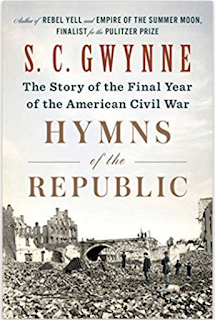
Hymns Of The Republic: The Story Of The Final Year Of The American Civil War
By S. C. Gwynne
C. Gwynne tells the story of the final year of the American Civil War in Hymns of the Republic. From the first chapter, “The End Begins,” which puts the reader in the nation’s capital city at the beginning of 1864, he allows the reader to feel and understand events as they occur.
An award-winning journalist and Pulitzer finalist, Gwynne took the material unearthed by his team of researchers and wrote a masterful a story that brings the Civil War into clear view. He provides historical summaries to help the reader understand the events and repercussions of that final year of war.
“Washington, DC, had never, in its brief and undistinguished history, known a social season like this one,” the story begins. “The winter of 1863-64 had been bitterly cold, but its frozen rains and swirling snows had dampened no spirits. Instead a feeling, almost palpable, of optimism hung in the air, a swelling sense that, after three years of brutal war and humiliating defeats at the hands of rebel armies, God was perhaps in his heaven, after all.”
President Abraham Lincoln and his wife, Mary, held two receptions per week at the White House. The author describes how they greeted all visitors who poured into the East Room as the Marine Band played in a nearby room. One of those visitors on March 8 was Ulysses Grant, who had just been promoted by act of Congress to the rank of lieutenant general. He would be the first active three-star general in the nation’s history. When people recognized the new leader of the Union armies, he had to stand on a sofa to avoid being trampled.
The focus of the war was changing from restoring the Union as it had been before secession to the goal of abolishing slavery. The Emancipation Proclamation of 1863, in addition to freeing slaves in the rebel states, also authorized former slaves to be combat soldiers. The author writes, “Thus with a stroke of the pen Lincoln had transformed the war from a morally unanchored attempt to reunite a divided nation into a war for the freedom of the nation’s 4 million slaves—a war of black liberation.” The treatment of black soldiers, by both the Union and the Confederacy, is a major thread in the book.
Another important change in fighting the war was the treatment of the South by victorious Union generals. William Tecumseh Sherman, even prior to the burning of Atlanta and his march to the sea, wanted to show the consequences of rebellion. “For the first time,” writes the author about Mississippi in early 1864, “Union troops were under specific orders to wage a campaign of destruction, tearing up railroads and burning crops. Soldiers were instructed to leave civilians only enough for survival.” General Philip Sheridan destroyed Virginia’s Shenandoah Valley in September. “The sheer malevolent thoroughness of the devastation astounded everyone who saw it,” Gwynne writes. “Black smoke swirled up from thousands of fires and rose in columns and filled the valley as far as the eye could see in every direction.”
For both those who studied the Civil War in school and those who are unfamiliar with it, Hymns of the Republic offers a one-book summary of the war in storyteller fashion. The depth of human suffering comes through clearly, soldier and civilian, black and white, North and South. The author moves smoothly from personal trauma to political topics.
As the 1864 presidential election approached, Lincoln feared he would lose. Antiwar Democrats worked with the Confederacy to defeat him; that coalition hoped to immediately end the war, leaving slavery intact. The leadership of General Grant and victories such as those by Sheridan and Sherman turned the tide. National Union Party (Republican) candidates began winning elections, and Lincoln won his second term by a landslide. “The Republican victory had another meaning, too, with immediate consequences for the nation,” the author writes. “The election had created a three-quarters antislavery majority in Congress, which was powerful enough to abolish slavery by constitutional amendment.”
Gwynne describes the negotiations between Generals Grant and Lee that led to the surrender at Appomattox, and how Grant followed Lincoln’s instructions to allow the conquered soldiers to return to their homes. Immediately thereafter came the assassination of Abraham Lincoln that almost reopened the armed conflict. Hymns of the Republic closes with a description of prisoner-of-war camps and the efforts of Clara Barton, the famous Civil War nurse who later founded the American Red Cross, to identify those who had died in the camps.
Hymns of the Republic: The Story of the Final Year of the American Civil War is a must read for any individual who wants a better understanding of the history of the United States.