
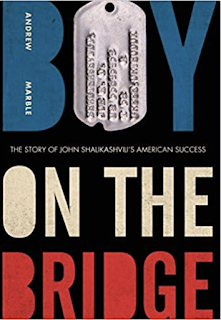
Boy On The Bridge: The Story Of John Shalikashvili’s American Success
By Andrew Marble
General John Shalikashvili [shalli-kash-VEE-lee] served from 1993 to 1997 as Chairman of the U.S. Joint Chiefs of Staff. His thick European accent made people wonder about his heritage. Descended from a line of Tsarist Russian princes and born in Poland in 1936, he and his family had come to the United States as penniless refugees following World War II. With such a background, how did he become the highest-ranking officer in the U.S. military and the principal military advisor to the President of the United States?
In Boy on the Bridge: The Story of John Shalikashvili’s American Success, Andrew Marble offers an answer. With expertise as a political scientist and editor of journals on international affairs, the author spent ten years researching the story, traveling 30,000 miles and interviewing 300 people. Those interviewed included former President Bill Clinton, General Colin Powell, and former Secretary of State Madeline Albright.
Marble paints Shalikashvili as an ideal leader. His actions and decisions were based on what was good for the nation, his command, and his people, not on what made him look good. One subordinate described him as “a ‘we’ person and not an ‘I’ person.” He gave credit and praise to others, holding himself accountable for any shortcomings. Trying to stay out of the limelight, he threw himself into whatever project needed to be accomplished.
This six-part biography opens with Shalikashvili’s nomination and selection as Chairman. The next chapter shows his high school girlfriend watching him on the news and thinking, writes the author, “how different both their lives would’ve been if she hadn’t betrayed him that summer almost forty years ago.” The reader is then taken back decades, to those high school days in Peoria, Illinois, before going further back to World War II and the Shalikashvili ancestry.
Shalikashvili was eight years old when he saw his first Americans. His family had fled Poland and was staying with relatives in a small German town as the Allied armies approached in early 1945. The Germans ordered the townspeople to dismantle a bridge, which they had spent all night trying to do, when the lead scouts of the 86th U.S. Infantry Division appeared on the opposite bank of the river. The war was almost over.
The Shalikashvili family arrived in Peoria in 1952, sponsored by a local family who provided housing and employment. “Helped along by classmates charmed by their handsome, athletic European refugee classmate,” the author writes, “John successfully adjusted to high school in America.”
Following a chapter in which Shalikashvili becomes an American citizen, graduates from college, and is commissioned an officer in the U.S. Army, the book jumps ahead 32 years to show Lieutenant General Shalikashvili as leader of the humanitarian mission, Operation Provide Comfort, which returned the Kurds to their homeland in 1991. The author chooses this mission to illustrate moral character and leadership skills, foreshadowing Shalikashvili’s nomination for Chairman two years later.
As the general peers out of a C-130 cockpit at the mountains where Kurdish refugees are located, the author writes, “He understood the critical need to find them. He had first-hand experience with how treacherous snowy mountains could be.” The next scene flashes back to 1959, when Second Lieutenant Shalikashvili was posted to Alaska for his first assignment as a commissioned officer. This non-chronological telling of a life story places the focus on character building rather than career milestones. Prior events are added to help explain why this high-ranking general believes and acts as he does.
Following a discussion of the four years of Shalikashvili’s chairmanship and his retirement ceremony, the book ends with his retirement years and his death at age 75, after his second stroke. In the epilogue, to sum up the story, the author asks, “How did the penniless, stateless refugee boy who stood out on that bridge watching GI’s stream into Pappenheim at World War II’s end go on to become the thirteenth chairman of the US Joint Chiefs of Staff?”
He concludes it was Shalikashvili’s skill in carrying out his personal philosophy: “Every person has a responsibility to see the world as it really is, imagine it as it should be, and then work to make it better.”
Adding to the readability of this biography is Marble’s mastery in putting the reader in the scene without manufacturing a character’s thoughts. For example, one chapter opens with a U.S. Air Force colonel scanning the skies and looking for one plane in particular, the one carrying his new boss. “But the colonel was not at all convinced that a new commander was needed,” Marble, who had interviewed the colonel, writes. “In fact, he was downright worried this leadership change was a grave mistake.”
Boy on the Bridge: The Story of John Shalikashvili’s American Success is a must read for anyone who wants to be a better leader, regardless of the type of organization. And, those who enjoy reading biographies won’t want to miss this one.