
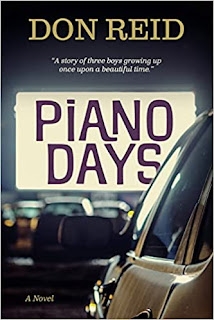
Piano Days
By Don Reid
Don Reid describes his latest novel, Piano Days, as “just one big Statler Brothers song without the music.” And that’s how I felt while reading it. I’ve been a Statler Brothers fan since they started recording country music in the 1960s. Reid was the quartet’s lead singer and primary songwriter. In the acknowledgements section of the novel, he reminisces about growing up with older brother Harold in Staunton, Virginia, during the 1950s. Last year, I enjoyed reviewing his non-fiction book, The Music of The Statler Brothers: An Anthology, in which he documented their 42 albums and mentioned every song they recorded in their four-decade career.
I sometimes had to remind myself that Piano Days is fiction, rather than a continuation of the stories in the anthology. It felt so real. The main characters are three small-town high school boys in the early 1960s. The narrator mentions himself only as “Frank’s son.” He doesn’t name his mother or older sister, although he gives first and last names to all other characters in the book. He is an accomplished pianist whose best friend, Billy Hudlow, enjoys hearing him play. They spend hours together at the piano, often with sheet music that Billy acquired for his friend to try out.
Each chapter title is a date, such as “July 1960” or “Spring/Summer 1962.” The narrator tells his story through chapters he wrote later in life and sent to his sister, who compiled them into a book with the help of her son. The chapters are out of chronological order, supposedly printed as the sister received them, whenever her brother felt the urge to tell a story. Scenes are built around the places where teens normally hung out in that era–drive-in theater, favorite restaurant, church, school, a football game.
Reid’s writing immediately drew me in. From the first line, he sets the tone of a storyteller recalling his boyhood: “The first time I saw Lannie May Kiser the way I still remember her after all these years was by the candy shelf in the concession stand at the softball diamond.”
I absorbed the scenes as they unfolded, complete with fictional background information to fill in the gaps. The narrator sees his youthful actions through older eyes: “As an adult, I know there’s nothing humorous about what happened that day. But when you’re fourteen and in a group of laughing boys, it’s funny.”
He philosophizes about choosing which stories to record: “Memories are like old clothes. You go through them and save the ones you like, the ones that make you feel good, the ones that look the best on you. …” He then moves into his story: “It was ten minutes into second period on a Friday morning. I had a hall pass in my shirt pocket and was rounding the corner by the science lab, heading for the library, when I heard a crash and saw a snake, amid large pieces of glass, rolling directly toward me.”
After high school graduation, when the narrator is leaving the next day for college and his two best friends have already left, he sits alone in his car and thinks about the changes: “Tonight, for the first time in our lives, we were going to spend the night in entirely different towns. There would be no drive-ins, no hanging around each other’s houses after school, and no double dating and no meeting in my yard after we had taken the girls home.”
The reader learns about his later life through the sister’s son, who appears partway through the book. He talks about “Uncle Be-Bop” dropping out of college in his senior year to fight in Vietnam. The night before enlisting in the U.S. Army was the last time his uncle played the piano. Wounded in Vietnam, he spent the next two years in a VA (Veterans Administration) hospital.
With two unnamed narrators and chapters out of chronological order, this could be confusing. It’s an indication of Reid’s storytelling ability that he allows the reader to sort through the details and put the story in order. I enjoyed the challenge and followed the characters with little effort.
Beginning as a coming-of-age story and ending with solving a mystery, Piano Days offers both the warm feeling of youthful reminiscences and a suspense story, interspersed with regrets we all feel about past decisions. Those topics are found in Statler Brothers songs written by Reid, such as “Do You Remember These,” “Class of 57,” and “Official Historian on Shirley Jean Berrell.” Anyone who enjoys their music will enjoy this book.