
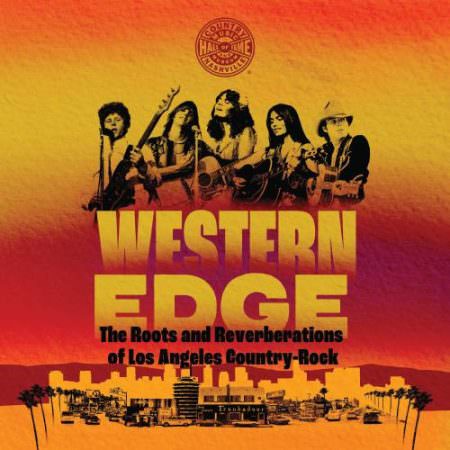
Western Edge: The Roots And Reverberations Of Los Angeles Country-Rock
By the Country Music Hall of Fame and Museum staff
“What Was the First Country-Rock Record?” That is the title of one essay in Western Edge: The Roots and Reverberations of Los Angeles Country-Rock, the companion book to a multi-year exhibition currently at the Country Music Hall of Fame and Museum in Nashville, Tennessee. In this essay, musicians Chris Hillman and Dwight Yoakam discuss their opinions of what constitutes the L.A. country-rock sound. They decide “Hello, Mary Lou,” recorded in 1961 by Rick Nelson, former child star of The Adventures of Ozzie and Harriet television show, was the first country-rock recording.
During the 1960s-1980s, young singers and musicians in Los Angeles experimented with pop and rock by adding elements of folk, bluegrass, and country. They formed tight-knit communities anchored in a few local nightclubs. In the foreword of Western Edge, Linda Ronstadt writes, “In 1964, when I was eighteen, I first visited Los Angeles, and I was hooked, so I returned during my spring break from college in ’65. . .. I quit college and moved there, knowing I would have more musical opportunities than I would ever have in Tucson. I didn’t have much money, but I had a burning desire to sing.”
Western Edge is the first book in a partnership between the Country Music Foundation and the University of Illinois Press to co-publish new or out-of-print books on country music and related music styles. It contains a selection of essays, with the main story written by Los Angeles music journalist Randy Lewis. Other shorter essays are interspersed throughout; they stand out by being printed on variegated yellow and orange pages instead of white.
In his history of the three-decade period, Lewis introduces major personalities and events. He calls San Diego native Chris Hillman, founding member of the Byrds and the Flying Burrito Brothers, “the linchpin figure.” Singer/songwriter Hillman brought Gram Parsons into the Byrds, took the band to Nashville in 1968 to record the genre-building album, Sweetheart of the Rodeo, and introduced Parsons to Emmylou Harris. His other bands included the Souther-Hillman-Furay Band and the Desert Rose Band. Dwight Yoakam, one of many eastern singers called west by the vibrant L.A. scene, considers Hillman “the connective tissue between West Coast country music tradition and the rock & roll generations, from Buck Owens to the Byrds.”
Yoakam, who built his career in Bakersfield and became “connective tissue” himself, bridged the gap between West Coast country musicians and the Nashville-based traditionalists who refused to embrace the expanded sound. Emmylou Harris, now a member of the Country Music Hall of Fame, also bridged the gap, as did fellow Hall of Fame member Vince Gill, who became a Nashville traditionalist after spending time as a member of Pure Prairie League. Western Edge discusses numerous bands who recorded in Nashville with varying degrees of success. The groundbreaking 1972 album by the Nitty Gritty Dirt Band, Will the Circle Be Unbroken, successfully combined “California hippies” with Nashville traditionalists. Songs by the Eagles were played on country radio, and Linda Ronstadt scored #1 country hits. She first charted in 1967 with “Different Drum,” written by Texas singer/songwriter Mike Nesmith of television’s The Monkees.
The rhinestone Nudie suit designed for Nesmith by Nudie’s Rodeo Tailors in 1967 is on display in the exhibit. So are those worn by Gram Parsons and fellow members of the Flying Burrito Brothers. The decorative costumes also appear in the 10×10-inch softcover Western Edge, a museum piece in itself. Although the book could have benefited from an index and a standard order for identifying its 168 photographs, it is filled with period photos of musicians and band performances, along with photos of many of the musical instruments and stage costumes currently on display at the museum. The easy-to-read type is double spaced.
I’ve always been a country music purist with little interest in most of the performers discussed here. My attitude has become more inclusive over the years, and this book opened my eyes about my former limited perspective. Steel guitars and Nudie suits were popular in Los Angeles, too, not just in Nashville. Many of these acts now sound more country to my ears then do today’s country music stars. The genre continues to evolve, and the argument about “what is country music” will never end. Western Edge provides an excellent and picturesque history of country-rock. I highly recommend it.