
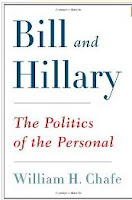
Bill And Hillary: The Politics of the Personal
By William H. Chafe
Bill Clinton learned from his mother to look on the bright side and deny negative realities, to present a cheerful front and believe people were more good than bad. Hillary Rodham learned from her mother that the highest priority was keeping the family together, showing strength in the face of personal sacrifice and disrespectful treatment. Bill’s alcoholic stepfather was physically and verbally abusive; Hillary’s father’s abuse was mostly psychological, such as his punishment for leaving the cap off the toothpaste tube. He would throw the white cap outside into the bushes and order the offending child to find it on the snow-covered ground.
In Bill and Hillary: The Politics of the Personal, author William H. Chafe shows how these products of two dysfunctional families came together with a goal to change the world. The couple met at Yale Law School in 1970. Hillary had graduated from Wellesley College, and Bill had returned from two years in England as a Rhodes Scholar at Oxford University. “From the moment of their meeting,” the author says, “they created a partnership, both political and personal, that helped shape the course of the country.”
Hillary’s friends believed she would become the first female president of the United States. But Bill, the author writes, “hoped very much that she would decide to come to Arkansas with him and be part of a political team that would ascend the heights, first of state politics, then perhaps more.” In spite of knowing she would be putting her political career on hold and knowing his womanizing reputation, she agreed. “It was not a simple decision,” the author says. “She knew by now exactly what she was getting into. . . . But once she made her decision, Hillary was committed to sticking to it–a lesson she had learned from her mother.”
Chafe, a Duke University history professor and former president of the Organization of American Historians, combed through oral history interviews and what he calls “the extraordinary research and writing of others” to develop this perspective on how the Clintons’ personal relationship affected their political decisions. With extensive source notes and index, Bill and Hillary: The Politics of the Personal is based, Chafe states, “on the work of journalists and others who have done so much to illuminate the contours and tensions of the partnership between Bill and Hillary Clinton.”
From Bill’s election as Arkansas’s attorney general, through his terms as governor of Arkansas and President of the United States, the reader gains an understanding of why the Clintons acted as they did in specific instances. Withholding personal information in the hope an issue would go away was a common misstep, as at the beginning of the Whitewater investigation. According to the author, “Hillary Clinton revealed her own fatal flaw in the way she responded to questions about her law practice. Unable to acknowledge her human frailty, she chose to resist disclosure of her personal business records. Yet all she did by stonewalling reporters was to inflame their appetite for more investigations.”
Bill, the author says, “displayed his inability to come clean about personal issues that were at the core of his identity. Sometimes he outright lied. More often, he shaded the truth. . . . One inevitable consequence was to make his audience, most often reporters, profoundly suspicious. As he came to believe that the press was ‘out to get him’ as part of a conspiracy to destroy his presidency, Clinton never realized the degree to which he had actually created the problem by evading the truth.”
One fateful dynamic was consistent throughout the years: “The more Bill sinned and was caught, the greater Hillary’s control over their lives became, politically as well as personally,” the author writes. In the opinion of staffers, whenever Hillary rescued her husband from sexual accusations, she assumed greater power over his career than she should hold.
The first of two instances in which Hillary’s influence over Bill led to catastrophe was when they refused to let The Washington Post see their Whitewater files. “It was a moment–and a decision–that changed history,” the author opines. Had they released the files, “there would have been no independent counsel, no Kenneth Starr, no Monica Lewinsky case, no impeachment.” The second was health care reform. When Hillary and her team refused to compromise with Congressional leaders, the proposal died without reaching the Senate floor. Chafe insists the President “bore fundamental responsibility for the virtually unlimited–and unconstrained–authority that Hillary had been granted over health care.” And that had been because “his philandering had humiliated her. If he were to have any hopes of returning to her good graces, he must do whatever she asked.”
Chafe concludes with a “What If?” chapter. What if the Clinton presidency had begun with a strong chief of staff who could have disciplined the staff, shaped the White House image, and kept the focus on achieving the administration’s goals? What if welfare reform had preceded health care reform? Or if health care reform had been an issue for negotiation? What if reporters’ questions had routinely been answered?
In spite of public and private struggles, the Clintons readily acknowledged they could do more together than separately. Hillary used her painful lessons to become a successful U.S. Senator, willing to listen and compromise, seeking to achieve common goals rather than antagonize. Bill chose to travel the world, speaking and working as an international community fundraiser.
For a better understanding of this controversial couple and their contributions, I highly recommend Bill and Hillary: The Politics of the Personal. It is a fascinating exploration of a driven, devoted, and highly political team. All in all, the Clintons come across as a dedicated couple who overcame their flaws–and their tumultuous relationship–to accomplish what they believed was their destiny, making the world a better place.