
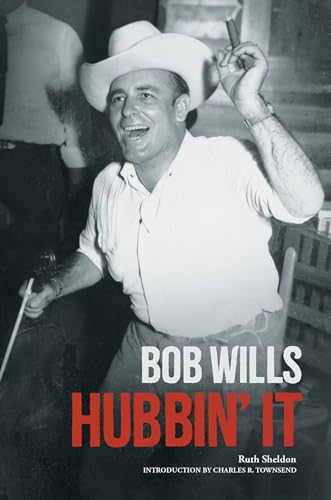
Bob Wills: Hubbin’ It
By Ruth Sheldon
Hubbin’ It: The Life of Bob Wills was written by a fan, Ruth Sheldon, and privately published in 1938. It is one of four books recently republished in a cooperative effort by the Country Music Foundation Press and University of Illinois Press. The new title is Bob Wills: Hubbin’ It. Wills biographer Charles Townsend writes the introduction for the new edition. He says he might never have written his biography if he hadn’t read hers as a child in a family of Bob Wills fans in 1938.
Sheldon, who’d earlier interviewed Bob for a Tulsa Tribune feature, was fascinated by his stories. He told her people often asked questions he didn’t have time to answer. They agreed she would write his book. “So we began,” she said in her Author’s Note. “I’ve tried to tell faithfully what Bob told me.”
Her purpose was to bolster his image, not give an objective rendering of his life. According to Townsend, she left out much of the story, mainly his alcoholism and problems related to his drinking. “Though Wills did have all the admirable qualities she emphasized so very well,” Townsend says, “he had some less admirable traits as well.”
Sheldon’s example of a poor boy who worked hard and made a success of himself served as encouragement to her Depression-era readers. “Hubbin’ it,” also a Bob Wills song, referred to a wagon bogged down to its hubs on a muddy road, an illustration of working through tough times.
Bob was born to a musical Texas farm family in 1905. He left home at 16, and the book tells of his struggles to earn a living, which included playing the fiddle and becoming a barber. By 1938, Bob and his Texas Playboys were homebased in Tulsa, Oklahoma, playing at Cain’s Ballroom and broadcasting over KVOO Radio. Sheldon called him currently “the most important figure in the entertainment world in the southwest.” She said he was driving himself to accomplish the last goal he had set: “Sometime in the future when the day arrives, when he knows he has given all he can give, he wants to say goodbye before the public has a chance to tire of him. While he is still ‘tops,’ he will give one last, glorious, farewell dance and disappear.”
The public never did tire of him. He lived to see his induction into the Country Music Hall of Fame in 1968 and the inaugural class of the Nashville Songwriters Hall of Fame in 1970. James Robert Wills, “the King of Western Swing,” died in 1975 at age 70.