
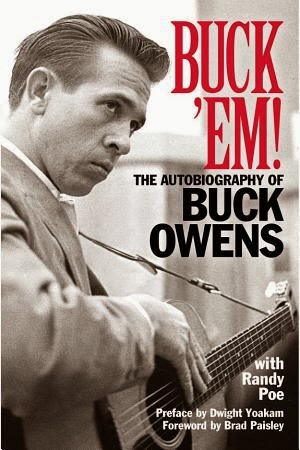
Buck ‘Em! The Autobiography of Buck Owens
With Randy Poe
Buck ‘Em! The Autobiography of Buck Owens is more about his music than his life. During the late 1990s, Owens recorded almost one hundred hours on cassette tapes, telling his story the way he wanted to be remembered. His last tape was recorded in September 2000, and his failing health prevented him from finishing his autobiography project.
Buck Owens took country music around the world during his decades as a hitmaker, with fifteen consecutive number ones on Billboard during the 1960s. The Beatles had a standing request for his new albums to be sent to them immediately upon release. He invented the Bakersfield Sound and promoted West Coast artists, co-hosted the television show Hee Haw in Nashville for seventeen years, and was elected to the Country Music Hall of Fame in 1996.
After Owens died in 2006, his sons contacted Randy Poe, who had recently published Skydog: The Duane Allman Story, to write an authorized biography. Poe states in the Background section of Buck Em! that when he saw the dozens of cassette tapes, “my ‘authorized biography’ idea quickly turned into a totally different concept: to create Buck’s autobiography, using his own words from his cassette recordings, just as he had originally intended.”
As a biographer myself, I would enjoy such a project and I’m impressed with the quality of Poe’s work. He transcribed and rearranged the material, filling in gaps by using quotes from magazine articles and other interviews. The story flows smoothly and chronologically. Poe says, “The writing I contributed to Buck’s autobiography was minimal. In some instances connective sentences were added for the sake of continuity. . . . I infrequently corrected Buck’s grammar. . . . In the end, with only a handful of exceptions, the words in the book prior to the afterword are those of Buck Owens himself.”
Owens devotes minimal time to discussing relationships with family members and business professionals. For instance, he says he spent 302 days on the road in 1965, with only “sixty-three days when I wasn’t either doing a show or on my way to one.” Instead of then addressing time with his wife and children, his next sentence is, “By the time we were able to get back into the studio, it was late March.” He mentions four wives and three children, and talks about band members coming and going in his life, but seldom acknowledges the many confrontations that have been publicized over the years. His focus is on his music and how he combined that with his businesses of owning radio stations and publishing companies.
Buck ‘Em! begins with a definition of the Buck Owens Sound, which Owens credits to Don Rich, his frontman and lead guitar player. He says, “I can tell you exactly where and when the Buck Owens Sound started. The Buck Owens Sound kicked in right before Christmas of 1959, in a 1957 Cadillac, on a long, lonely stretch of California Highway.” He describes how Rich sang harmony with him in the car and “I knew Don was going to be my musical partner for life.” Fourteen years and twenty number ones later, Owens says, “Then—in the blink of an eye—it was all over. The Buck Owens Sound ended just the way it began—on a long, lonely stretch of California highway.” He’s referring to the death of Don Rich in a motorcycle accident in 1974.
Owens shows his competitiveness–and humor–in this quote about battling with Faron Young for the top spot on Billboard: “My record sat in that second spot for eight weeks—and ‘Hello Walls’ never budged. I thought that was mighty thoughtless of ol’ Faron—especially since I’d played on so many records of his when I was a session musician for Capitol. I’m just kidding, of course, but I guess I did turn things around on him—he didn’t have another number one record the whole rest of the decade, and a lot of the time I was the one to blame for that.”
A recurring theme throughout the book is antipathy between the Bakersfield Sound and the Nashville Sound. “I’d spent years watching those Nashville record producers doing everything they could to come up with a record that would cross over,” Owens says. “The funny thing was, it really didn’t hardly ever work at all. . . . And now here I’d come from way out in Bakersfield, playing with my little band of honky-tonk pickers, and gone and scored a hit that had reached the top of the country charts [‘Tiger by the Tail’] and the Top Twenty-Five on the pop charts. If the Nashville folks didn’t like me for not playing their game before, they sure as hell didn’t like me now.”
In 1989, Owens re-recorded his first number one song, “Act Naturally,” this time with Ringo Starr. They were nominated for two awards, and Owens says, “We lost both times to a duet of ‘Tears in my Beer’ by Hank Williams Sr. and Hank Jr. Hey, nobody wants to lose, but it’s really hard to beat the guy who’s probably the most revered figure in the history of country music—especially when he makes a new record after he’s been dead for thirty-six years.”
The chatty tone of Buck Em! The Autobiography of Buck Owens makes for entertaining reading, and anyone interested in Buck Owens will enjoy learning about his life from his perspective. Those who want to know more should read Eileen Sisk’s Buck Owens: The Biography. The truth about Buck Owens lies somewhere between her generally negative portrayal and his vanilla version of himself. The two books taken together provide an understanding of one of the most important and most successful country music singers of the twentieth century.
Note: I reviewed Buck Owens: The Biography on November 13, 2010: http://internetreviewofbooks.blogspot.com/2010/11/buck-owens-biography.html)