
Diane’s Country Music Newsletter — 26 November 2025
NEWS
I watched portions of the 59th Annual CMA Awards, which aired live from Nashville’s Bridgestone Arena on November 19 on ABC-TV. My favorite part was seeing Vince Gill presented with the Willie Nelson Lifetime Achievement Award. The segment began with the announcement that Brandi Carlile would sing “When I Call Your Name.” The song was a good choice; I could mentally hear Vince singing his early hit. Suddenly, Patty Loveless was onstage and singing. Vince watched them with a big smile and tears in his eyes. When they finished, George Strait–to everyone’s surprise–walked onstage. He was last year’s 2024 recipient of the Willie Nelson Lifetime Achievement Award. “There’s not a lot more to say about this man that hasn’t been said, or that you don’t already know,” George said in his introduction. “But his guitar playing is amazing, his songwriting is amazing, his singing is amazing, he can sing higher than anyone I know … there’s not a more deserving person to receive this great honor.” Vince then came forward to accept the trophy from George and thank everyone who has supported him for four decades. Talking about “family,” he thanked the CMA family, Opry family, management family, and immediate family, ending by thanking his five kids and his wife Amy Grant, the “kindest soul I’ve ever known.”
The 59th Annual CMA Awards was hosted by Lainey Wilson, who followed Reba McEntire and Dolly Parton as the only women to host solo. Last year, Lainey co-hosted with Luke Bryan and Peyton Manning. Nominated for six awards, Lainey was named Entertainer of the Year, with the award presented by Keith Urban. She is the third woman in CMA history to win Entertainer of the Year twice, following Taylor Swift and Barbara Mandrell. Only eight women have been named Entertainer of the Year. Lainey also took home Female Vocalist of the Year and Album of the Year for her Whirlwind project. Country Now reports she has watched the CMA Awards since she was a little girl at home in Baskin, Louisiana.
The CMA Musician of the Year award went to Paul Franklin, 71, who had been nominated 33 times and is the most nominated person in the 59-year history of the CMA Awards in any specific category. He played steel guitar behind Brandi Carlile and Patti Loveless singing “When I Call Your Name” in honor of Vince Gill. Paul is a former member of The Time Jumpers western swing band. He and Vince have released two collaborative albums, Bakersfield (2013) and Sweet Memories: The Music of Ray Price and the Cherokee Cowboys (2023). Paul has played on over 500 recordings and was inducted into the Steel Guitar Hall of Fame in 2000 and the Musicians Hall of Fame in 2019.
Brooks & Dunn became the most-awarded artists in CMA history when they won Vocal Duo of the Year for the sixteenth time. Their twenty wins since 1992 include an Entertainer of the Year, Album of the Year, Single of the Year, and Music Video of the Year.
During the 59th Annual CMA Awards, Zach Top was named New Artist of the Year. His five nominations also included Album of the Year (Cold Beer & Country Music), Male Vocalist of the Year, Single of the Year (“I Never Lie”) and Song of the Year (“I Never Lie”). “It is cool whenever other folks in your business feel like you’ve been doing a good job and want to pat you on the back and say ‘good job,’” Country Now reports him as saying. “I’m really, really proud to just be nominated for all them things.” In his acceptance speech, he said, “I’m so thankful to be included in a category with a bunch of other great artists that have had phenomenal years. Thankful to be here. This is my first CMA win ever, so it’s a big deal to me, and I got a long list of people to thank. My father in heaven, for giving me the gift of being able to sing and play, first of all, my mother and father for realizing that I was never going to be a professional cowboy or a baseball player, so maybe the closest I could get was to sing about cowboys.”
The Mavericks will celebrate the life and musical legacy of ailing frontman Raul Malo with two special tribute shows at Nashville’s Ryman Auditorium on December 5 and 6, reports Taste of Country. Billed as Dance the Night Away, the shows will salute him with a “celebration of the band’s decades long history and contribution to American and Latin music.” A portion of the proceeds will go to benefit Stand Up to Cancer. Since 2024, Raul has been battling Leptomeningeal Disease (LMD), a form of cancer in the cerebrospinal fluid and leptomeninges, the membranes that surround the brain and spinal cord. “I’m really looking forward to these two nights at the Ryman,” Raul says. “The overwhelming support and love from my musician friends, fans, friends and family will prove these shows to be something special.” Jamey Johnson, Jeff Hanna, Jim Lauderdale, Mandy Barnett, Marty Stuart, Ray Benson, Steve Earle, Wade Hayes, and Wendy Moten are only a few of the more than 25 artists scheduled to perform.
At the 73rd annual BMI Country Awards, Clint Black was named this year’s BMI Icon, in recognition of his lasting influence on artists and fans across generations. Country Now reports he co-wrote his 22 No. 1 singles and received 20 BMI Country Awards since his affiliation with BMI began in 1993. “Well, I’m used to being recognized, but being honored is something entirely different. Very special. I can’t wrap my head around it,” Clint, 63, said while on the BMI red carpet. His tribute began with Midland singing his first No. 1 hit, “Better Man,” followed by Jamey Johnson with “Untanglin’ My Mind,” Wynonna Judd and Randy Houser singing “A Bad Goodbye,” and Riley Green concluding with “Killin’ Time.”
“Where My Heart Is” comes from the Warner Records Nashville vault, a Christmas song Randy Travis recorded years ago. The newly released track may have been recorded for one of his earlier Christmas albums, An Old Time Christmas (1989) or Songs of the Season (2007). Alongside the new single, according to a press release, the Randy Travis Foundation has partnered with Nashville-based sporting gear brand Absolutely Ridiculous to deliver new baseball gear to over 100,000 kids. Donations can be made at randytravisfoundation.org.
Nashville Songwriters Hall of Fame member Walt Aldridge, 70, died November 19, following a long illness. According to MusicRow, he was “a producer, a singer, a studio engineer, a guitarist and a bandleader.” A native of Florence, Alabama, James Walton Aldridge Jr. spent 17 years as a staff engineer at Fame Studios in Muscle Shoals. His early songwriting hits included Ronnie Milsap’s “(There’s) No Gettin’ Over Me” in 1981, “‘Til You’re Gone” by Barbara Mandrell in 1982, “Holding Her and Loving You” by Earl Thomas Conley in 1983, “She Sure Got Away With My Heart” by John Anderson in 1984, “Crime of Passion” by Ricky Van Shelton in 1987, and Conway Twitty’s “She’s Got a Single Thing in Mind” in 1989. In the 1990s, he wrote or co-wrote Shenandoah’s “See If I Care,” Ricky Van Shelton’s “I Am a Simple Man,” Steve Wariner’s “Leave Him Out of This,” BlackHawk’s “I Sure Can Smell the Rain,” Pam Tillis’s “Deep Down,” Reba McEntire’s “The Fear of Being Alone,” and many, many more. “Some Things Never Change” for Tim McGraw and “Modern Day Bonnie and Clyde” for Travis Tritt came in 2000 and 2002. As a record producer, Walt worked with Lacy J. Dalton and Marty Stuart, among others. He was inducted into the Nashville Songwriters Hall of Fame in 2017 and the Alabama Music Hall of Fame in 2018.
HEART*LIFE*MUSIC, the memoir co-written by Kenny Chesney and Holly Gleason, has reached the top of two New York Times Best Seller lists, Hardcover Nonfiction and Combined Print & E-Book Nonfiction. Holler reports Kenny as saying, “When we started, I didn’t truly believe I had a story to tell. When you’re living it, especially at the speed we’ve been at for so many years, you don’t make a lot of connections. If writing a song is looking at a moment through a straw, then this is looking at a bunch of years through a fish-eye lens. It’s so wide open, and you have to make decisions about what you’re looking at.” He credits Holly with keeping him motivated, saying, “Holly had a sense or belief going in. We would talk for hours, break for lunch, talk more — and she would go off and think. Then we’d start again the next day. I knew two things: I wanted anyone with a dream to see how, step-by-step, you can build it if you’ll be patient, and to make sure all the people and places that were so important to me were written down and remembered for all the magic they were.”
Billy Strings (William Lee Apostal), 33, has revealed what killed his mother, Debra Apostal, on June 19, 2025. He had played a hometown show in Lansing, Michigan, and then driven with his crew to get to the next day’s show in Kentucky. Billy had been sleeping for about three hours when his wife woke him to tell him his mother had died. She wasn’t sick, and Billy had no idea what killed her–possibly an aneurysm or heart attack. He performed his show that night, telling the crowd that it was “what my mom would have wanted me to do.” Billy was on tour in Australia four months later when he received an email with her death certificate. “Methamphetamine intoxication,” he tells Taste of Country. “And I didn’t know she was using.” His biological father died of a heroin overdose when Billy was two years old. He was raised by his mother and stepfather Terry Barber, a bluegrass musician. They fostered his love for music, beginning with his first bluegrass festival when he was four years old.
LETTERS
Dominique ‘Imperial’ Anglares writes from France, “Thanks for the care given to the pic I have sent. Great to read about Biff Collie who was a great DJ and MC working for the famous Philip Morris Country Music tour. Biff (Hiram Abiff) Collie, who was also a show promoter and trade paper reporter, was born November 25, 1926, in Little Rock, Arkansas, but raised in San Antonio, Texas. He graduated in 1944 and began his radio career at KMAC radio in San Antonio. Radio stations where Biff worked are KMAC (San Antonio, Texas, 1944-45), KWD (Browning, Texas, 1945-46), KBWI (Alice, Texas, 1946-47), KNUZ (Houston, Texas, 1948-55), KPRC (Houston, Texas, circa 1955-57), KLAC (Los Angeles, 1959), KFOX (1960-69, Long Beach, CA) to name a few. He recorded for Columbia (with his wife Little Marge), Macy’s, Specialty, Starday and gave a strong support to a young Elvis way back in the early days. Nice to remember him with you and your readers. Warmest regards from your French friend.”
Larry Delaney of Cancountry writes from Canada, “This article published by the Country Music Assoc. Ontario might be of interest to you: Ontario’s Country Music Pioneers (November):
Danney Yates says, “Thank you, again, for your informative newsletter. I was saddened to hear of John Wesley Ryles’ passing. Back when I was in college, I listened to him a lot. My question for you is why one of his most popular albums, Let the Night Begin, is excluded from all his other albums on the streaming services? I’ve checked Spotify, Amazon music and Apple Music, and none have it. It included the song ‘Liberated Woman,’ and I can only find some of the album cuts on YouTube. Is there an avenue to urge that an album be included in streaming services? Finally, I really love reading the profiles on the DJs and would love to see mention of Rhubarb Jones, a country DJ in Atlanta for many, many years. Thanks for reading and we appreciate all you share with us.”
Diane: I have no knowledge of streaming services, Danney. Perhaps one of our readers can answer your question. Rhubarb Jones was inducted in 2001, and you’ll be able to read about him when that year rolls around.
Bob Jennings writes from Indiana, “Nice interesting Podcast of you being interviewed by Frank Gerard. Do you know much about Webb Pierce? He came up to the Minneapolis area three times–the first time I was in the 8th Grade and if you liked Country Music, you were a Square. Well, when I went to this first show of Webb’s, who was in the audience? All the kids from school who said I was a Square for liking Country Music. Thousands of would-be Pedal Steel Players were driven nuts trying to figure out how Bud Issacs did the Pedal Steel run in the song ‘Slowly.’ Alvino Rey played the Pedal Steel Guitar but just did different chords–Bud Issacs got it going and Jimmy Day and Buddy Emmons did the rest–My Wife and I went out to Yuma, Arizona and visited Bud Issacs and his Wife in September of 2000. They came to the Camping Park where we were and it was 108 degrees–we had the A/C going full, drank iced tea and Bud told a lot of stories of his music career–We took lots of pictures of them and us with them–got the film developed and it was all blank–the battery in the camera was dead. Bud Issacs is originally from Bedford, Indiana–about 30 miles from us–how I found Bud was in Arizona–I discovered he was from Bedford–I looked in the phone book and found some Issacs–called one and asked if she knew of a Bud Issacs–she said. ‘I hope so, he’s my brother.’ She then told me they lived in Yuma and gave me his phone number–I called and said we were coming out to visit a relative in Yuma and asked if we could visit them–he said yes and to call when we got there and they would come to the RV Park where we were.”
Carolyn Berry in Charlottesville, Virginia, says, “I love this newsletter. It is full of good information. I plan to watch the Tree Lighting with Reba McEntire.”
Martha Moore of so much MOORE media in Nashville writes, “Thanks so much for including Alex Miller. He and I went to the VIP Grand Re-opening party for Ernest Tubb Record Shop Nov 10. Performances of ET songs by Chris Scruggs, Vince Gill, Marty Stuart, Linda Davis, Wynonna was a true highlight.”
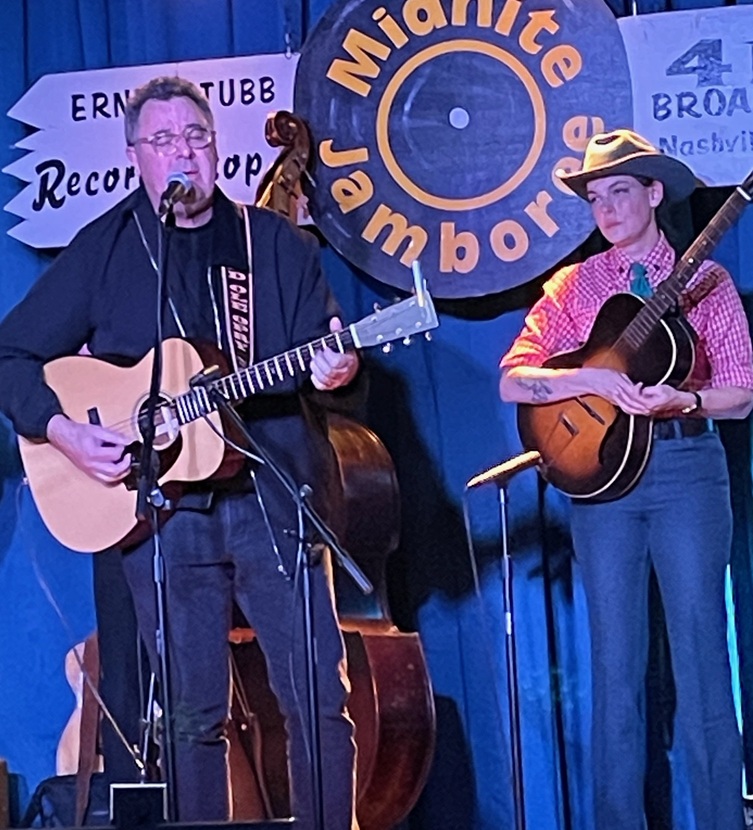
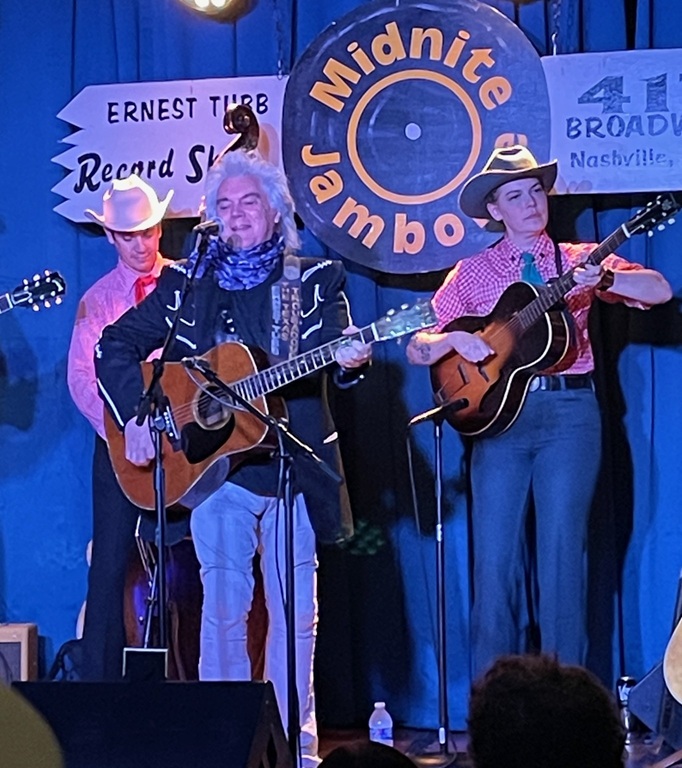
Bobby Fischer writes from Nashville, “Thanks for listing my info. I’m having fun you shouldn’t be able to have at my age and you’re one of the main reasons. I think a lot of readers think that. Also, happy Veterans Day.”
Michael Green says, “Thanks as always for a great newsletter. As I recall, Hank Snow recorded and sometimes sang ‘Snowbird’ and would note that his fellow Canadian recorded it. Interestingly, he recorded another song called ‘Snowbird,’ but I’m not sure who wrote it (another Canadian artist, Gene McLellan, wrote the Anne Murray song). She SHOULD be in the Country Music Hall of Fame. As a Dodger fan, I’m glad Brad Paisley has been good luck for our side winning games, but could he keep them a little shorter? By the way, when the Dodgers were trying to sign Shohei Ohtani, there was a communications issue between manager Dave Roberts and team executives, and they were resolved at Paisley’s farm. The winter meetings were in Nashville, and he invited them all out there. After much food and drink, everybody was happy–especially Brad, since he’s a Dodger fan.”
Jean Earle writes from England, “This may come a big surprise. We used to keep in touch—Alan and Jean Earle. The old memory is not what it used to be….We enjoy your news. And all of Faron’s songs…But the years have taken their toll…..87 is difficult!! Sorry I do not get onto the computer nowadays. But we think of you and all our lovely friends in Nashville. Cannot manage the computer like I used to. Forgive me. Best wishes for Christmas.”Diane: How wonderful to hear from you, Jean! It has been a while.
COUNTRY MUSIC DISC JOCKEY HALL OF FAME – 1980 and 1981
1980
T. Tommy Cutrer, born Thomas Clinton Cutrer in Mississippi in 1924, was playing high school football in 1940 when struck by osteomyelitis. After a year in bed, he resumed school where he learned elocution and began working as emcee of a radio variety show. By 1949, he was a disc jockey and emcee at KNUZ in Houston; the station manager called him “T. Tommy” because “cut-Trair” was difficult to pronounce. At KCIJ in Shreveport, T. Tommy was the first disc jockey to play Johnny Cash records and the first outside of Memphis to play Elvis Presley records. He formed a country and gospel band, serving as singer, drummer, and band leader. Floyd Cramer and Jimmy Day were two of his band members. Losing his left leg in a car crash while driving to Nashville in 1954 ended his band. He joined WSM radio and, in the next ten years, gained national fame as a disc jockey and the voice of the Grand Ole Opry. He was named the nation’s top D.J. in 1957. As emcee of the broadcast Country Music Worldwide, he was heard across Europe, South America and Africa. In the 1970s, his nationally syndicated country music interview show, Music City, USA, was heard on more than 130 stations. He was elected a Tennessee state senator in 1979 and served a four-year term. T. Tommy Cutrer died of a heart attack in 1998 in Gallatin, Tennessee, at age 74.
Bob Jennings, born in 1924, began his career as a member of the hillbilly country band Bob Jennings and the Farm Hands in the 1940s. He later became a top-rated deejay at WLAC and WSM in Nashville and served as Air Talent and Program Director at WLAC Radio. He contributed liner notes to many country LPs in the 1960s and 1970s. Bob died in 1984 at age 59.
I couldn’t find any information on Skeets Sweeney. Can someone tell me about him?
1981
King Edward Smith IV, 49, music director for Salem radio station WSLC and a national figure in country music, died of heart disease and gallbladder complications on April 23, 1981, at the Medical College of Virginia in Richmond. He joined WSLC (then WSLS) in 1964 and became music director in 1967. He was named Disc Jockey of the Year by the Academy of Country Music in 1979, the same year he was elected to the Country Music Association CMA board of directors. Smith had his own band, King Edward and the Knights.
Charlie Walker was born in 1926 in Copeville, Texas. In 1943, he joined Bill Boyd’s Cowboy Ramblers and served as a disc jockey for the Armed Forces Radio Network during World War II. He worked as a disc jockey from 1951-1961 at KMAC and from 1961-1963 at KENS in San Antonio, Texas. He booked singers for concerts in the San Antonio area from 1951-1965. He moved to Nashville and joined the Grand Ole Opry in 1967. After signing with Columbia Records, he had his biggest success with the Harlan Howard song “Pick Me Up on Your Way Down.” Other hits included “Who Will Buy the Wine,” “Don’t Squeeze My Sharmon,” and “I Wouldn’t Take Her to a Dogfight.” Charlie died in 2008 at age 81. He lived in Hendersonville, Tennessee.