
Diane’s Country Music Newsletter — 7 January 2026
BOOK REVIEW – THE HOURS ARE LONG BUT THE PAY IS LOW
The title of Rob Miller’s newly released memoir, The Hours Are Long But the Pay Is Low, caught my attention and made me want to read the book. It tells the story of Bloodshot Records, a recording company Miller cofounded in Chicago in 1993. “For decades,” he writes, “music has grabbed me by the lapels, kicked me in the seat of the pants, and kept me from falling into, or pulled me out of some deep, lonely pits.”
Miller grew up in the early 1980s, a bullied youth in the Detroit school system. The many detailed descriptions of the cruelty he experienced explain how his “outsider” attitude in his music career resulted from being in survival mode throughout his teens. He escaped into the world of music performed by those not accepted in mainstream musical genres, as he built a large record collection and repertoire of musical knowledge. He worked in record stores and wrote reviews for local magazines. By the time he graduated from college in 1989, he was employed as a concert promoter. Eventually burned out by the grind, he moved to Chicago in 1991 to get away from the music business.
There, he started a painting company with “two fellow Michigan defectors” and barely made ends meet. While “rolling paint onto endless walls at jobsites,” he listened to a variety of radio stations and spent his off-time drinking in music-filled taverns. As music crept back into Miller’s life, he once again began seeking record stores and live venues to discover new sounds. At a tavern one winter night in late 1993, he and two friends decided to start a label to record the musicians they were hearing. They filled a bar napkin with a list of bands to contact and then spent the next months searching for bands to record. The bands they gathered “were glad someone, anyone, wanted to document what they were doing.”
To choose a name for their record label, the cofounders brainstormed on themes inherent to country and punk–hard-living and rebellious, songs about hangovers and bloodshot eyes. “Bloodshot it was,” Miller writes. “It sounded cowboy, but not hick, more renegade black hat Magnificent Seven Yul Brynner than hagiographic white hat John Wayne.” And what would they call their music? “It is a truism that where there are English majors and beer,” Miller writes, “there will be a thesaurus and dictionary nearby.” They ran through words like rebel, guerilla, and malcontent, settling on insurgent: “It had it all–conviction, purpose, and an antisocial, piratical flourish.” He would devote the next twenty-eight years to “championing music that lurked between genres and under the radar.”
To get an idea of what “insurgent country” sounds like, I turned to YouTube to hear several artists: Old 97’s- – Scott Biram — Robbie Fulks — Cramps — Split Lip Rayford — the Meat Purveyors. Mostly enjoyable, the music emphasized to me the futility of trying to force singers and their songs into genre boxes.
The story Miller tells is often hard to follow, with the lack of chronology mixing the Detroit and Chicago days, as well as pre- and post-record label experiences. For example, Neko Case appears in chapter 14 as one of his artists, but Miller doesn’t meet her until chapter 16. The kaleidoscope of names and excessive detail is impossible to follow and sometimes overwhelming. However, Miller’s humor and descriptive skills make the overall read enjoyable. He sounds like he’d be a fun person to know.
He passes on the wisdom he learned over the years, such as the easiest way to maneuver through a crowded bar: “Follow the waitress with the tray full of drinks as she effortlessly parts the crowd like Charlton Heston did the Red Sea.” I enjoyed how, throughout the book, he used cultural references as similes, not caring whether the reader recognized the names. If you got it, you smiled. If you didn’t, you missed out.
As the label became a success, its music had to be categorized. Miller explains, “The need to pin down the music and our artists became a persistent bete noire as industry people wondered, Where do I file this, where does it fit, who, in short, will buy it?” The term “insurgent,” which had been coined out of necessity, became something of a millstone. Miller writes, “as people…ascribed their own biases to it…. Self-appointed sourpuss arbiters of authenticity quickly sought to codify what the Bloodshot sound couldn’t be, and, remarkably, began telling us what the term meant and who could claim it.”
“So what and who is authentic?” Miller wonders. “Steve Earle didn’t serve two tours in Vietnam, John Fogarty wasn’t born on the bayou, and Johnny Cash never shot a man in Reno just to watch him die.” He now answers the What is alt/insurgent country? question with candor: “It’s whatever I say it is. It’s whatever you say it is. Alt-country is not one thing.” His focus was on working with “artists looking for sustainable ways to build a career doing something they loved.” He never cared about “authenticity” or fitting into a category when it came to music. Miller himself is, however, authentic. And so is The Hours Are Long But the Pay Is Low.
NEWS
Stu Phillips (1933-2025)
The eldest member of the Grand Ole Opry, Stu Phillips, died on Christmas Day at the age of 92. Born in Canada in 1933, he began performing at an early age and hosted a variety of radio shows before moving to television on the CBC network. He left Canada for Nashville in 1965, where he signed with RCA Records and Chet Atkins. Stu joined the Grand Ole Opry in 1967. (I remember listening to him on the radio.) On the Fourth of July weekend in 1998, Stu celebrated his new American citizenship with his wife, Aldona, on the Opry stage. “Whenever I traveled overseas, I used to think of Canada as my home,” he said. “After moving to Nashville, our lives became integrated into this land with all its comforts. Now, whenever I travel overseas, home is Tennessee, where I live.” Stu was inducted into the Canadian Country Music Hall of Fame in 1993.
Singer/songwriter Todd Snider, based in Nashville and known for songs like “Beer Run,” “I Can’t Complain” and “Just Like Old Times,” died of pneumonia on November 14. He was 59 years old. While in Salt Lake City, Utah, for his High, Lonesome and Then Some Tour, he had been beaten and robbed on November 2. He was taken by ambulance to the Salt Lake City Regional Hospital. According to USA Today, he made verbal threats against the hospital staff for discharging him against his wishes. The Salt Lake City police arrested him, and he was charged with disorderly conduct, threat of violence, and suspicion of criminal trespassing. He was released on his own recognizance. On November 3, he cancelled his tour and returned home to Nashville. He had trouble breathing and entered a hospital for treatment, where doctors determined he had been suffering from undiagnosed walking pneumonia. Earlier in the year, Todd participated in Bobby Bare’s 90th birthday celebration at the Country Music Hall of Fame and Museum with Writers Round: The Songs of Bobby Bare.
All three daughters of Alan Jackson (67) and his wife, Denise (65), are pregnant, reports IHeart Country Radio. On Christmas Day, Alan posted an Instagram photo of the three: Mattie Denise Jackson Smith, 35, Alexandra “Ali” Jane Jackson Bradshaw, 32, and Dani Grace Jackson, 28. The caption read, “Merry Christmas from our growing family!” Ali and Mattie and their husbands both have toddler sons.
Former BMI Nashville executive Roger Sovine, 82, died peacefully at Alive Hospice on December 23, surrounded by family. Born in West Virginia, he was the son of entertainer Woodrow Wilson “Red” Sovine (1917-1980). MusicRow reports the family moved to Nashville in 1955, when Roger was 12. Red joined the Grand Ole Opry and had his biggest hits with “Giddyup Go,” “Phantom 309,” and “Teddy Bear.” Roger served in the U.S. Marine Corps and worked as a songwriter and recording artist before joining BMI in 1972 as Assistant Vice President of Writer Relations. He was named Vice President of Tree International in 1982. He returned to BMI in 1985 and became Vice President of Writer/Publisher Relations. Roger Sovine served four terms with the Nashville chapter of the Recording Academy. He was president and chairman of the board of the Country Music Association, as well as chairman of the Copyright Society of the South. Roger retired from BMI in 2001 and moved to Gulf Shores, Alabama.
The Tracking Room, located at the edge of Music Row, was a cutting-edge recording studio from when it opened in 1995 until it suspended operations in March 2020. A group of developers bought the property in March 2021 but found the half-acre plot unsuitable for their plans and put it back on the market. MixOnLine reports that Keith Urban purchased the 9,300-square-foot building in June 2024 and renamed it The Sound. The remodeling is now complete. “I have always been passionate about recording,” Keith says. “I don’t have any hobbies. I don’t play any sport. I don’t play golf. I don’t hunt. I don’t fish. I just play music and write and create, and I’ve always felt at home in studios.” He wants The Sound to always be available for his use, although he plans to rent it out “when I know for sure I’m going to be on tour.” He is currently enjoying having a studio all to himself. “I just like hanging out in here,” he says. “I’ll wander over to the piano and write a little bit or go into the guitar room and play. I’m in heaven.”
Alabama natives Jamey Johnson and Riley Green, who both attended Jacksonville State University and share a deep love for their home state, have teamed up for a song, reports 101.5 HANK FM in Seattle. “There’s a natural connection with us there,” Jamey explains. “I was immediately impressed with his writing and singing.” They co-wrote “Smoke” with Erik Dylan. Jamey says, “It has an interesting sound to it, with one part going down while the other part is going up. I like the whole concept of this guy not being too upset about whatever she is mad at. That smoke probably has a lot to do with it.” They recorded “Smoke” at The Cash Cabin and Big Gassed Studios. Kyle Lehning and Jim “Moose” Brown were the producers. Jamey previously worked with Kyle on Randy Travis – 25th Anniversary Celebration (when Jamey and Randy sang “A Few Ole Country Boys”), but this was the first time he and Kyle worked together from start to finish on one of his songs.
Backstage Country reports that Randy Travis joined Joe Nichols onstage at the Penn & Teller Theater in Las Vegas on December 12. Joe welcomed him by saying, “If it’s okay with y’all, I’m gonna play one of your songs, if that’s all right. If you want to stay out here for it, all right. That makes me even more nervous knowing you’re watching. All right, boys, don’t mess this up.” Joe then flawlessly sang “On the Other Hand.” (I interviewed Joe for Randy’s biography. “When I was a young kid, Storms of Life was one of the best records I ever heard,” Joe told me. “This new guy, Randy Travis, I thought was really, really great. Sounded like the old guys but he’s a new guy.”) Randy’s 2025 More Life Tour included more than 50 shows and entertained roughly 60,000 fans. The tour continues into 2026, beginning March 12 at the Frauenthal Center in Muskegon, Michigan, and ending May 23 at Memorial Auditorium in Spartanburg, South Carolina. James Dupré will continue as guest vocalist, backed by Randy’s actual touring band.
Robert G. “Bob” Allen, 77, died December 10 in Washington, DC. Born in 1948 in Sykesville, Maryland, Bob graduated from the University of Maryland and began his career by writing freelance articles for Nashville! magazine and Country Music magazine. Hired as an editor at Country Music magazine, he retained that association into the 1990s. His work appeared in top publications such as Billboard, Rolling Stone, The Washington Post, The Baltimore Sun, The Atlanta Journal, Time-Life Records, Esquire, and Playboy. In recent years he wrote for Bluegrass Unlimited magazine. Books he authored or edited include Waylon Jennings and Willie Nelson: a Rip-Roaring Photo Bio, Waylon & Willie: The Full Story in Words and Pictures of Waylon Jennings and Willie Nelson, The Blackwell Guide to Recorded Country Music, George Jones: The Life and Times of a Honky Tonk Legend, and The Billboard Illustrated Encyclopedia of Country Music. Bob was an avid historian, with focused expertise in the Civil War and the Lincoln assassination. The Center for Popular Music at Middle Tennessee State University houses the Bob Allen Papers, a collection that measures 25 linear feet of manuscript papers, news clippings, photographs and audio cassettes.
American Songwriter published an article with the title “These 3 Country Songs From 1961 Will Be Classics Forever.” It celebrates three songs from 65 years ago: “Crazy” by Patsy Cline, “Hello Walls” by Faron Young, “Don’t Worry” by Marty Robbins. Two were written by Willie Nelson and one by Marty Robbins. And I wrote biographies on two of the three singers!
Steel guitarist Kenneth “Corky” Owens, 66, of Henderson, Kentucky, died at his home on New Years Day, following a massive heart attack. Born in 1959, he was raised in Tyler, Texas, where he discovered his love for music. He worked with Joe Stampley and then spent 15 years as steel guitarist and band leader with Gene Watson’s Farewell Party Band.
Thanks to Saving Country Music for a great job compiling a list of music people we lost in 2025. Here are five deaths I missed during the year, beginning with Benny Birchfield, widower of Jean Shepard. He died August 2 at age 88. He joined the Osborne Brothers in 1959, playing bass, twin banjo, and guitar. Known across bluegrass and country circles for his harmony vocals, he also worked with Roy Orbison. In 1968, Benny married Jean Shepard, and they remained together for nearly five decades until her death in 2016 at age 82.
Dave Burgess, 90, died in Dover, Tennessee, on October 19. A songwriter and guitarist, he was best known as a member of The Champs, who recorded the hit song “Tequila” in 1958. He wrote songs for Marty Robbins, Slim Whitman, Eddy Arnold, Glen Campbell, Dean Martin, and others. His website claims he had more than 700 registered song copyrights.
Louise Rowe, the only female musician ever in the Bob Wills and His Texas Playboys band (hired in 1953), died in her sleep on October 31 at age 93. Born Virginia Louise Rowe in 1932 in Midland, Texas, and raised in Duncan, Oklahoma, she was the last child and only girl in a musical family with seven older brothers. The family band went by the name of Seven Rowe Brothers. She sang in the family band and was hired at age 18 by Jim Boyd as the girl singer to his “Men of the West” band. She met Bob Wills when he and The Texas Playboys came to Dallas and played a battle of the bands with the Seven Rowe Brothers. The next year Bob hired Louise as his girl singer. When the bassman left in the middle of the tour to get married, Bob hired 19-year-old Louise as the first and only female band member. Bob ordered her a custom Nudie’s of Hollywood uniform and took her to get her musician’s union card. He told her to wear the name with pride because, for her whole life, she would be known as a Texas Playboy. She married fiddler Buddy Beasley in 1959 and went into retirement to raise two daughters. She later returned to Western Swing music and played for the rest of her life with her own band, Louise Rowe’s Texan Playboys. Her last gig with the band, at age 91, celebrated the 10-year anniversary (in her honor) as the house band at the Texan Kitchen Restaurant in Euless, between Fort Worth and Dallas.
Carlos DeFord Bailey, 66, grandson of Country Music Hall of Famer and Grand Ole Opry legend DeFord Bailey, died of cancer on November 3. He performed on the Grand Ole Opry and participated in numerous educational programs at the Country Music Hall of Fame. Born in Nashville, Carlos was the son of “Nashville Blues Legend” Deford Bailey, Jr. and the grandson of Deford Bailey, who had been the first performer ever introduced on the Grand Ole Opry. DeFord was a Black artist traveling during the Jim Crow era and couldn’t be in many of the same hotels and restaurants as the other performers. For decades, DeFord shined shoes on Nashville’s 12th Ave. and lived in a nearby apartment building. He died in 1982. Carlos worked to keep his grandfather’s memory alive.
Bill Ivey, the Country Music Hall of Fame CEO from 1971-1998, died November 7 at age 81. He was born in 1944, in Detroit, Michigan, and was an influential folklorist, cultural policy leader, and advocate for the arts. He served as Chairman for the National Endowment for the Arts under President Bill Clinton from 1997-2001 and later as director of the Curb Center for Arts and Public Policy at Vanderbilt University.
“When I was a young girl growing up in Alberta,” Terri Clark remembers, “with my sights set on the Grand Ole Opry and the CMA, my mother would often talk about one honor being head and shoulders above the rest… the Order of Canada. The highest honor our country can bestow upon a civilian.” She has now received the Order of Canada, reports MusicRow, presented to her by the Governor General of Canada. Since the award was created in 1967, more than 8,250 people from all areas of society have been appointed to the Order. Terri was the first Canadian female member of the Grand Ole Opry, and she is in the Canadian Country Music Hall of Fame and the Canadian Music Hall of Fame. She and fellow country artist Paul Brandt recently visited 34 cities across Canada on their co-headliner acoustic Homecoming 2.0. Tour.
Every morning since January 7, 2016, Neal McCoy has recited the Pledge of Allegiance live on Facebook to begin his day. Whiskey Riff reports that he is celebrating his tenth anniversary of doing so, and he hopes to keep it going as long as he can. “I was sitting at home and I told my wife, ‘I’m just going to type in the Pledge of Allegiance on my Facebook page,'” he remembers. “The Republicans and Democrats were trying to figure out who their nominees were going to be for president.” He wanted to “let people know that the Pledge of Allegiance to the United States of America is just a short thing, but it’s pledging your love for our American flag and our country.” As time went by, he realized how much it meant to the people who listened each day. Even with a hectic touring schedule, even through the deaths of his parents, even on a ship in the middle of the ocean, he didn’t miss a day. “Pretty simple… It’s not meant to be political,” he says. “It’s just meant to show your love and respect for our flag and country. Doggone, it can’t be that hard.”
WKRN News 2 in Nashville reports that the Centennial Park Conservancy is raising funds to benefit the Nashville park by selling two limited-edition t-shirts that feature a bench dedicated to Taylor Swift. The bench was installed by the city of Nashville when she returned to Nashville for her Eras Tour in May 2023. The inspiration for the bench comes from Taylor’s 2020 song “Invisible String” with the lyric: “Green was the grass where I used to read in Centennial Park.” The plaque on the bench reads:
For Taylor Swift
A bench for you to read on at Centennial Park
Welcome home, Nashville
LETTERS
Bill Anderson writes from Nashville, “Always good to see your newsletter in my mailbox. You asked about Hap Wilson. I don’t know his full bio, but I do know he was a longtime disc jockey and singer/songwriter from Alabama. He co-wrote ‘A Sleeping At The Foot Of The Bed’ under the name of Gene Wilson for Little Jimmy Dickens. He was on the air in Huntsville, Alabama, in his latter radio days, and at one time was married to singer and Opry star, Marion Worth. Hopefully some other folks will know more and can fill in the empty spaces. I hope all is well in your world. Merry Christmas and Happy New Year.”
Diane: Thanks, Bill, I found him! BMI lists “Sleeping at the Foot of the Bed” as cowritten by Eugene B. Wilson, which is his real name. I’ve updated my Hall of Fame entry. I remember Marion Worth being on the Opry and her song “Shake Me I Rattle (Squeeze Me I Cry).”
Ken Johnson writes, “Surprised to find out that writer Bob Allen recently passed away. I met Bob at Country Radio Seminar one year. Great guy who wrote some excellent books & articles about country music. Appreciated his well-researched Country Music Magazine articles back in the day – and his book on George Jones.”
Diane: Thanks for sending me his obituary, Ken. I posted his death in the news section. Bob’s 1987 interview with Randy Travis was an important source for me in talking about Randy’s early touring. And his 1981 interview with Marty Robbins was an important source in writing about Marty’s final days.
Mark Meusborn says, “I would like to sign up for the country music newsletter.”
James Akenson writes, “As always, I enjoy receiving your newsletter. You keep everyone up to date. I trust you’re having some good holiday relaxing time and that 2026 will be a great year. Happy New Year!”
Frances G Miller says, “This newsletter is always informative. Thanks for sharing it with me.”
Ken Johnson sends a correction to a comment in last month’s newsletter that Mandy Barnett had been one of the actresses on The Brady Bunch: “According to Mandy’s bio she was born in 1975. That is more than one year after the final new Brady Bunch episode aired in 1974. So it was impossible for Mandy to have appeared in that show.”
Martha Moore of so much MOORE media says, “Merry Christmas and cheers to more country news, music and more in 2026.”
Terry L. Campbell writes, “June Campbell—known to her radio listeners as ‘Happy Valley June’—was my mother. I am currently developing a musical titled Junebug about her life and her time in the traditional country music scene. You can learn a little more about my project here. Thank you for your time and for the work you do in preserving these musical histories.”
June Thompson says, “This ol’ country girl in Alabama sends thanks for your great newsletter. I wish for you and your family a blessed Christmas and wonderful new year.”
Jackie Allen Thomas in Arizona says, “Have a wonderful Christmas and a healthy and good coming new year. Thank you so much for all your wonderful music news all year and look forward to the next great newsletter.”
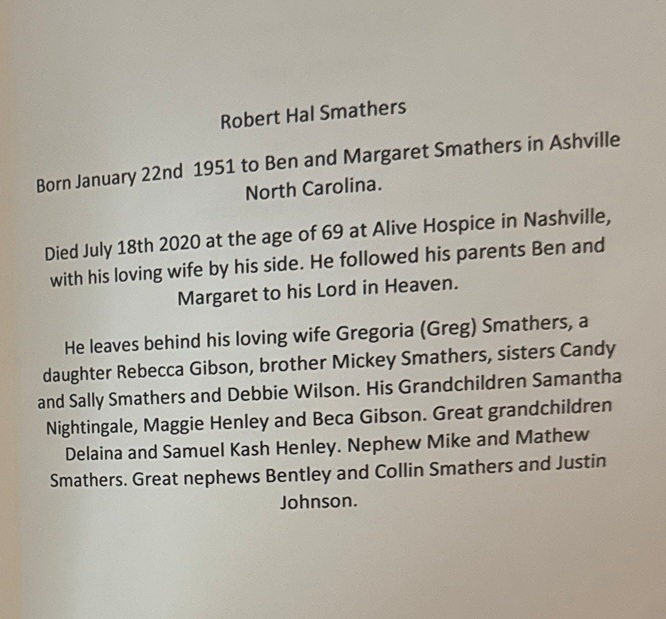
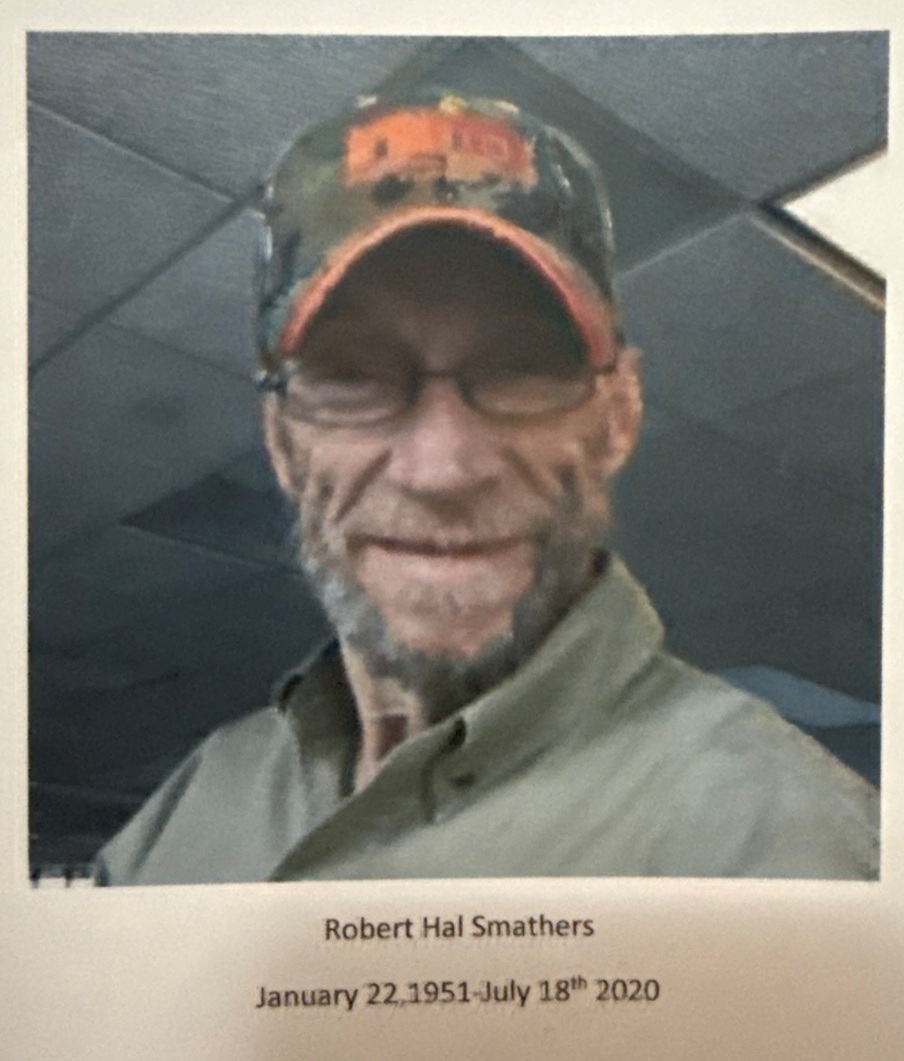
Margaret Nightingale, granddaughter of Hal Smathers of the Stoney Mountain Cloggers, writes, “I was reading an article posted about his passing and how you weren’t able to find an obituary for him. I have one and would be happy to share it.”
Ron Wood writes, “I always enjoy your newsletter. In your section on DJs, I wonder if you have ever published an entry for Lem Hawkins of KFGO 790 in Fargo, ND? I worked for the same company (while in college at NDSU) that owned that radio station, but I worked in the KXJB-TV part of the company. Something I just found out is that he had a band, too, Lemuel Q. Hawkins and his Hill Billies. Wonder if there might be some recordings of his band? His real name was Earl King. And have a Happy New Year!”
Diane: Lem isn’t in the Disc Jockey Hall of Fame, so I’ll provide his history here: Earl King was best known by his radio name of Lemuel Q. “Lem” Hawkins. A popular Fargo-Moorhead radio personality for many years, he began as a country music entertainer in Missouri and moved to Moorhead, Minnesota, in 1931. Lem’s band played for barn dances in the 1930s. Since there was no electricity, farmers lit their haylofts with kerosene or gas lanterns. To lessen the fire danger, Lem started bringing an electric generator with lights and wires. Other bands, lacking this safety equipment, lost bookings to him. Lem worked for the government during World War II. He also had radio jobs in Aberdeen, South Dakota, and Omaha, Nebraska. He then joined Fargo-Moorhead’s KFGO to finish up his 40-year radio career. He and his wife, Velma, lived in Moorhead. She died in 1973, and Lem followed the next year at age 70.
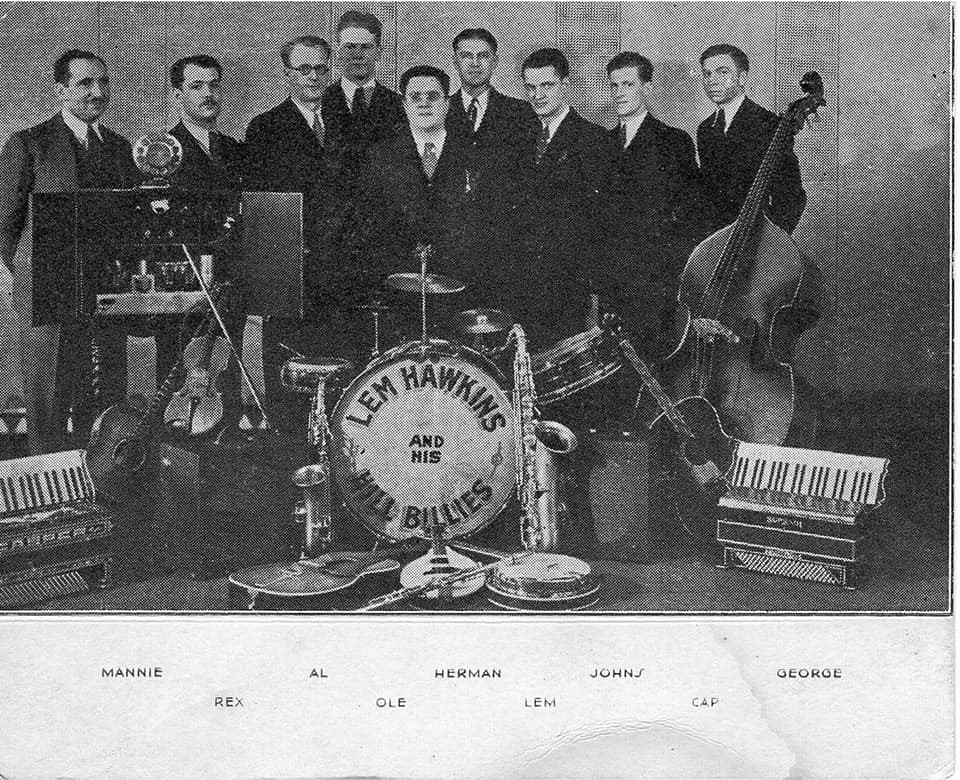
Lemuel Q. Hawkins and his Hill Billies
Roger Ryan writes from Cork, Ireland, “After 38 years as the country music correspondent for the Echo I have decided to retire. I will still keep in touch with the scene, though, and will also visit Nashville regularly to see my friends. I really enjoy your newsletter. Happy Christmas to you and all your readers.”Nobuhiko Ogino writes from Kobe, Japan, “Merry Christmas! Thank you for the newsletter, I enjoyed every month.”
HARGUS “PIG” ROBBINS BIOGRAPHY UPDATE
Weather permitting, I’ll be in Nashville in just over two weeks to start researching the life of Pig Robbins. This will be my fourth Country Music Hall of Fame biography with the University of Illinois Press.
COUNTRY MUSIC DISC JOCKEY HALL OF FAME – 1985 and 1988
1985
Louis Albert “Ramblin’ Lou” Shriver, born in 1929 in Tonawanda, New York, was an American country musician and radio broadcaster who lived in western New York state. He began his broadcasting career as a teenager at WJJL Buffalo in 1947 and was the first person to broadcast country music over the Western New York airwaves. In 1970 he purchased WMMJ in Lancaster, a Buffalo suburb, and renamed it WXRL (the “RL” referring to his initials). A preeminent country music promoter, he brought numerous acts to Buffalo and Niagara Falls, including Elvis Presley, Buck Owens, Johnny Cash, and Hank Williams. He and his wife and children performed locally and internationally as the “Ramblin’ Lou Family Band.” He broadcast his Ramblin’ Lou radio show on WXRL until 22 days before his death on January 17, 2016.
Hap Wainwright was born in Perdido, Alabama about 1927 and grew up around country music. The family played Jimmie Rodgers records on a phonograph at home, and he was determined to be a musician. Around 1955, he was a disc jockey at radio station WKRG in Mobile, Alabama. In 1958, Happy’s band, “Kings of the Hillbillies,” contained Roy Wainwright on rhythm guitar, Cecil Smith on bass fiddle, Burel Dixon on steel guitar, and Eddie Smith on piano. They were all members of the Orders of the Oddfellows, and their “Oddfellows Chorus” visited churches to offer their musical services there. I couldn’t find any information about an obituary.
There were no inductions in 1986 or 1987.
1988
Tex Justus, born Olus William Justus in Thurman, Texas, in 1910, taught himself to play guitar and began singing professionally in 1936 after being inspired by a meeting with Jimmie Rogers. He made his radio debut as a singer on WLAP Louisville, Kentucky, where he was nicknamed “Tex.” He formed the Texas Cowboys, a Bob Wills-style dance band, and joined WOMI Owensboro (Kentucky) in 1939. He turned down announcer offers from both the Renfro Valley Barn Dance and The Grand Ole Opry to continue his six-day-a-week half-hour show of live music. From 1951, for the next three decades, Tex hosted the “T.J. Time” program on WBNL radio station in Boonville, Indiana. He was twice named Mr. DJ USA by WSM radio and was a charter member of the Country Music Association. He died in 1985, at age 74, in Evansville, Indiana.Tom Perryman, born in 1927 in Dallas, Texas, started in country radio at KEBE Jacksonville, Texas, after his high school graduation. He joined KSIJ in Gladewater and, in 1953, became a charter member of the Country Music Disc Jockey Association. He moved to WSM Nashville in 1956 and became the first regular disc jockey of an all-night country music show on WSM. He served as General Manager and partner with Jim Reeves at KGRI AM/FM Henderson TX and General Manager of WMTS AM/FM Murfreesboro TN. In 1985, he became Vice President of Jim Reeves Enterprises. He died in 2018, at 90 years old, in Tyler, Texas. He was recently inducted into the 2025 Texas Radio Hall of Fame as a Lone Star Legacy honoree.
Addition to class of 1983:
Happy Wilson was born Eugene Burnett Wilson in Haleyville, Alabama, in 1919. He got his start in radio at the age of 15 and soon became known as “Happy” Wilson. He spent four years in the U.S. Army. Since his medals included the Purple Heart, Combat Infantryman’s Badge, and Belgian Croix de Guerre, I’d guess he was in combat in Belgium during World War II. While living in Birmingham in the 1950s, he met and married fellow Alabama native Marion Worth, and they moved to Huntsville. They then moved to Nashville, where Marion became a recording artist and Grand Ole Opry member. Happy headed a large music company for years and for a short time was in charge of the Capitol Record operations in Nashville. He co-wrote “A-Sleepin’ At The Foot Of The Bed” based on his childhood experience. “During the depression I lived in Haleyville,” he once said, “and when company visited, I had to sleep at the foot of the bed.” Happy died in Nashville in 1977, at age 58.