
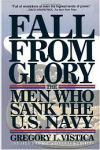
Fall From Glory: The Men Who Sank the U.S. Navy
By Gregory L. Vistica
Secretary of the Navy John Lehman largely orchestrated the Reagan military buildup of the 1980s. To obtain funding for a massive force of aircraft carriers and new strategic homeports, designed to counter a perceived Soviet threat, Lehman suppressed intelligence reports and studies that described a defensive, submarine-based Soviet navy.
So says author Gregory Vistica in Fall from Glory: The Men Who Sank the U.S. Navy. Published in 1995 and reissued in 1997, the book covers the rise of Lehman and the admirals he favored, along with actions that resulted in most of them leaving under less than honorable circumstances. Lehman himself was quietly fired in 1987. Vistica had initially intended to write about the 1991 Tailhook scandal, a story he broke while reporting for The San Diego Union-Tribune, but he expanded into a larger work covering several decades of naval history.
Stories of drunken aviators assaulting women during the annual Tailhook Association convention reverberated through the Navy and the nation in 1991. Following a period of investigation and cover-up, the Secretary of the Navy (SECNAV) resigned in 1992 and the Chief of Naval Operations (CNO) in 1994, not because they misbehaved but because they lied about witnessing misbehavior. SECNAV Garrett’s resignation letter said he accepted responsibility and accountability “for the leadership failure which allowed the egregious conduct at Tailhook to occur in the first place.” Critics and admirers alike, according to Vistica, rightly suggested he could have prevented the public affairs disaster by saying that at the beginning.
Most of the events described in Fall from Glory occurred during my 32 years in the U.S. Navy. An aircraft maintenance officer, I retired as a captain, after a tour on the Naval Inspector General staff. Knowing friction has always existed between the civilian leadership and the admirals who run the Navy, I wasn’t surprised to read about confrontations among various SECNAVs and CNOs. What shocked me were the self-serving actions and lack of integrity in those entrusted to look out for this country’s best interests. I’ve always considered the Tailhook fiasco a failure of senior naval leadership (before, during, and after the event), but I didn’t realize it reflected the upper echelon’s standard way of dealing with problems: telling lies to deflect criticism.
The most blatant instance in this book was the story of Major General Royal Moore, placed in charge of Marine Corps aviation in the Persian Gulf in 1990. Other aviators called him “inept and dangerous,” and he falsified his aviation safety exam by having a junior officer take it for him. He once taxied an F/A-18 Hornet into a guard shack, injuring the sentry inside but not setting off the Sidewinder missile on the aircraft wing. According to the author, Moore “did not think the incident was serious enough to report.” A young captain who objected to flying with him was forced to resign his commission, while Moore was promoted and assigned as commanding general of all Marine Corps forces in the Pacific.
When Kara Hultgreen crashed her F-14 fighter into the ocean in 1994, killing herself and her backseater, it was the only time in my career I felt relief at hearing the cause was aircraft malfunction. I knew pilot error would increase the existing animosity toward women aviators. So did Navy leaders, who first advertised engine failure but changed to pilot error after the engines were recovered and tested. If the truth had been admitted immediately, the backlash might not have been so severe and so public. Hultgreen, even though rushed through the training pipeline, was not a poor pilot. Because of the cost of training aviators, Vistica states, “the Navy keeps an inordinate number of mediocre and poor male pilots, many of them less qualified than Hultgreen was. But the Navy could not say this after Hultgreen’s death, lest it give away the truth. . . .”
Fall from Glory also describes successes, and it makes clear the majority of naval personnel are dedicated and ethical. It describes the 1981 dogfight over Libya that emphasized freedom of the seas, the 1985 capture of the Achille Lauro hijackers, and Desert Storm in 1991.
Vistica wrote a balanced and well-researched book, complete with index and footnoted sources. Minor errors (such as defining RAG as Reserve Air Group instead of Replacement Air Group and saying a person with 24 years of service would resign rather than retire) detracted only slightly from his overall credibility. He made extensive use of Freedom of Information Act (FOIA) files, and he interviewed many of the people discussed, including John Lehman.
During Lehman’s first meeting as SECNAV, he put his hand on CNO Hayward’s shoulder and said he needed no introduction. Some admirals considered this action rude and arrogant, but Vistica says, “Lehman saw the meeting in a much different light. Ever conscious of his youth, he did not want to humiliate Hayward the veteran officer.” This example illustrates the author’s efforts to provide journalistic balance by presenting all sides of an issue.
Fall from Glory is still relevant today. That is shown in the 2011 firing of Captain Owen Honors, which followed the “standard” sequence. He should have been fired for poor judgment when his crude videos were exposed in 2007. Instead, he received command of the aircraft carrier USS Enterprise. Now that the videos have become public, the Navy Department has to show accountability. The admirals who made the decision to keep him in 2007 should be held accountable for the Navy’s most recent black eye.
One chief of public affairs stated that most problems could end much sooner “when you just acknowledged everything you did, and apologized and got done with it.” Vistica writes, “In the secretive Navy, that philosophy was anathema.”
I’d like to see Fall from Glory: The Men Who Sank the U.S. Navy discussed at the Naval Academy and in staff colleges. It would show our future leaders the pitfalls of trying to hide problems and would emphasize the importance of integrity and professionalism in the U.S. Navy.