
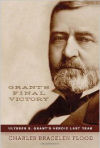
Grant’s Final Victory: Ulysses S. Grant’s Heroic Last Year
By Charles Bracelen Flood
Grant’s Final Victory: Ulysses S. Grant’s Heroic Last Year, by Charles Bracelen Flood, is the story of the final year of General Grant’s life. Following his Civil War victory and two terms as President of the United States, Grant and his wife, Julia, purchased a home near Central Park in New York City in 1881. Although Grant “had little understanding of money” (according to the author), he and his son Buck contributed funds to Ferdinand Ward and James Fish to establish the four-partner investment firm of Grant & Ward. With Grant’s prestigious name and the Ward/Fish financial reputation, their firm attracted investors and began paying large dividends. The Grants enjoyed life as millionaires.
On Sunday, May 4, 1884, Ward explained to Grant that the New York City treasury had drawn an excessive amount of money from the Grant & Ward bank, which could not open the next day without an extra $150,000. Grant borrowed the money from his friend, William Vanderbilt, the richest man in the city. On Monday Ward told Buck he needed an additional $500,000. Buck, who had trusted his financial partners to handle the books, took the company’s records to financier Jay Gould and asked for help. Gould told him the securities weren’t worth the paper on which they were printed.
Grant & Ward collapsed when banks refused to honor its checks. The $150,000 had never been deposited, and its accounts were empty. Throughout the life of the firm, Ward and Fish had kept two sets of books. Flood says, “The set kept for the official record, the one showing Grant & Ward’s capitalization at $16 million, was a financial fairy tale.” Ward and Fish were eventually arrested, convicted, and sent to prison.
Grant, at age 62, was penniless. He and Julia sold most of their possessions, accepted as loans the donations from friends, and moved to a house in the country. According to Flood, “The reality of the moment remained: Ulysses and Julia had to have more money, just to live simply, let alone pay off their debts. Neither of them had any idea of how he could make any money at all.”
Feeling humiliated and betrayed, Grant worried about bankruptcy and how his role in the firm’s collapse would be portrayed. Although he had previously refused requests to write about his war experiences, he now agreed to do so. A four-article contract with Century Magazine evolved into a plan for a complete book. He wrote to his daughter, “The indications now are that the book will be in two volumes of about four hundred and fifty pages each. I give a condensed biography of my life up to the breaking out of the rebellion. If you ever take the time to read it you will find out what sort of a boy and man I was before you knew me. I do not know whether my book will be interesting to other people or not, but all the publishers want to get it, and I have larger offers than have ever been made for a book before.”
Then he was diagnosed with terminal throat cancer. Constant pain in his throat had made him agree in October to seek treatment. Physicians told Julia her husband had a “complaint with a cancerous tendency.” By November the cancer had spread too far for surgery to be effective. One physician said their unanimous decision not to operate “was manifested in sparing him unnecessary mutilation and allowing him to pass the remainder of his days in comparative comfort. Relatively, however, it meant suffering for him until the end.” The following months became a race to write his memoirs before death claimed him, so book royalties could provide Julia with an income.
A friend named Samuel Clemens, better known as Mark Twain, came to visit in November. He and Grant were, “at this moment,” the author says, “the two most famous men in America.” Twain offered to publish Grant’s memoirs and Grant objected, saying he didn’t want his friend to lose money on a risky venture. Twain persisted and Grant signed a generous contract with Twain’s publishing company. Twain didn’t yet know about the cancer.
With several editorial assistants, including son Fred, Grant sometimes wrote and sometimes dictated in a whisper. When the page proofs of the first volume arrived, his assistants read them aloud for his corrections. He finished the second volume on July 20, 1885. Since the previous September, according to the author, “he had written an average of seven hundred and fifty words every painful day.” Grant died three days later.
His farewell note to Julia concluded with “the knowledge I have of your love and affections, and of the dutiful affections of all our children, I bid you a final farewell until we meet in another, and I trust better, world.” Julia lived for seventeen more years and became a wealthy woman. She received $600,000 in royalties from her husband’s Personal Memoirs.
I highly recommend Grant’s Final Victory. I found it educational, easy to read, and enjoyable. Flood does a masterful job of weaving in Grant’s experiences throughout prior years. Well-versed in Civil War history, Flood previously wrote books on Grant, Lee, Sherman, and Lincoln. The scenes of Civil War generals from both sides getting together twenty years after the war brought them to life; they became more than names in a history book. Flood’s authoritative references to events that happened during certain years helped me put the time periods in perspective.
Although Ulysses S. Grant was also President Grant, he is much better loved and remembered as General Grant.