
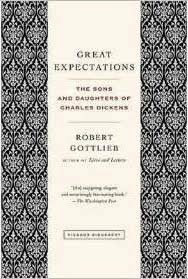
Great Expectations: The Sons And Daughters Of Charles Dickens
By Robert Gottlieb
Great expectations were what Charles Dickens had for his ten children, and he was mostly disappointed. Seven sons and two daughters grew to adulthood under the influence of a father who tried to direct how they lived their lives. He expected them to possess his tenaciousness and energy level, not realizing the difference between being the son (which he was) of a man in debtor’s prison and, as Robert Gottlieb states, being a “child of the man who was not only the world’s most famous writer but the world’s most beloved writer, and probably the best-known person in the nation apart from the Queen.”
Great Expectations: The Sons and Daughters of Charles Dickens traces the lives of these children. The author, Robert Gottlieb, is former editor-in-chief of Simon and Schuster and of Alfred A. Knopf, as well as editor of The New Yorker. He introduces his theme with these words: “Dickens’s death freed them all from his immediate influence, but by dividing their individual biographies into two sections—pre- and post-1870—I hope to emphasize that they never really transcended his decisive effect on them.”
Nine months after Catherine Hogarth married Charles Dickens in 1836, she gave birth to their first child, Charley. Their tenth child (not counting miscarriages) was born in 1852. Then, in 1858, Charles expelled Catherine from the home. This was shortly after he met Ellen Ternan, who would be his secret mistress until his death in 1870. He considered Catherine lazy and weak, and he blamed her for raising indolent sons. Her sister, Georgina, then helped Charles raise the younger children. This situation shows the power of his personality, that people were willing to go along with what he wanted.
“Dickens eliminated his wife from his life and to a considerable extent cut his children off from their mother, whom, despite his disclaimers, they also loved,” Gottlieb writes. “The children lived with him and their Aunt Georgina, and although their mother could always see them in her own home, they knew that he disliked it when they visited her. They were forbidden to speak with the rest of her family, including their grandmother.”
Charley was 21 when the split occurred, and he accompanied his mother, after writing to his father, “Don’t suppose that in making my choice, I was actuated by any feeling of preference for my mother to you. God knows I love you dearly . . . I hope I am doing my duty, and you will understand it so.” After several failed business attempts, Charley eventually found his calling–as editor of his father’s successful magazine, All the Year Round. Gottlieb writes parenthetically: “We may ask ourselves again why Dickens hadn’t recognized his affinity for literary journalism earlier on and pointed Charley in its direction: Clearly, he was more suited to the world of literature than to commerce or the army.”
When son Alfred wanted to go overseas, Dickens suggested Australia, a country that intrigued him. According to Gottlieb, “Dickens threw himself into his typical practice of making connections for his boys—writing or calling on distinguished and/or successful men who could introduce the newly arrived emigrant to other potentially useful connections.”
Dickens proudly obtained a Royal Navy appointment for Sydney, who wanted to be a sailor. But Sydney’s spendthrift ways so angered his father that Dickens wrote to another son, shortly before his own death, “I fear Sydney is much too far gone for recovery, and I begin to wish that he were honestly dead.”
The eldest daughter, Mamie, lived happily with her father until his death. Then she became a wanderer without husband or career. Gottlieb says she “never really got beyond that childhood. First, she prolonged it by staying unmarried and living at home with Dickens as an indulged girl into her thirties. After 1870 and his death, she never found anything in life to compare to what was gone.”
Plorn, the youngest, was Dickens’s favorite child: “We have in this house the only baby worth mentioning; and there cannot possibly be another baby anywhere, to come into competition with him.” Plorn’s extreme shyness led Dickens to withdraw him from boarding school and have him privately tutored. But Dickens then decided Plorn had “want of application” and should be sent overseas to be toughened. He arranged for Plorn to join Alfred in Australia, and he wrote of saying farewell to his 16-year-old son: “It was a sad parting, for he had been the baby all his life, and was the pet at home. He went away bravely, but we all broke down at last, I am afraid.”
Great Expectations is well-researched and easy to follow. Gottlieb draws heavily on the voluminous correspondence from Dickens himself, one-sided because Dickens “destroyed in enormous bonfires the thousands of letters he had received through the decades,” Gottlieb tells us. Written reminiscences by three of the children also provide valuable source material. Direct quotations in the book are numerous but not overdone. The only thing that bothered me was Gottlieb’s frequent disruptive insertion of present tense in the earlier part of the book: “Father and son have another long talk, and Dickens again advises against the army.”
Charles Dickens comes across as an egotistical man who placed his children’s interests second to his own. As adults, they routinely expressed their love for him in a manner consistent with what society now recognizes in abused children. “It is easy to condemn Dickens as an over-demanding, even harsh, father, but he was also a loving, generous, and involved one,” Gottlieb writes. “He was at his best with the little ones; once they approached adolescence, he retreated.”
Gottlieb wraps up with a chapter on “Dickens’s Other Children,” and he concludes, “There was, in fact, almost no overlap between the real children and the imagined ones. . . . [Dickens] is the sufferer for whom all his tragic child victims are stand-ins.”
Great Expectations held my attention because I wanted to learn what happened to each of the children. This story illustrates how we as parents influence our children’s lives, not always in the way we intend.