
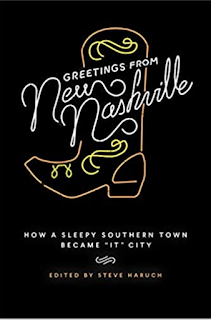
Greetings From New Nashville: How A Sleepy Southern Town Became “It” City
Edited by Steve Haruch
Nashville, Tennessee, has always been one of my favorite cities, due to the Grand Ole Opry and other country music connections. In recent years, I’ve been a frequent visitor while writing and promoting several biographies. I eagerly delved into Greetings from New Nashville: How a Sleepy Southern Town Became “It” City.
Steve Haruch is a Nashville writer, editor, and filmmaker who selected twenty essays to explain Nashville’s explosion in growth and popularity. The number of tourists increased from two million in 1998 to fifteen million in 2018, and the city’s population—without changing physical boundaries—increased by 150,000. A New York Times article named Nashville “the nation’s ‘it’ city” in 2013.
It’s no wonder Haruch chose 1998 as the year Nashville became a “real city.” He explains in the introduction why 1998 was a turning point for Nashville. It marked the death of famed Music Row producer Owen Bradley and, after 122 years of daily publication, the demise of The Nashville Banner. The tornado that hit East Nashville in 1998 resulted in an influx of insurance money and rebuilding. The Nashville school board succeeded in ending decades-old court-ordered busing, and a statue of Ku Klux Klan leader Nathan Bedford Forrest was erected on private property overlooking I-65. An advocacy organization for urban renewal began operation. Two new stadiums had been built for the two major league teams that came to town—the Predators in the National Hockey League and the Tennessee Titans in the National Football League.
The book’s first essay, “Nashville’s Band of Outsiders,” was written by award-winning novelist Anne Patchett. She summarizes Nashville’s country music industry, old and new. Contrasting the music in Nashville’s clubs to what is heard on the radio, she writes, “It feels like the music that happens when talented country folk get together, as opposed to the music that happens when talented producers hire pretty girls.”
Other essays cover the political climate over two decades. To attract business, Nashville put millions of taxpayer dollars into building stadiums that destroyed rather than rebuilt existing neighborhoods. “Demolition Derby” warns that “rapid development is producing a dire consequence: a growing number of low-income residents getting bumped out of their neighborhoods.” Some neighborhoods now contain new apartment buildings in which previous tenants cannot afford to live. Longtime homeowners can no longer afford their property taxes.
With the help of three decades of court-ordered busing, Nashville had led the nation in statistical desegregation, After busing ended in 1998, Nashville regressed to the mean. Ansley Erickson in “Desegregation and Its Discontents” wonders “how assertively the city will value the schooling of its children, naming equity as a goal and attending directly to the black and poor children Nashville has historically neglected most. Those students today are most likely to attend sharply segregated schools.” In 2018, Nashville voted to establish a strong community oversight board to reform police practices. “Who Will Hold the Police Accountable?” discusses the needs and hopes concerning that issue.
“Burned Out” is an essay about an original Nashville food, hot chicken. At Prince’s Hot Chicken Shack in the 1950s, Zach Stafford explains, “black people ate in the front while white people ate in the back, a radical inversion of Nashville’s Jim Crow laws at the time. It’s no wonder that hot chicken remained an underground dish, exclusive to Nashville’s black community for decades: White people in Tennessee didn’t want to be seen eating it in public.” Following decades of hot chicken’s increase in popularity, its origins were ignored when a food magazine credited a white restaurant chef with launching the hot chicken craze.
“Dish Network” discusses Nashville as a culinary destination. The city has also developed a major bachelorette-party industry, as described in “Welcome to Bachelorette City,” in which Nashville journalist Steven Hale writes, “It is an overwhelmingly white phenomenon, which is not all that surprising. Nashville’s political and cultural power structure has historically been white, and after all, so has country music.”
I thoroughly enjoyed Greetings from New Nashville and the perspective it provides. Nashville is about so much more than music. My eyes were opened concerning its cultures, racial issues, industries, people, and places to visit. This is a book for anyone who cares about Nashville, as well as a source for those interested in the struggles a city faces in balancing all issues that make for the betterment of its citizens.