
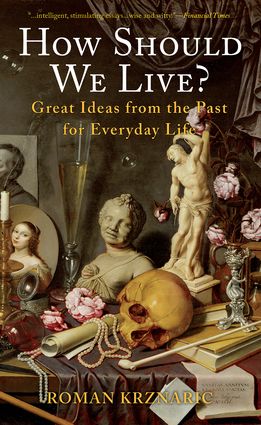
How Should We Live? Great Ideas From The Past For Everyday Life
By Roman Krznaric
How Should We Live? Great Ideas from the Past for Everyday Life was first published in 2011 and is being reissued in 2014. “I believe the future of the art of living can be found by gazing into the past,” writes author Roman Krznaric in the preface. “If we explore how people have lived in other epochs and cultures, we can draw out lessons for the challenges and opportunities of everyday life.”
One of Great Britain’s leading lifestyle philosophers, Krznaric believes learning from history helps us to identify improved ways of living and to recognize attitudes we’ve inherited from ancestors. We may choose to accept these legacies that shape our world views, or “we may reject them and cut ourselves free from an unwanted inheritance, ready to invent anew.”
How Should We Live? is drawn from three thousand years of human history, mostly European and North American, but also from Asia and the Middle East. The book analyzes twelve topics, grouped into four categories: Nurturing Relationships, Making a Living, Discovering the World, and Breaking Conventions.
The first topic is Love. Krznaric debunks what he calls “the potent myth of romantic love” and describes six varieties of love espoused by ancient Greeks: eros (sexual passion), philia (friendship), ludus (playful affection), pragma (mature love/commitment), agape (charity), and philautia (self-love). He suggests we focus less on finding “true love” and more on asking ourselves, “How can I cultivate the different varieties of love in my life?”
In the chapter on Work, Krznaric tells us “the difficulties of choosing a career are a modern dilemma. For centuries, human beings had little choice about the work they undertook. The way they earned their daily bread was largely a matter of fate or necessity.” The shift from fate to choice gained momentum–at least in Europe–with the growth of public education and meritocracy (rewarding skills and aptitude). Krznaric describes four main work purposes that motivate human beings: being driven by values, pursuing meaningful goals, obtaining respect, and using one’s full array of talents.
The travel industry, in the form of package vacations, began in the 1840s in England when Thomas Cook, a Baptist preacher, organized a train trip to a temperance meeting in a nearby town. He wanted to offer poor working people a respite from routine labor and a chance to broaden their minds through cultural encounters. Travelers can be pilgrims, tourists, nomads, or explorers. The author suggests we consider what kinds of journeying might transform our approach to the art of living. It’s more about observation than destination.
Deathstyle, in the section on Breaking Conventions, is the last topic. Krznaric describes today’s cemeteries as “solemn and empty places . . . full of neatly clipped grass and polished headstones.” He contrasts this with 600 years ago when “they were the equivalent of city shopping malls . . . where you could find tradesmen selling wine, beer and linen . . . . People would stroll, socialize and make merry amongst the graves.” Today’s increased life spans and improved medical facilities have distanced us from experiencing death around us. Krznaric believes we need to breathe the air of death, as well as the air of life, to recognize “the true value of life means understanding that it could so easily be lost.”
How Should We Live? encourages individuals to expand their horizons and set “new standards for future generations” who can use our lives as sources of inspiration for their own. The historical tidbits are enjoyable and informative to read, such as how family conversation at the dinner table has evolved over time. Voluminous research went into this book, and I didn’t find reason to argue with the paths traced or the author’s conclusions. Whether the stories will motivate many readers to change their lives is unlikely, though, and it would take a lot of individuals to change society.
“If we wish to incorporate the lessons of history into our own lives,” the author challenges his readers, “we may have to defy cultural norms and risk standing out from the crowd. This could well happen if we choose to resign from a well-paid job to pursue a career that better reflects our values, or if we live in a home without a television set, or start talking about death at dinner parties.”
For those readers seeking a life change, How Should We Live? offers suggestions and encouragement. For those seeking information, it offers provocative ideas. Either way, Krznaric urges us to “open the wonderbox of history” to find “new and surprising possibilities for the art of living.”