
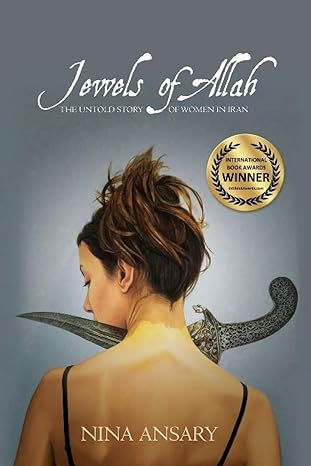
Jewels Of Allah: The Untold Story Of Women In Iran
By Nina Ansary
Jewels of Allah: The Untold Story of Women in Iran reveals “how a full-blown feminist movement developed and grew in the patriarchal climate of post-revolutionary Iran,” says author Nina Ansary. To illustrate the opposite lifestyles and beliefs portrayed in the book, she mentions her two grandmothers. One was a devout woman “who never left her home without wearing a head scarf,” and the other was western-educated and progressive-minded.
Ansary, born in Tehran, Iran, left her home country at age twelve, when her family moved to the United States at the onset of the 1979 Islamic Revolution. She earned a Ph.D. in History from Columbia University and now lives in Los Angeles. She wrote Jewels of Allah to reconnect with the history of women in her native land and to “contribute in some small way to their ongoing struggle for empowerment.” All proceeds from the book will go to philanthropic organizations, mostly those that empower disadvantaged young women in Iran.
Jewels of Allah begins with a brief history: “Twenty-five centuries ago in ancient Persia, women were in some ways more liberated than they are in modern Iran.” Ansary explains, “Simply put, male and female are seen as being equally represented in earth’s creation.” That disappeared with the Arab invasion in the seventh century and Persia’s subsequent conversion to Islam. (Persia changed its name to Iran in 1935.) Ansary’s story of women is interwoven with a chronicle of the governing dynasties throughout recent centuries. Her focus is solely on the treatment of women, and she keeps political opinions to herself.
The Pahlavi Dynasty emerged in 1925 and ushered in an era of westernized education and dress. This included abolishment of the veil in 1935. Ansary writes, “Vehemently opposed to the new unveiling law, religious families kept their daughters at home.” The Pahlavi attempt to modernize Iran and improve its standing in the world included coeducational schools. Many parents did not want their daughters in schools with boys. Thus, policies that allowed thousands of girls to get an education also kept thousands of them out of school.
Then came the Islamic Revolution in 1979, with the overthrow of the Pahlavi monarchy by Ayatollah Khomeini and his followers. The institution of Islamic law dismantled the progressive Pahlavi agenda and stripped women of their civil rights. In spite of dire consequences because of oppressive new rules, there were unexpected benefits. Once the traditional atmosphere returned, many women who had stayed home to avoid being seen unveiled in public, and those not allowed to participate in westernized coeducation, now enjoyed freedom to move about and attend school.
The literacy rate for Iran’s female population in 1979 was 35 percent. Although Khomeini did not intend to empower women, the return to single-sex schools and compulsory veiling played a role in increasing the female literacy rate to 80 percent by 2007.
Ansary describes international research that supports the benefits of single-sex education. She explains how subliminal messages in Iranian textbooks served to empower women. The Khomeini-era textbook changes failed to delete photos of families interacting and women participating in public events: Although the photos showed female instructors teaching girls and male instructors exclusively in boys’ classrooms, most other photos showed boys and girls together in various leisurely activities.
I enjoyed the irony of how a government that professed to educate everyone failed to do so and a government that sought to keep women in domestic roles has inadvertently educated and empowered them. At least, that is the message I absorbed from this book.
Ansary leads readers through Jewels of Allah with comments such as, “In this chapter, we will explore,” “we will examine,” “we will also survey . . . .” Her conversational tone and explanatory style make the dense material easier to understand, especially for someone unfamiliar with all the names.
The epilogue, “Exemplary Women of Iran,” contains photos and mini-bios of a hundred or so Iranian women throughout history who have advocated for female empowerment. There is the first Iranian woman to earn a pilot’s license, the first to start an opera company, the first film director, and the first Iranian woman in space. The women range from the military strategist Sura of Parthia in AD 213 to today’s head of security at Google Chrome, Parisa Tabrizi.
My overwhelming feeling after finishing Jewels of Allah is gratitude–for my country and my freedoms. I am also grateful for the opportunity to peek into an unfamiliar culture, and I recommend the book for those reasons. It covers a variety of issues, from women’s inheritance rights to freedom of expression to professional opportunities.
While Ansary’s main focus is encouraging Iranian women to continue their fight for equality, she also educates the rest of us on the complexities of this culture. “Even within a repressive environment,” she says, “girls who are exposed to empowered female role models through books and a decent education—and who are free to learn and express themselves in a girls-only classroom—have a fighting chance.”