
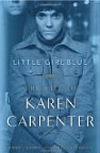
Little Girl Blue: The Life Of Karen Carpenter
By Randy L. Schmidt
Karen Carpenter is almost as famous for her anorexia nervosa death as for being lead singer of the duo, The Carpenters, in the 1970s. Little Girl Blue: The Life of Karen Carpenter encapsulates two decades of research by author Randy Schmidt. He became fascinated with Karen when he watched the made-for-TV movie, The Karen Carpenter Story, as a teenager in 1989, six years after her death. “There was something about the way that film presented the pathos of her story, atop the soundtrack of her sometimes optimistic but often mournful voice, that drew me in,” Schmidt writes in an author’s note. “I wanted to know more. And I have spent many years searching for those answers.”
He found answers by talking to friends and associates whose opinions had previously gone unheard. Karen’s family approved the content of the movie and one earlier biography. By the time Schmidt wrote his biography, the parents were dead and Karen’s brother declined to comment. Thus, Little Girl Blue could be written with a broader perspective.
The Carpenter family moved from Connecticut to Los Angeles in 1963, partly so son Richard could pursue a career as a pianist. In 1966, Richard (age 19) and sister Karen (age 16) formed a band, with Karen on drums and vocals and Richard on piano. In 1969, they signed with A&M Records, co-owned by Herb Alpert, leader of the Tijuana Brass. Their first hit was “(They Long To Be) Close To You” in 1970.
Recordings such as “We’ve Only Just Begun” and “Top Of the World” followed, and the Carpenters spent the decade touring the world. Between 1970 and 1976, every one of their single releases reached number one or two on the Adult Contemporary chart. On the pop charts, they had 16 consecutive Top 20 hits and five Top 10 albums. The duo won three Grammy Awards and an American Music Award.
Little Girl Blue recounts with excruciating detail the songs recorded and the musicians on each recording session. The book comes across as half musical history and half biography, which is fine for readers looking for history and too detailed for those interested mainly in Karen’s story.
The two things Karen wanted most in life were her music and her mother’s love. But both apparently belonged to Richard. He controlled her songs, her appearances, and her singing style, almost as if she were one of his musical instruments. He was also their mother’s obvious favorite.
Sherwin Bash, their first manager, states, “Over the years, Karen Carpenter became beloved in the world as a very special artist, a very special voice, who reminded everybody of the daughter they wished they had. In her own home she never was told or maybe never even felt that existed from her own parents, especially her mother.”
Schmidt summarizes the opinion of housekeeper Evelyn Wallace by saying, “Karen was well aware of her second-place ranking in the home and perhaps even felt it was justified. Agnes’s adoration for her firstborn–to the point of idolization, according to some–was emulated and even proliferated by Karen.”
When Karen wanted to record a solo album, her family objected. According to the author, Agnes “was fearful a temporary split might lead to a permanent separation and the end of her son’s career.” Karen went to New York City to record an album she and her producer brought back to Los Angeles with pride. Sadly, it was rejected by Richard and her record label and not released until after her death.
The singing star wanted to marry and have children, and she fell for a wealthy man who wooed her with great attention. Karen brushed aside her friends’ suspicions about his wealth and character. The night before their extravagant wedding ceremony, her fiancé admitted he’d had a vasectomy. “Karen felt betrayed,” the author writes. “Tom had lied to her; he had withheld the information for the duration of their courtship and engagement, knowing full well that starting a family was at the top of Karen’s list of priorities. This was a deal breaker. The wedding was off.” Her friends hated to see her in pain but were glad she’d decided not to marry him. Karen called Agnes, who talked about the expense and the preparations and then told her 30-year-old daughter, “The wedding is on, and you will walk down the aisle.” She added, “You made your bed, Karen. Now you’ll have to lay in it.”
With her musical career and personal relationships closely controlled by her brother and her mother, Karen controlled the only thing she could–her body. On February 4, 1983, the day she planned to finalize her divorce, Karen died of complications associated with anorexia nervosa. She was 32 years old.
Little Girl Blue is an objective telling of Karen’s life. Interviews with numerous friends and musicians provide a more accurate picture of the Carpenter family than had been depicted in the 1989 movie. Richard’s conversations with previous interviewers are included to add his important perspective.
Several out-of-sequence events detracted from the overall smoothness, the main one being Richard’s problems with drug addiction. After a chapter about the Carpenters’ traveling and recording and relationship issues, the author flashes back in the next chapter to describe Richard’s health problems and drug use. That information should have been blended into the previous chapter where it occurred. Another example is Carol Curb, whom the author quoted numerous times without an introduction. I thought she must have married Karen’s former boyfriend, Mike Curb. Several chapters later, we learn that Carol and Mike are siblings.
These minor flaws don’t detract from the telling of this talented and tormented woman’s story. Little Girl Blue: The Life of Karen Carpenter is a must read for anyone who wants more knowledge of the Carpenters or the 1970s era of popular music.