
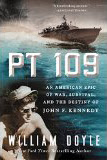
Pt 109: An American Epic Of War, Survival, And The Destiny Of John F. Kennedy
By William Doyle
PT 109: An American epic of War, Survival, and the Destiny of John F. Kennedy makes a strong case that Kennedy might never have become President of the United States without the publicity generated by the saga of his war heroism.
William Doyle, a New York Times bestselling author and historian, expands the well-known PT 109 story and documents its ongoing key role in the political career of a future senator and president. Kennedy’s patrol boat was sliced in half by a Japanese destroyer during World War II and his crew shipwrecked. The young commanding officer swam for miles in search of rescue, and he towed a burned crewmember by holding a strap in his teeth. Doyle includes the perspectives of the Japanese destroyer commander and the PT boat commander who eventually rescued the crew.
John F. Kennedy joined the U.S. Navy at the beginning of World War II. Despite his fragile health and frequent illnesses, he yearned to be in combat. He was fascinated by the small patrol torpedo (PT) boats and the idea that a junior officer could command them. These new fast-attack boats, with a crew of twelve, carried four torpedoes and ten depth charges. His father, Joseph P. Kennedy, finagled an assignment for him in this unique naval community. “Even if he hadn’t been the son of a powerful man,” Doyle writes, “Kennedy appeared to be an excellent candidate to command a PT boat, given his intellect and experience piloting small craft. What almost no one else knew was that by now Kennedy’s back troubles were so severe he had spent almost two months earlier that year [1942] in hospitals, and doctors recommended corrective surgery.”
Lieutenant (junior grade) Kennedy took command of Motor Torpedo Boat 109 (PT 109) on April 25, 1943. Half of Doyle’s book, PT 109, is devoted to the week of August 1-7, 1943: the mission, the sinking, the rescue attempts, and the actual rescue of the crew. The second half explains how Joseph Kennedy used this incident to turn his son into a war hero, and how “the event crucially shaped his public image from ‘child of privilege’ to ‘battle-tested combat veteran’ and helped propel him into the House of Representatives in 1947, into the U.S. Senate in 1953, and into the White House in 1961.”
In 1951, when Kennedy was campaigning for election to the U.S. Senate, his father sent him on a world tour. Doyle relates, “The trip would climax, the elder Kennedy decided, in Japan, for a startling photo opportunity that could generate headlines and attach his son’s name and face to a historic image of grace, humility, and mature diplomacy. John F. Kennedy would go to Japan, track down a former Japanese Imperial Navy officer—and embrace the man who nearly killed him.”
Kennedy, however, never did meet Kohei Hanami, former commander of the Japanese destroyer Amagiri, but they did establish a correspondence. Kennedy wrote to Hanami, “Your letter was most helpful and we released it to the press with very beneficial results and I think it helped build good will between our two countries.” Doyle includes several of these letters in an appendix.
Even the 1963 Cliff Robertson movie, PT 109, was a Kennedy-controlled production, based on a book by Robert Donovan. “As an ‘authorized’ account produced in cooperation with a sitting president,” Doyle tells us, “the book was highly favorable to John F. Kennedy.” About the film, he says John and Joe Kennedy “tightly controlled key aspects of the project, demanding (and obtaining) veto power for approval of script, director, and cast.” The movie flopped, losing over one million dollars for Warner Brothers.
Doyle offers a balanced portrayal of the sinking and aftermath of PT 109. He addresses and refutes accusations that Kennedy’s decisions led to the actual crash. He explains how the entire crew, throughout their lives, uniformly admired and praised their leader. “Lieutenant Kennedy was one hell of a man,” crewmember William Johnson said. “I didn’t pick him for my skipper, but I kept thanking God that the Navy had picked him for me.”
New details of the PT 109 episode include previously unpublished Japanese connections and recent interviews with Kennedy associates. Doyle presents a compelling theory and supporting facts of how the Kennedys used the PT 109 saga as an effective campaign tool. “The Oval Office soon filled up with mementos of the PT 109,” Doyle writes about the new President Kennedy, “talismans from the event that paved his path to power.”
PT 109: An American epic of War, Survival, and the Destiny of John F. Kennedy is written in a conversational tone and supplemented with photos, source notes, and an index. As a Kennedy fan and U.S. Navy officer, I highly recommend this fascinating account.