
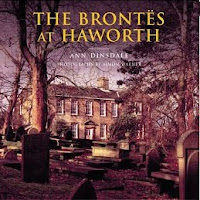
The Brontes At Haworth
By Ann Dinsdale
Charlotte Bronte’s Jane Eyre and Emily Bronte’s Wuthering Heights are two of the most enduring classics of English literature. The softcover release of Ann Dinsdale’s The Brontes at Haworth, originally published in 2006, carries on a 160-year tradition of discussing and preserving the Bronte legacy. Dinsdale is the librarian at the Bronte Parsonage Museum in Haworth, West Yorkshire, Great Britain, where the world’s largest collection of Bronte writings and memorabilia is preserved.
The parsonage in Haworth became home to the Brontes in 1820, when curate Patrick Bronte moved his young family there. His wife died in 1821, leaving behind six children aged one through seven. The two eldest daughters died of tuberculosis in 1825, Maria at age 11 and Elizabeth at 10.
The remaining children, Charlotte, Branwell (the only boy), Emily, and Anne grew up as an insular unit with a world view mostly gained from books. They developed and sketched their own fantasy worlds of Angria and Gondal. Boarding school attempts were short-lived. Unusual for the time, Patrick believed in the intellectual capability of girls, and he encouraged their writing and their imagination.
In 1846, the three sisters paid to publish a book of poems under the pseudonyms of Curer, Ellis, and Acton Bell. They chose men’s names, Charlotte later wrote, because “we had a vague impression that authoresses are liable to be looked on with prejudice.”
The following year, Curer Bell’s Jane Eyre became an immediate sensation when published in 1847. Novelist W.M. Thackeray wrote to the publisher, “I wish you had not sent me Jane Eyre. It interested me so much that I have lost (or won if you like) a whole day in reading it at the busiest period. . . . Who the author can be I can’t guess–if a woman she knows her language better than most ladies do, or has had a ‘classical’ education.”
Emily’s Wuthering Heights and Anne’s Agnes Grey were published two months after Jane Eyre, using their Bell pseudonyms. All three sisters drew upon siblings, local homes and landscapes, and personal experiences in developing their stories. Jane Eyre’s experience at Lowood School mirrored that of Charlotte at boarding school. According to Dinsdale, “Wuthering Heights, with its air of decayed grandeur, owes much to the Gothic novels of the late eighteenth century. The characters belong to the fictional world of Gondal and were drawn from Emily’s imagination.” Agnes Grey relates Anne’s experiences as a governess.
By the time the women’s identities were discovered, Emily and Anne were dead. They and Branwell died of tuberculosis, Branwell in September 1848 at age 31, Emily three months later at age 30, and Anne in May 1849 at 29. Charlotte died during pregnancy in 1855 at age 38, almost a year after becoming the only sibling to marry. Patrick outlived all his children, continuing to reside at the Haworth parsonage until his death in 1861.
The Bronte Society was formed in 1893, and the house became the Bronte Parsonage Museum in 1928. In The Brontes at Haworth, Dinsdale describes the society as having “evolved from a small group of enthusiasts mainly based in Yorkshire into a worldwide literary body. Today it continues to care for the family’s former home and to carry out its founding aim: to collect, preserve, publish and exhibit material relating to the Brontes’ lives and works, and make them known to a wider audience.”
The Brontes at Haworth consists of 25 short and well-organized chapters, covering the Brontes, their individual books, the parsonage, Bronte society, Bronte biographers, and the family’s legacy. All chapters are illustrated with photographs of present day scenery, such as specific houses believed to be models for homes in the novels, and Bronte memorabilia in the museum.
Quotes bring the Brontes to life, such as Charlotte’s recollection of Patrick giving her a packet of her mother’s letters: “The papers were yellow with time all having been written before I was born—it was strange to peruse now for the first time the records of a mind whence my own sprang . . . I wished She had lived and that I had known her.” After Branwell’s death, Charlotte wrote, “Branwell was his Father’s and his sisters’ pride and hope in boyhood, but since Manhood, the case has been otherwise. . . . There is such a bitterness of pity for his life and death—such a yearning for the emptiness of his whole existence as I cannot describe.”
Dinsdale’s unfettered access to Bronte materials and research has allowed her to give a comprehensive overview of what she calls “a world-famous literary shrine.” The Brontes at Haworth will encourage readers to want to visit Haworth—and perhaps discover the other novels. Although many have enjoyed Jane Eyre and Wuthering Heights, fewer know about Charlotte’s three additional novels and the two by Anne. I am reading them now.