
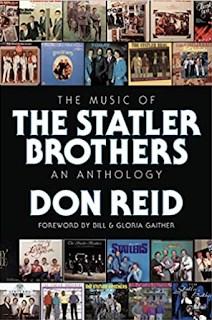
The Music Of The Statler Brothers: An Anthology
By Don Reid
The Statler Brothers spent almost four decades touring and recording as one of the top draws in country music. Brothers Harold and Don Reid, along with Phil Balsley and Lew DeWitt, two boyhood friends from their hometown of Staunton, Virginia, joined the Johnny Cash show as the Statler Brothers in 1964. While never losing their Southern Gospel roots, they quickly gained national attention with their first country hit, “Flowers on the Wall.”
Don Reid, the quartet’s lead singer and primary songwriter, has authored The Music of The Statler Brothers: An Anthology to document the 42 albums they recorded. Not the usual definition of anthology as a collection of poetry or other people’s work, this is a collection of memories. Reid mentions every song on every album, along with every song recorded but not released on an album. He discusses writers, lead and harmony parts, session musicians, photos for album covers, and circumstances surrounding recording or performing a particular song. Addressing the frequent simplistic musical arrangements, he says, “We often did that consciously so the music would not get in the way of the lyric. More often than not, we were selling words just a little more than we were music.”
The book is dedicated to longtime Mercury Records producer Jerry Kennedy, who allowed the Statler Brothers the freedom to use their own artistic ideas on their recordings. As Reid finished writing each chapter of his anthology, he sent it to Kennedy and brother Harold for comment. Sadly, Harold died after the completion of the book and before its publication. Both brothers’ children also contributed by discussing the songs they had written for the quartet.
“Was it coincidence that four kids who grew up together happened to like to sing?” Reid ponders. “Coincidence that they had four different voices ranging from bass to tenor? Or that one was an accomplished guitarist and one was a natural comedian? Or that three of the four of them were songwriters? When you believe in God, you don’t believe in chance.”
An ideal way to read this anthology would be sitting next to a stack of Statler Brothers albums or with YouTube access. Then you could listen to every song as Reid describes it. He talks to the reader, as if we have pulled up the song to hear it along with him. For example, he describes the recording of “Woman I Still Love” as “the best solo I’ve ever heard Lew sing. Listen to it with your eyes closed.”
Reid marvels at how their childhood idols later became their friends. Gene Autry, the original singing cowboy, had been their childhood hero. Making reference to The Statler Brothers Show, Reid writes, “We grew up watching him and now he was watching us.” He recalls watching Pat Boone’s first movie and writes, “From a twelve-year-old fan of his music and his movies to a friend in years to come, Pat guested a couple of times on our TV series in the nineties.” He adds, “In this business it’s sometimes hard to separate the dreams from reality.”
The anthology is filled with Reid’s admiration for specific songs, singers, melodies, and musicians. He makes revelations such as, “I’m going to tell you something right here I have never told Jimmy. Of all the wonderful songs he wrote for the Statlers through the years, this is my favorite.” Jimmy Fortune had replaced DeWitt, who retired in 1982 for health reasons. He spent the remaining two decades as one of the Statler Brothers.
The two Reid brothers wrote “Don’t Wait on Me,” which reached number five on Billboard in 1980. It included the line, “When the lights go on at Wrigley Field, I’ll be coming home to you.” The song was so popular that the Chicago Cubs invited the Statlers to sing the National Anthem during their 1988 ceremony when lights first went on at Wrigley Field.
The Music of The Statler Brothers is a must-read for fans who want to relive the memories and learn more about specific favorite songs. There may never be another family-oriented male quartet that provides such a level of musicianship and entertainment. For those unfamiliar with the Statler Brothers, this anthology will introduce them to a body of recording that brings enjoyment by listening to everything from “How Great Thou Art” to “You Can’t Have Your Kate and Edith, Too.”
Reid states, “I have come to believe in this book so much that I urge and even challenge other recording artists to do the same with their body of work. Their stories should be told and remembered.”
I strongly second that recommendation.