
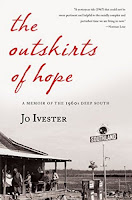
The Outskirts Of Hope: A Memoir Of The 1960s Deep South
By Jo Ivester
“Many Americans live on the outskirts of hope,” President Lyndon Johnson said in his historic 1964 War on Poverty speech. “Some because of their poverty and some because of their color, and all too many because of both. Our task is to help replace their despair with opportunity.”
The Outskirts of Hope: A Memoir of the 1960s Deep South tells the story of a white Massachusetts family who accepted that challenge. In 1967, Dr. Leon Kruger traded his successful pediatric practice for a two-year assignment to establish and run a public-health clinic in Mound Bayou, Mississippi. He and his wife, Aura, sold their home and moved with three children from Boston to the poverty-stricken, all-black town of 1,300 people.
This first-person story, written by daughter Jo Ivester in her mother’s words, consists mostly of Aura’s reconstructed journal entries, interspersed with Jo’s childhood recollections. “Both my mother and I kept journals of our time in Mound Bayou,” Ivester writes in the prologue. “Hers is the basis of the true story you are about to read. I burned mine decades ago because I was embarrassed by all that happened and couldn’t imagine ever wanting to share my story. Reading my mother’s journals, I was surprised how vividly and completely those memories came back.”
She describes how her mother objected to the move and worried about the children’s education, but acceded to her father’s wishes. “I didn’t complain,” Aura wrote in her journal. “In our twenty-five years of marriage, I never complained, even if I felt Leon was being unfair.” Two mobile homes were moved to an empty lot in Mound Bayou to provide a home for the Kruger family. Although small, the units were brand new and had air-conditioning. “It was still home,” Aura concluded.
The only modern facility in Mound Bayou, other than the new clinic, was a swimming pool that had been paid for by the neighboring town of Cleveland. As Leon explained to Aura, “One of their city council members raised a concern that with all the civil rights stuff going on, blacks might try to swim there. . . . The rest of the council was so horrified they offered to pay for a pool in Mound Bayou, in exchange for a promise that blacks would never try to swim in theirs.”
Although ten-year-old Jo and her two older brothers were the only white kids in their school, they made friends and adjusted to their new environment. The Krugers participated fully in the town’s activities, attending all the sports events and local dances. When Aura worried whether residents considered them outsiders, Leon told her, “Of course they think we’re outsiders. We are. But that doesn’t mean they don’t want us and the clinic.” Both Dr. Kruger and Aura became respected and appreciated figures in Mound Bayou. Not much is said about the clinic in The Outskirts of Hope; it focuses mainly on Aura’s role as an English teacher at the local high school, with the doctor supporting his wife as she became a civil rights advocate. She taught remedial reading, self-esteem, civil rights literature, and an awareness of the outside world. “One night over dinner,” she recorded in her journal, “Leon told me how he’d provided medical care that day for a young black teacher who had been taken to jail and beaten for the crime of encouraging her students to stand up for their rights—a crime I committed myself every day in my classroom.”
Near the end of Dr. Kruger’s two-year assignment, Jo was assaulted one afternoon in a treehouse hangout. “If the KKK finds out that four black boys attacked a white girl,” the local priest warned Aura, “they might burn down the whole town in retaliation. I hate to say it, but for the well-being of the town, I think it’s time for you to go back to Boston.” After several quickly arranged farewell parties, the family left.
While researching material for The Outskirts of Hope, Ivester returned to Mound Bayou in 2008. The town had doubled in size, and federal funds had paid for replacing shacks with actual houses. The clinic was the area’s biggest employer, and many local residents had graduated from college as medical professionals. “Forty-one years earlier,” Ivester writes, “I’d moved to Mound Bayou a naïve ten-year-old girl, believing I could handle anything that came my way. Returning as an adult, I realized that the strength I’d developed during our time there gave me the ability to do just that.” She confronted her main attacker, and he apologized “for what we did to you.”
This compelling story held my attention throughout, and the schoolteacher thread reminded me of movies such as Freedom Writers, To Sir With Love, and Up the Down Staircase. Pertinent quotes and photos at the beginning of each chapter illustrate the atmosphere of this tumultuous period in the Deep South. I highly recommend The Outskirts of Hope.