
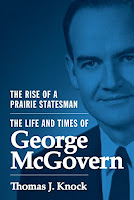
The Rise Of A Prairie Statesman: The Life And Times Of George McGovern
By Thomas J. Knock
The Rise Of A Prairie Statesman: The Life And Times Of George McGovern is the first volume of a major two-part biography on the most eloquent critic of the Vietnam War. Thomas J. Knock, a distinguished historian and teaching professor at Southern Methodist University, has written an aptly titled account of the life and times, through the 1968 elections, of this U.S. Senator from South Dakota.
George McGovern was elected to a second term in the U.S. Senate in 1968, after losing to Hubert Humphrey for the Democratic nomination for President of the United States. The two had been close friends until divided by the war in Vietnam. Early in the Presidential campaign, Humphrey picked up the torch for President Lyndon Johnson’s bombing approach, while McGovern supported Robert Kennedy’s de-escalation desires. Then came the second Kennedy assassination. Knock writes, “Among those who knew both slain brothers, many felt the same emotion: They were more stunned by RFK’s assassination than JFK’s. McGovern was definitely one of these.”
Kennedy supporters saw McGovern as best suited to carry the antiwar message, and he agreed to enter the race. Knock describes McGovern’s influence even though losing the nomination fight: “A year earlier [McGovern] could not have guessed that over 40 percent of the delegates would adopt his position on the war against LBJ’s policy and that they would constitute as powerful a wing of the Democratic Party that they now did.”
McGovern had grown up in Mitchell, South Dakota, the son of a Methodist minister who was determined his four children would all attend college. George had a rocky start in school. “Because he was so painfully shy, the first grade was a nightmare,” Knock writes. “His teacher began to interpret his reticence and stammering as a lack of intelligence. By year’s end she had doubts about promoting him.” George’s mother, who had taught him to read at home, insisted he be promoted to the second grade. He developed into a star on the Mitchell High School debate team and furthered that reputation at Dakota Wesleyan College. The ongoing second world war was the major topic in national collegiate debate. McGovern signed up for the Army Air Corps prior to receiving his draft notice in early 1943. At age 22, he took his B-24 aircrew into combat in Cerignola, Italy.
A defining moment occurred at the end of his twentieth bombing mission, when his crew dislodged a bomb that landed directly on a farmhouse. “The crew returned to base to learn that George had become a father,” Knock writes. His wife, Eleanor, had given birth to their first child. “The thought kept creeping back into his mind that he probably had wiped out an innocent family . . . and maybe the Austrian farmer’s wife also had recently had a baby.” It made him feel different for the rest of the war–and the rest of his life.
Upon McGovern’s return to South Dakota, he finished his college degree, earned a Ph. D in history at Northwestern University in Evanston, Illinois, and became a professor at Dakota Wesleyan College. In 1956, he ran for the U.S. House of Representatives and unseated the Republican four-time incumbent, Harold Lovre. Honoring a commitment from ten years earlier to “be a part of that postwar effort to build a structure of peace,” McGovern headed off to Washington, D.C. He was the first Democrat sent by South Dakota to the U.S. Congress in 20 years.
This thoroughly researched and well-documented biography includes the history of South Dakota politics in the mid-twentieth century, the Democratic Party leadership during that period, and the buildup to the Vietnam War. One chapter is devoted to McGovern’s term as director of President John Kennedy’s new “Food For Peace” organization, with its resulting benefits around the world. Knock also describes McGovern’s chagrin upon watching the program fall apart in later years.
The reader moves with McGovern through his triumphs and defeats, all the while experiencing the deep struggles involved in difficult actions and decisions. One of McGovern’s highest and lowest points occurred July 27, 1968, when he gave a keynote speech in Los Angeles in tribute of Bobby Kennedy. The crowd was on its feet, chanting, “We want McGovern! We want McGovern!” At the same time, he was dealing with the news that his daughter had been arrested for possession of narcotics. He immediately caught a plane home to South Dakota.
In writing this biography, Knock acknowledges McGovern’s cooperation as “essential to the project.” He states, “Through the scores of hours of our recorded interviews between the 1990s and 2010, he was consistently gracious and generous with his time.” McGovern died October 12, 2012, at the age of ninety. “It pains me deeply that I will never have the pleasure of putting a copy of this book into his hands,” Knock says.
The 400+ pages of The Rise Of A Prairie Statesman: The Life And Times Of George McGovern are packed with historical detail. Written in an easy-to-read style, this biography is a solid reference all history buffs on this tumultuous period will want on their bookshelves. I’m looking forward to the second volume.