
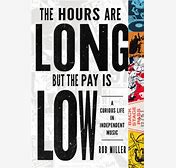
The Hours Are Long But the Pay Is Low
By Rob Miller
The title of Rob Miller’s newly released memoir, The Hours Are Long But the Pay Is Low, caught my attention and made me want to read the book. It tells the story of Bloodshot Records, a recording company Miller cofounded in Chicago in 1993. “For decades,” he writes, “music has grabbed me by the lapels, kicked me in the seat of the pants, and kept me from falling into, or pulled me out of some deep, lonely pits.”
Miller grew up in the early 1980s, a bullied youth in the Detroit school system. The many detailed descriptions of the cruelty he experienced explain how his “outsider” attitude in his music career resulted from being in survival mode throughout his teens. He escaped into the world of music performed by those not accepted in mainstream musical genres, as he built a large record collection and repertoire of musical knowledge. He worked in record stores and wrote reviews for local magazines. By the time he graduated from college in 1989, he was employed as a concert promoter. Eventually burned out by the grind, he moved to Chicago in 1991 to get away from the music business.
There, he started a painting company with “two fellow Michigan defectors” and barely made ends meet. While “rolling paint onto endless walls at jobsites,” he listened to a variety of radio stations and spent his off-time drinking in music-filled taverns. As music crept back into Miller’s life, he once again began seeking record stores and live venues to discover new sounds. At a tavern one winter night in late 1993, he and two friends decided to start a label to record the musicians they were hearing. They filled a bar napkin with a list of bands to contact and then spent the next months searching for bands to record. The bands they gathered “were glad someone, anyone, wanted to document what they were doing.”
To choose a name for their record label, the cofounders brainstormed on themes inherent to country and punk—hard-living and rebellious, songs about hangovers and bloodshot eyes. “Bloodshot it was,” Miller writes. “It sounded cowboy, but not hick, more renegade black hat Magnificent Seven Yul Brynner than hagiographic white hat John Wayne.” And what would they call their music? “It is a truism that where there are English majors and beer,” Miller writes, “there will be a thesaurus and dictionary nearby.” They ran through words like rebel, guerilla, and malcontent, settling on insurgent: “It had it all—conviction, purpose, and an antisocial, piratical flourish.” He would devote the next twenty-eight years to “championing music that lurked between genres and under the radar.”
To get an idea of what “insurgent country” sounds like, I turned to YouTube to hear several artists: Old 97’s — Scott Biram – Robbie Fulks — Cramps – Split Lip Rayford – the Meat Purveyors. Mostly enjoyable, the music emphasized to me the futility of trying to force singers and their songs into genre boxes.
The story Miller tells is often hard to follow, with the lack of chronology mixing the Detroit and Chicago days, as well as pre- and post-record label experiences. For example, Neko Case appears in chapter 14 as one of his artists, but Miller doesn’t meet her until chapter 16. The kaleidoscope of names and excessive detail is impossible to follow and sometimes overwhelming. However, Miller’s humor and descriptive skills make the overall read enjoyable. He sounds like he’d be a fun person to know.
He passes on the wisdom he learned over the years, such as the easiest way to maneuver through a crowded bar: “Follow the waitress with the tray full of drinks as she effortlessly parts the crowd like Charlton Heston did the Red Sea.” I enjoyed how, throughout the book, he used cultural references as similes, not caring whether the reader recognized the names. If you got it, you smiled. If you didn’t, you missed out.
As the label became a success, its music had to be categorized. Miller explains, “The need to pin down the music and our artists became a persistent bete noire as industry people wondered, Where do I file this, where does it fit, who, in short, will buy it?” The term “insurgent,” which had been coined out of necessity, became something of a millstone. Miller writes, “as people…ascribed their own biases to it…. Self-appointed sourpuss arbiters of authenticity quickly sought to codify what the Bloodshot sound couldn’t be, and, remarkably, began telling us what the term meant and who could claim it.”
“So what and who is authentic?” Miller wonders. “Steve Earle didn’t serve two tours in Vietnam, John Fogarty wasn’t born on the bayou, and Johnny Cash never shot a man in Reno just to watch him die.” He now answers the What is alt/insurgent country? question with candor: “It’s whatever I say it is. It’s whatever you say it is. Alt-country is not one thing.” His focus was on working with “artists looking for sustainable ways to build a career doing something they loved.” He never cared about “authenticity” or fitting into a category when it came to music. Miller himself is, however, authentic. And so is The Hours Are Long But the Pay Is Low.