
Diane’s Country Music Newsletter — 29 April 2026
NEWS
Country Music Hall of Fame songwriter Don Schlitz, 73, died April 16 at a Nashville hospital after a sudden illness, reports MusicRow. Born (in 1952) and raised in Durham, North Carolina, he moved to Nashville at age 20. His first cut came in 1978 when Kenny Rogers recorded “The Gambler.” He wrote fifty top 10 songs, including “The Gambler,” “On the Other Hand,” “Forever and Ever, Amen,” “He Thinks He’ll Keep Her,” “The Greatest,” and “When You Say Nothing At All.” He was inducted into the Nashville Songwriters Association Hall of Fame in 1993, the Songwriters Hall of Fame in New York in 2012, and the Country Music Hall of Fame in 2017. In 2022, he became the only non-artist songwriter inducted as a member of the Grand Ole Opry in the show’s 100-year history.
Following the death of Don Schlitz, Tennessee Representative Steve Cohen, 76, offered a musical ode on the floor of the U.S. House of Representatives, reports The Hill. He sang the 1978 Kenny Rogers hit, “The Gambler,” and he said, “Don Schlitz was 23 years old when he wrote that song. He was one of the greatest songwriters of our time.” After listing several of Don’s other songwriting hits, he said, “He was also a friend of mine. He used to call me ‘his congressman,’ even though he lived in Nashville and I was in Memphis.”
In a recent interview with Sky News, Billy Ray Cyrus, 64, explained why he performs for both Democratic and Republican presidents: “My dad was a Democrat and served in the Kentucky legislature for over 20 years. But my dad always said, ‘When the president asks you to do something, you do it, son.’” He most recently performed at President Donald Trump’s inauguration in January 2025. He has also served with Presidents Bill Clinton, Barack Obama, George W. Bush, and George H.W. Bush.
Country Insider reports the death of Nashville session guitarist Wayne Moss, 88, on April 20. Born in West Virginia in 1938, he moved to Nashville in 1959 and joined Brenda Lee’s touring band, the Casuals. As a Nashville session musician, he played the signature guitar riff on “Oh, Pretty Woman” (Roy Orbison) and the guitar solo on “Only Daddy That’ll Walk the Line” (Waylon Jennings), as well as recording with Patsy Cline, Loretta Lynn, Dolly Parton, Charley Pride, Tammy Wynette, Joan Baez, Linda Ronstadt, Bob Dylan, and many others. In 1961, Moss founded Cinderella Sound Recording Studio, which is Nashville’s oldest continuously operating studio. He co-founded the Escorts band, as well as Area Code 615 and Barefoot Jerry. He spent 15 years in the house band on Hee Haw. He was also a songwriter. The Country Music Hall of Fame honored Wayne Moss as a Nashville Cat in 2009, and he was inducted into the West Virginia Music Hall of Fame in 2013.
Don Carter, 93, died in his sleep on April 20, 2026, in Coppell, Texas. Born Donal Jewel Carter in 1933 in Hunt County, Texas, he grew up as a sharecropper’s son. He spent his early years picking cotton in Hunt County and writing songs in the fields. He and his uncle, Dub Nalls, formed a team in which Don wrote the songs and Dub handled the business. While in the Army in Germany in the early 1950s, he learned that Elton Britt had recorded the first song he wrote, ”Lonesome River.” He returned home and continued writing songs during his careers at Affiliated Foods in Dallas and in the insurance industry. He appeared on the Louisiana Hayride and had a songwriting hit with the Jim Reeves recording of ”How Can I Write on Paper (What I Feel in My Heart)” in 1961. His songs were recorded by George Jones, Skeeter Davis & Bobby Bare, Merle Haggard & Bonnie Owens, The Browns, Ray Price, Wilma Burgess, Gene Vincent, Boxcar Willie, and most recently by Justin Trevino. During his final trip to Nashville, Don was recognized on the Grand Ole Opry stage for his significant contributions to country music.
One of the biggest bands in all of roots music is coming to Sioux Falls. The Alabama-born country music band, the Red Clay Strays, will be at the Denny Sanford Premier Center on August 16, the sixth stop on a 37-date tour that ends in November. The Grateful Tour is a highly anticipated North American arena stint that supports the release of the group’s upcoming album Grateful. “We’re at a point where we’re grateful,” says frontman Brandon Coleman. “Looking to God in whatever situation you’re in is a denominator in all of the albums.”
Alan Osmond, 76, of The Osmonds family band died April 20 in Salt Lake City, Utah. ABC4 reports he was diagnosed with multiple sclerosis in 1987, after which he mostly retired from performing. He was born in Ogden, Utah, in 1949, the third of nine children and the oldest of the seven who sang. His older brothers were hearing impaired. He and three younger brothers began singing as a barbershop quartet in 1958. The family moved to Los Angeles to pursue a music career. Younger brothers Donny and Jimmy later joined them. From 1976 to 1979, the Osmonds starred in the TV show Donny & Marie with their little sister, Marie Osmond. In 2025, brother Wayne suffered a massive stroke and died at age 73. Thanks to Ken Johnson for sending Alan’s obituary. Ken says, “Marie Osmond’s country hits are well-remembered, but The Osmonds country recordings – not so much. They recorded in Nashville during the ‘80s for three major labels and charted 11 singles but none became big country hits.”
When Zach Top opened the sold-out in-the-round George Strait concert this past weekend in Lubbock, Texas, he debuted a new version of his band. Lead guitar player William Bagby was still there, as were drummer Nate Felty, keyboardist David Meyer, and Ryan “Stiggy” Stigmon on steel guitar and saxophone. But harmony singer and utility player (rhythm guitar, mandolin, and fiddle) Cheyenne Dalton Meyer was gone. Her husband, Jimmy Meyer, left with her; Norbert McGettigan replaced him on bass guitar. (David and Jimmy are brothers.) According to Whiskey Riff, Cheyenne had built a following because of her incredible vocals. She posted last week on social media that she had been let go, and it was unexpected. Saving Country Music opines that “probably the main reason they decided Cheyenne Dalton was no longer needed” was William Bagby’s presence: “Zach Top happens to be an excellent lead guitar player himself and still plays many of his own breaks. Bringing on Bagby allowed Zach to focus more on vocals and play more acoustic guitar and rhythm. That made Cheyenne less necessary to fill out the sound.” The other new member, Ryan Joseph, plays fiddle and mandolin.
LETTERS
June Thompson says, “Hope this finds you doing well, and that Spring is coming to your neck of the woods. Your mentioning of Joe Rumore brings back lots of childhood memories for me. WVOK was a mighty powerhouse of a radio station, even though it just played from daylight till dark. Many Alabamians remember the ‘hot 5 at 5’ in the afternoons and the ‘howdy neighbor’ noontime show. As always, thanks for such a generous and thoughtsome newsletter.”
Bobby Fischer says, “Don Schlitz passed away too early. He wrote some of the greatest ever music. Gifts to the world.”
Joseph Allen writes from Australia, “Yes to Slim Dusty in the Hall of Fame. I moved to Aus in 1988 to marry my pen pal. First few years here I listened mainly to US country music. A college friend named Steve was into all things Aussie and wanted some Aussie country music. I asked my Aussie wife who to pick and she stated Slim. I bought a greatest hits CD for Steve. He brought his boom box to my dad’s house, and we played the Dusty CD. My dad wanted to hear more and a few weeks later I sent him a 3-CD set of Slim’s hits. He played that every morning till he went in the hospital and passed away. I now have about 2 meters of Slim’s CDs. He passed away 6 days after Johnny Cash. When Slim died, I read a site where people were writing in. I was amazed at the following Slim had among Alaskan truck drivers. My wife and I saw him in a concert at a local pub, and I got to talk a little to him and his wife, Joy. Joy wrote many of Slim’s hits, his biggest being ‘Lights on the Hill.’ Joy passed away 26 May 2023 at age of 93. Back in the mid-1970s Slim and Tom T Hall became great friends and Slim and his daughter Anne recorded a Tom T song called ‘The Man on the Side of the Road,’ available on YouTube. Slim was also a big encouragement to Keith Urban and helped Keith in his early Aussie country music days. Slim is still the biggest selling country music singer in Australia. And a definite yes to Slim’s place in the Hall of Fame.”
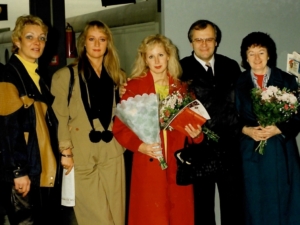
Cor Sanne writes from The Netherlands, “I was reading your Newsletter and as always a very enjoyable thing to do. I saw Bobby and Helen mentioned and that reminded me of a few shows we did in The Netherlands way back with Cee Cee Chapman. On the picture we see on the left Rineke and Alexandra (BMG Record Co) Cee Cee, Cor Sanne (promoter), and Helen Fischer (right). This all was at the Amsterdam Airport on November 21st of 1989. I cannot recall why Bobby isn’t on this picture. Cee Cee sang so much different from today’s singers, male or female, they are vocals acrobats. By golly, do I hate that! They should listen to, for example, Cee Cee singing ‘A Winters Night’. That is what really is called singing. Wonder what Cee Cee did after Nashville?”
Daniel Burritt in Phoenix, Arizona, says, “Thank you for the Music Newsletters. You are amazing to keep us updated on so many of the Music Greats.”
Doug Lippert writes from Greater Indianapolis, Indiana, “I stopped by the Birthplace of Country Museum in Bristol, Virginia yesterday for a visit. It’s worth a stop but wasn’t quite all I had hoped for. It was more of a pilgrimage for me in this centennial year of Ralph Peer’s recording of Jimmie Rodgers and The Carter Family. In fairness to the museum, they were having an IT issue, so I couldn’t get the full complement of interactive experiences, such as the orientation movie. But they do have Jimmie’s guitar that Ernest Tubb used for years, so that was cool. And a nice display on Tennessee Ernie Ford, who was one of my favorites and, in my opinion, is often overlooked. The town of Bristol was equally as interesting, noting the historical plaques along State Street and also seeing The Burger Bar, which is where Hank Williams’s driver stopped for food and the last place Hank was confirmed alive. I probably enjoyed that as much as the museum. (The Burger Bar was closed when I visited on Sunday but there were many shops open.) The museum is worth a stop but if you’re already familiar with Peer’s sessions from 1927, most of what you will see you already know. I made a trip (from Indianapolis) of driving the Tail of the Dragon, then to Savannah for a Collective Soul concert, then back home through Bristol over four days. Lots of back road driving that was fun. In the old days, I’d find something to listen to on AM radio when I’d travel through towns. That’s pretty much gone these days in favor of talk radio. But we have Spotify, which I think is incredible.”
Terry Burford says, “I am so pleased to be getting all your newsletters now and I use some of your material on Inside Nashville on KXHE. Hope you don’t mind.”
Diane: Not at all, as long as you invite people to subscribe to my newsletter.
Martha Moore of so much MOORE media writes, “Thanks for sharing the news on Alex Miller’s new album. We are having a release party May 14 at the Troubadour Theater in case you are in town. Alex and the Kentucky Kowboys will be jammin’ …. bring your dancing shoes and join us.”
Mike Johnson says, “Thanks for the mention in your last issue. Sorry to hear about Ray Stevens. I can kinda relate to what’s happened to him. I’ve always enjoyed his songs and I’ll send him a card. Three neck vertebrae collapsed on my spinal cord in December 2003 and ended my 20-year trucking career. My first official performance after recovery was in 2005 at Bart Plantenga’s yodel book lecture at the Bowery Poetry Club in New York along with yodelers Randy Erwin and Lyn Book. Great enthusiastic crowd that night and Randy and I almost got lost on the subway trying to find our way back to the bus terminal.”
Jon Melvin Yipp writes from Nova Scotia, “I thought I would drop you a Line. Just to let you know how much I enjoy your newsletter. I really enjoy how you put it all together. I am totally blind, and a huge country music fan. I come to you from Sydney, Nova Scotia. In The East Coast of Canada.”
IN THEIR OWN WORDS
I somehow missed hearing of the death of Carl Lamm, “The Voice of Eastern North Carolina.” The Johnston County Report carried the obituary of Carl Edward Lamm, who died August 15, 2024, at the age of 97 in Smithfield, North Carolina. Born in 1927 in North Carolina, Carl served two years in the Naval Reserve near the end of World War II. He then enrolled in the National Academy of Broadcasting in Washington, D.C., followed by working at several North Carolina radio stations. In 1958, he became the owner of WMPM Radio in Smithfield, beginning his lifelong commitment to Johnston County. In 2007, Carl and his son, Mickey, purchased WTSB Radio. Carl was inducted into the North Carolina Broadcasters Hall of Fame in 2004.
I don’t remember how I originally connected with Carl, but I’m glad I did. He occasionally called me to chat live on his daily radio show, and he sent me a copy of his 2010 memoir, Sixty-Three Years on the Air: My Life and Times. He last emailed me in September 2022: “Thank you for continuing to send me your newsletter. I retired from WTSB Radio in Smithfield in 2019 after 72 years in radio broadcasting. At the time I retired, I believe I was the longest consecutive radio broadcaster in the United States. I am 95 years old and still stay at home with the help of my three children.”
This WTSB Radio transcript from August 10, 2012, was probably our first show together. Unfortunately, I didn’t record later ones. He would call me out of the blue and ask if I had time to talk that day. In addition to country music personalities, Carl enjoyed talking about the U.S. Navy. He and my mom were both stationed at Naval Air Station Hutchinson, Kansas, during World War II. They were the same age and both carried the rating of seaman first class, but they never met each other. He was experienced in asking questions to catch interviewees off-guard. I had to think quickly when he’d be rambling along and suddenly throw a question at me.
Carl: I’m talking to one of my favorite biographers. Her name is Diane Diekman. She is the biographer of Marty Robbins, a best seller. Also a best seller book about Faron Young. We’re talking to Diane in Sioux Falls, South Dakota. What’s the weather like today in Sioux Falls, Diane?
Diane: It’s cooler than it has been. We’ve been having it up in the 80s and 90s for the last month, but today it’s only around 65 or so.
C: You are a retired captain in the United States Navy, and I was a seaman first class when I got out of the Navy. Am I supposed to salute you today?
D: Not unless you’re wearing a uniform.
C: You’ve written two great books, one on Marty Robbins, one on Faron Young. I thought today we’d play a Faron Young song, and then we’d come back later and play something by Marty Robbins. I get the idea you had a lot of fun writing these books. Did you?
D: Oh, I did. I met so many people, I learned so many interesting things, I traveled, so yeah, it was enjoyable. A lot of work but fun also.
C: Tell me two or three fascinating things that the public does not know, but you know and you could share with us about Faron.
D: Oh my. Well, I guess pretty much everything fascinating I put into the book. The only things I didn’t talk about were things I thought nobody needed to know, so I won’t say those on the radio either.
C: Okay. I have a memory about Faron doing the Prince Albert Grand Ole Opry show one night. He was just an outstanding entertainer, but he came to Nashville from I think Shreveport, Louisiana, is that right?
D: Yes, Shreveport.
C: Tell us about that a little bit. Tell us about how he got to the Grand Ole Opry and how he got started.
D: Shreveport was his hometown. He grew up there, and he got acquainted with Webb Pierce, and Webb put him in his band and put him on the Louisiana Hayride. One time when Ken Nelson from out in Los Angeles, California—the A&R man for Capital Records—he was driving through the area, and he heard this singer on the radio. He knew it wasn’t Webb Pierce, so he went to the radio station to find out who this singer was. They said, oh, that’s this kid named Faron Young. Ken Nelson signed Faron to a recording contract and then set up a trip for him to Nashville in March of ’52. So Faron went to Nashville to record his first song and then in June of ’52, he went to Nashville to be on the Opry, and stayed there then.
C: We’re going to play a song right now by Faron Young. I think he had perfect timing. That’s one of the great attributes of Faron Young. Also he had perfect enunciation, and I think this song will kind of demonstrate that. It’s called “Travelin’ On.” You might want to add, what was the thing that connected Faron with his audiences out there? What was the mystique behind Faron?
D: Faron loved his audiences. He appreciated them, so he always involved them. That’s a similarity Faron and Marty had. They both cared about their audiences, they acknowledged that they were only a success because of their audiences, and they appreciated them, and they were showmen, they were entertainers, they wanted to entertain the audience, and for everybody to have a good time. The audiences felt loved and appreciated and entertained.
C: You’re absolutely correct. They were both great entertainers, and they had a great stage presence as well. Which one of the two would you say maybe had a little bit better stage presence and connected a little bit better with the audiences?
D: Hmmm, I would say possibly Faron, as long as he was sober. If he wasn’t too drunk, he had a more personal level connection, whereas Marty was more aloof. Although the audiences felt that he was connecting with them, I think he himself felt less connected than Faron did.
C: We’re having the biographer of Faron Young and Marty Robbins with us today, Diane Diekman from Sioux Falls, South Dakota. Diane, I can’t tell you how much of a pleasure this is. We’re gonna play that “Travelin’ On,” and I think this will—I picked this out because it’s upbeat and kind of a good little song to start out with. [Faron Young sings “Travelin’ On.”]
C: Okay, Diane, make a comment or two about that song, if you will.
D: That’s a young Faron. That must have been in the mid-50s. It sounds like something he might have done on the Hayride or his early days at the Opry. I certainly do enjoy listening to him singing yet.
C: So do I, and I would say something about Faron and Marty. Both of these fine entertainers were perfectionists. They had a certain perfectionist attitude about them, and would you agree?
D: Oh, yeah. Marty was very definitely a perfectionist in everything he did. Faron had a more devil-may-care attitude. But still, when it came to his music, he wanted it to be right, like in his recording sessions and such. Yeah, they were both dedicated to having the music come across the way it should.
C: Okay. I’ve got a Marty Robbins song we’re going to play here. It may be one you’re familiar with. I picked out “I’ve Got a Woman’s Love.” Would you mind introducing this?
D: Okay. If I remember this song correctly, this is one Marty wrote, and it was probably around 1970 or something. It’s a song that shows how well a man loves a woman, and I often wondered if he wrote it for Marizona.
C: Let’s play that right now. We’ll say goodbye in about three or four minutes, but Diane, you stay right where you are. [Marty Robbins sings “I’ve Got a Woman’s Love.”]
C: Diane, I don’t think there will ever be another voice like Marty Robbins, nor I do think there will ever be another Faron Young. We’re getting close to the time we’re gonna say goodbye, but I want to thank you for being here. Are you on any project now? Do you plan any books? If you could just sit down and have a meal sometime with some of the grand old personalities out of the past at the Grand Ole Opry, somebody maybe you never met, whom would you like to sit down and enjoy a meal with?
D: To answer your first question, I don’t have a project right now. I’m looking for one. I’d like to write another book, but I want it to be one that has a large enough market, so I’m searching for a topic. As for who I want to sit down and have a meal with, well, it just might be Marty Robbins. I found so much about him that I would like to know, and since I didn’t know him, I would have loved such an opportunity.
COUNTRY MUSIC DISC JOCKEY HALL OF FAME – 1999 (second half)
Gwyneth “Dandalion” Seese, who took her air name from misspelling dandelion, was born in Pennsylvania in 1937 and had been working in radio for four years by the time she graduated from high school in 1955. She then left radio until joining WHOL in Allentown PA in 1973. Six years later, she gave up her postal service career to work full-time in radio. In 1981 she was hired for overnights at WRKZ Z-Country (Elizabethtown PA) and WCAT-FM (Carlisle PA). She retired from her all-night show in 2000. She is the first woman in country music to be nominated for the industry’s top three Disc Jockey of the Year awards–and all simultaneously in 1989: the Academy of Country Music (she won), Country Music Association, and Billboard. In 1999, she became the first woman in the history of country music to host her own network show, Dandalion’s Cat Country Network. She died at a northeastern Pennsylvania long-term care facility in 2015, following a long illness. She was 77.
Native Texan “Pappy” Dave Stone, born Dave Pinkston in 1913, began his radio career in 1946 in Lubbock. He put KDAV on the air in 1953, programming it with only country music and establishing the nation’s first fulltime country music station. He gave Buddy Holly his first radio exposure and introduced his music to Eddie Crandall, a talent scout for Decca Records. Waylon Jennings and Roger Miller were both disc jockeys on KDAV. In 1955, Stone booked Elvis Presley for one of his first headlining appearances. He later established full-time country music stations in San Angelo and Amarillo. In 1959 he moved to Colorado Springs, Colorado, and established KPIK as the first full-time country station in that market. He remained on the air there until retiring in 1999. Pappy Stone died in Colorado Springs at age 90, in 2004.
“Cousin Ray” Woolfenden, born in Virginia in 1916, received his nickname at age five “because everyone in the area was related.” As a member the U.S. Army’s Special Services in 1945-46, he entertained troops in the Pacific Theater, playing bass in an Army band in Japan during the occupation. After his discharge, he started a Jamboree on WADC in Akron, Ohio. He managed a number of radio stations in the Virginia/North Carolina area until purchasing WPWC in Dumfries, Virginia in 1973. He hosted the morning show for more than 25 years while serving the Washington DC area with country, bluegrass, and gospel music. After more than fifty years in radio and nearly eighty years as an entertainer, Woolfenden died in 2000 at the McGuire Veterans Hospital in Richmond, Virginia. He was 83 years old.