
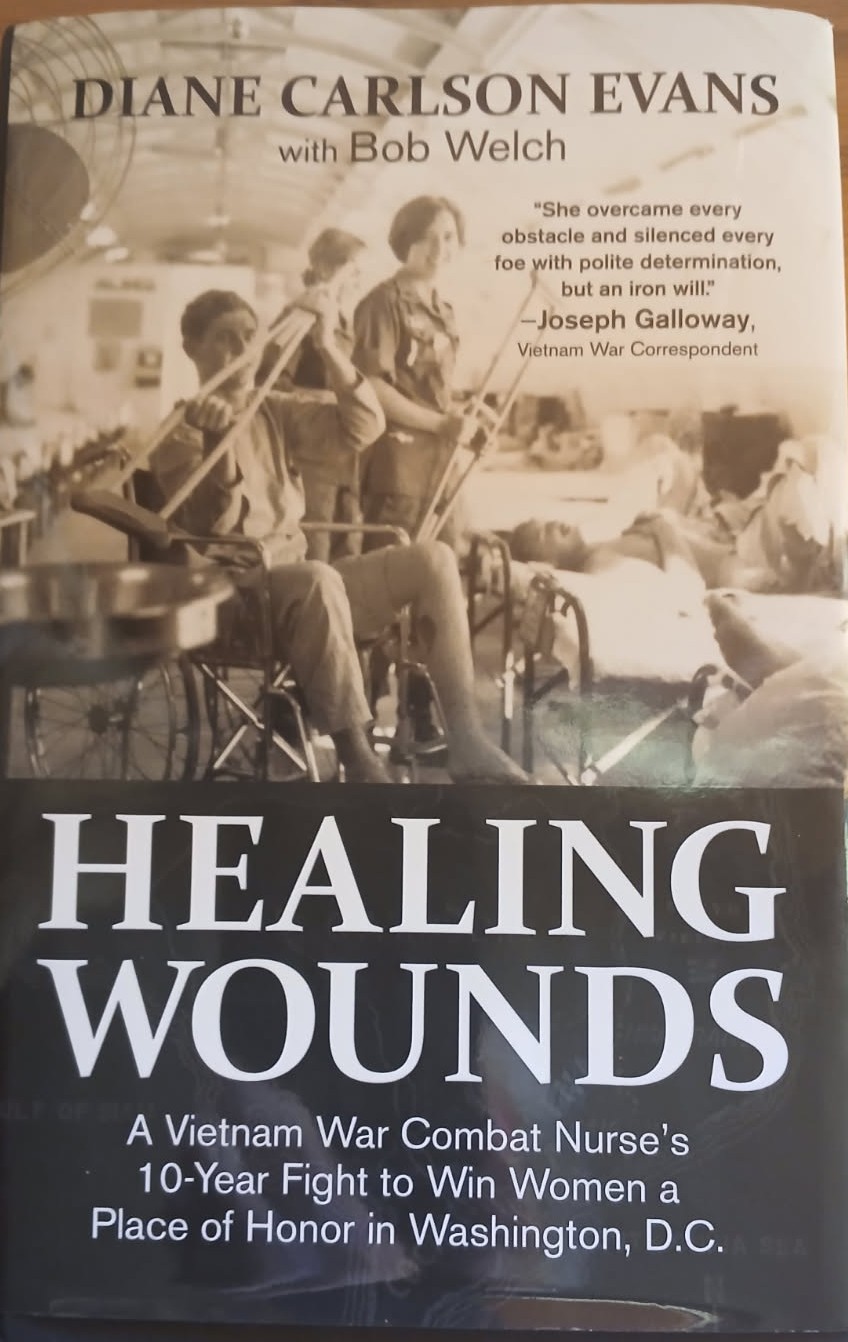
Healing Wounds: A Vietnam War Combat Nurse’s 10-Year Fight to Win Women a Place of Honor in Washington, D.C.
By Diane Carlson Evans with Bob Welch
“I was intrigued with the perils of wartime nursing,” Diane Carlson said about her decision to join the U.S. Army Nurse Corps in December 1965 at age nineteen. Growing up on a Minnesota farm with five siblings and their farmer father and head-nurse mother, she’d read about the experiences of Clara Barton and Florence Nightingale. She was paying her way through nursing school when she exchanged those expenditures for two years of her life.
Upon returning home, Diane got a job at the local hospital. When told she must be supervised while starting her first three IVs, she wanted to scream, “I did 28 of these in four hours on dehydrated men in shock with collapsed veins…in the dark…with a flashlight…with only one medic…while mortars were exploding outside. I think I can put in an IV.” But she didn’t say it. When it came to Vietnam, she’d lost her voice. She also knew that showing her experience would lead those around her to think she considered herself a hot-shot combat nurse who was better than them. Moving to Washington state, she rejoined the Army for a second tour and was promoted to captain. Marriage and children followed.
Diane’s year in Vietnam as a combat nurse covers only fifty pages of her memoir, Healing Wounds: A Vietnam War Combat Nurse’s 10-Year Fight to Win Women a Place of Honor in Washington, D.C. As described in the subtitle, most of the book is the story of the Vietnam Women’s Memorial and her efforts to place a statue at the Vietnam Veterans Memorial.
Diane Carlson Evans, with the assistance of journalist Bob Welch, tells the story of how she found her voice after attending the dedication of the Vietnam Veterans Memorial on November 13, 1982, and finding fellow veterans to talk with. After learning that a Three Servicemen statue would be added to the Memorial, she decided to fight for one that honored women. Within two years, she went from “someone who couldn’t even talk about Vietnam” to “addressing three thousand people in a Dallas convention ballroom.”
She was in Dallas to address the 1985 VFW national convention. “The monument is intended to complement and complete the Vietnam Veterans Memorial in Washington, D.C.,” she explained. “The Three Servicemen representing all men who suffered or served in Vietnam stand to the left of the Wall. We want our statue to stand to the right where she will be watching over the names of the men and women who died and the Three Servicemen.” She added, “I fought in Vietnam—not with a weapon, but I fought in combat zones for young men’s lives in the surgical and burn unit.”
During the discussion period that followed her speech, one man said, “If we honor the nurses at the Vietnam Wall, then helicopter pilots will want a statue, and bomber pilots, and pretty soon we’ll have a tank at the Wall.” She responded, “We are not tanks. We are women!” Many, many rejections came in the following years, some with death threats. What kept her team going, she said, “was the same thing that kept us going in Vietnam: for every soldier we couldn’t save, one would pull through.”
I enjoyed reading about her successes and felt the disappointment of the setbacks. Although familiar with the name and efforts of Captain Diane Carlson Evans over the years, I didn’t know much about her personal story. Reading Kristin Hannah’s combat nurse novel, The Women, made me want to learn more about her. I purchased this book not long before Diane died from cancer on May 20, at age 79. She was a hero, and I don’t use that term lightly. She deserved all the accolades she received.