
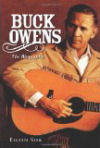
Buck Owens: The Biography
By Eileen Sisk
“This biography paints an unprecedented portrait of not only country’s biggest star of the ’60s, but perhaps its biggest son of a bitch.” So says the jacket cover of Buck Owens: The Biography. Following 19 number one songs on Billboard’s charts, Buck Owens spent 17 years as co-host of syndicated television show Hee Haw. He amassed a fortune of 100 million dollars between his birth into poverty in 1929 and his death in 2006. He was elected to the Country Music Hall of Fame in 1996.
Eileen Sisk, an investigative reporter and journalist in Nashville, spent more than a decade researching and writing the Owens story. According to Sisk’s Facebook page, the book began as an authorized biography. Owens withdrew his support when Sisk wanted to discuss the death of Don Rich, close friend of Owens and long-time band member. Pressure from Buck Owens Enterprises then kept family members and friends from talking to Sisk, she says. One such person was Bonnie Owens, best known for harmony vocals with husbands Buck Owens and Merle Haggard. She initially agreed to an interview but changed her mind. One former employee told Sisk to expect to write “a book about a very bad man who made very good music.”
Owens grew up in Mesa, Arizona. Although a math whiz with a photographic memory, he dropped out of high school because he preferred earning and spending money. He moved to Bakersfield, California, in 1951, where he would build his empire and spend most of his life. He married at least six times and had numerous girlfriends, usually several at the same time. (Sisk was unable to determine the exact number of wives and children.) Prior to obtaining a Capitol Records contract in 1957, Owens became a sought-after guitarist on Capital recording sessions in Hollywood. “Act Naturally” in 1963 became his first number one song. When he rerecorded it years later with Ringo Starr, he claimed songwriting credit, and the true writers had to sue him to get their royalties. Owens is presented throughout the book as a ruthless individual who cared mainly about power, money, and sex.
Those who stayed with him tolerated his behavior. Don Rich, whose harmony vocals and guitar work defined the Buck Owens Sound, joined Owens at age 16 in 1958. When Rich died in a motorcycle accident on a lonely California road in 1972, Owens never completely recovered from the loss. His hit-making days were over, with the exception of “Streets of Bakersfield,” a 1988 duet with Dwight Yoakum that went to number one.
Sisk did an excellent job of finding and interviewing sources, and she presents favorable opinions to balance some of the negative ones. Her journalistic skill shows in the way she combed through extensive interviews to compile subject-specific chapters. She should have skipped the gossipy speculation, however, and stayed with the facts. For instance, she says, “Still, there are some people who question Buck’s sexuality.” She then quotes a disc jockey who talked about meeting Owens in a restaurant and receiving an invitation for a later meeting. The man tells his companion, “I’m not really sure, but I think . . . he just hit on us.” There is nothing to back up this story, and the interviewee doesn’t appear again in the book. Buck Owens: The Biography is more a collection of stories about Owens than a biography. Sisk acquaints her readers with the people who are talking about him, but he isn’t there. The book lacks his voice, and we don’t learn how he felt about most issues. His quotes are usually presented only to prove he’s lying about something.
One important aspect of Buck Owens: The Biography is the preservation of band stories. Sidemen are too often neglected in books and on video, and Buck Owens owed a large part of his success to his award-winning band, the Buckaroos. Most of the still-living band members contributed their stories, adding credence to the overall negative image of Owens. Many people talked about being cheated out of royalties, wages, and other financial due. There was little mention of generosity.
What bothered me was the lack of attribution. Quoted material is presented as part of the narrative, with sources listed in chapter notes at the end. Thus, the author’s voice includes comments such as, “The family, like most Southwestern migrants, may have been poor as puppy’s piss, but they were prideful folk and always worked for what they got in life.” And “He soaked up praise and adulation like soppin’ bread and gravy.” At one point, Sisk writes about an Owens employee, “It was a reference not only to his height . . . but also to the size of his penis. It was of normal proportions, but Buck considered it inferior to his abnormally large member. . . .” One wonders how she knew this information.
In spite of its shortcomings, Buck Owens: The Biography makes an important contribution to the documentation of country music history. A detailed sessionography and discography add to its value. Even if Owens was the sex-crazed and selfish individual depicted here, he and the Buckaroos made beautiful music and left a significant legacy. I am pleased to have Buck Owens join the other country music personalities on my bookshelf.