Diane’s Country Music Newsletter — 18 February 2026
RANDY TRAVIS: STORMS OF LIFE AUDIOBOOK
Randy Travis: Storms of Life is now available as an audiobook. Thanks to Frank Gerard for doing the narration. I selected Frank because of his experience as a narrator and his love for classic country music. This is our third book together. He also narrated Twentieth Century Drifter: The Life of Marty Robbins and Live Fast, Love Hard: The Faron Young Story.
Frank and I recently discussed Randy’s story in a 13-minute podcast you can watch here. We talked about why I wrote the book, how the industry rejected Randy for being “too country,” Lib Hatcher’s role, Randy’s gospel music, and what was the hardest part of the book to write. Audiobook narrators don’t have to like the books they narrate, but Frank said he was “hanging on the edge of my seat” while reading this one. “I’ve always been a Randy Travis fan,” he told me. “I thought I knew everything. But I learned so much from your book.”
Frank’s proofer told him she became a Randy Travis fan while checking Frank’s narration against the written text. “I really loved this book,” she said. “I kind of knew who Randy Travis was but never thought I wanted to listen to his music.” While proofing the narration, she downloaded “a bunch of songs and I’ve become a real fan because of this book.”
The audiobook of Randy Travis: Storms of Life can be downloaded from Amazon.com or Audible.com, or you can email Frank (fr**************@***il.com) or me (di***@**********an.com) for a link to obtain a free copy.
While the University of Illinois Press returned the audiobook rights for my first three books, the contract for my upcoming Hargus “Pig” Robbins biography already grants me those rights. Frank has agreed to narrate that book when it’s published in 2030. “I’m really looking forward to it,” he says, because he knows nothing about Pig other than that he played piano. Frank is excited to learn about someone currently unfamiliar to him in the country music world.
I’m excited about offering the public a chance to listen to Randy’s story in addition to reading it.
NEWS
Famous Mercury Records producer Jerry Kennedy, 85, died February 11. Although I didn’t find a cause of death, I know he had been dealing with Parkinson’s disease for many years. “In Their Own Words” at the end of this newsletter contains stories he told me. Jerry Glenn Kennedy was born in Shreveport, Louisiana, in 1940. By age 16, he was a staff guitarist on the Louisiana Hayride, reports MusicRow. After graduating from high school, he followed fellow Shreveport natives Faron Young and Shelby Singleton to Nashville in 1961. In 1963, he became Singleton’s assistant at Mercury Records, and he took over as head of the Nashville label in 1969. Faron Young, Roger Miller, The Statler Brothers, Reba McEntire, Jerry Lee Lewis and Tom T. Hall are a few of those whose careers he helped build. He played guitar on many famous recordings, and he recorded his own instrumental albums. In 1984, he left Mercury Records and formed JK Productions, where he produced Tom T. Hall, the Statler Brothers, Reba McEntire, Mel McDaniel, and Connie Smith, along with new artists. He was part of the Nashville A-team inducted into the Musicians Hall of Fame’s inaugural class in 2007; the museum’s theater is named in his honor. Jerry’s three sons—Gordon, Bryan, and Shelby—are all heavily involved in the music business.
Steel Guitar Hall of Famer Junior Knight died February 14. I haven’t been able to find an obituary. Tracy Pitcox reports he played for Ray Price, Wynn Stewart, Leann Rimes, Jody Nix, and others over a period of more than 50 years. During his many years of working with Dewey Groom (his father-in-law) and the Longhorn Ballroom Band, Tracy says “he worked with nearly every country artist that made their way down to Texas.”
Falling on a patch of ice has required Marty Stuart to cancel his February concerts. He announced on Instagram, “I fell down on a patch of ice and did an excellent job of hurting my hand and spraining my wrist, complete with a state-of-the-art hairline fracture.” He added, “It’s getting better by the day. The worst part of it all is I can’t play the guitar or the mandolin, at the moment.” He said he will be back on the road as soon as he can.
The Musicians Hall of Fame and Museum has announced its 2026 inductees, the first since 2022 (which I reported in my September newsletter). The class includes (in alphabetical order by first name) Dann Huff, Dolly Parton, George Thorogood & The Destroyers, John Boylan, Keith Urban, Leland Sklar, Michael McDonald, and Nicky Hopkins (posthumously). The induction ceremony will be held April 28 at The Fisher Center for Performing Arts in Nashville.
The Von Braun Center in downtown Huntsville, Alabama, recently hosted the All-Star Salute To ‘90s Country: Honky Tonk Time Machine, with over 30 artists performing. Music Universe reports the night included special tributes to Daryle Singletary, Kevin Sharp, Randy Travis, and George Jones, as well as three throwback moments from Janie Fricke (Female Vocalist of the Year), Lee Greenwood (Male Vocalist of the Year), and The Forester Sisters (Group of the Year). The event was filmed for an upcoming television broadcast, which will be announced in the coming weeks.

Front Row: John Berry, Deana Carter, Carlene Carter, Lee Roy Parnell, Paulette Carlson, Bryan White // 2nd Row: Host Keith Bilbrey, Lee Greenwood, Rick Trevino, Tony Rich, Eric Blankenship, Ty Herndon, Michelle Wright, T. Graham Brown, Lorrie Morgan, Ken Mellons, Janie Fricke, Jamey Johnson // 3rd Row: Richard Young, Fred Young, Doug Phelps, Greg Martin, Mark Wills, Andy Griggs, Paul Overstreet, Terry McBride, Christy Forester, June Forester, Kathy Forester, Kim Forester // 4th Row: Billy Dean, Lionel Cartwright, Wade Hayes, Rhett Akins, Neal McCoy, Heath Wright, Darryl Worley, Tracy Byrd, Michael Peterson, Aaron Tippin, Larry Stewart, Tim Rushlow, Richie McDonald || Photographer: Bud Gambrell Photography; Photo assist/prep/lighting/direction: Jeremy Westby / 2911 Media
Steel guitarist and music historian Pete Finney, 70, died February 7. He toured with Vince Gill, the Judds, Reba McEntire, the Chicks, the Monkees, and more than 20 years with Patty Loveless. MusicRow reports he was touring with Reba McEntire when most of her band members were lost in a plane crash in 1991; Pete was flying on the second plane. He co-curated the Country Music Hall of Fame’s 2015–2018 exhibition Dylan, Cash, and the Nashville Cats: A New Music City. Sylvia writes on Facebook: “My heart is breaking to make this post. My friend Pete Finney has passed away. He was the first person I hired to play steel guitar in my band back in early 1983. He lived in Texas at the time and moved to Nashville to work with me on the road which he did for the next 5 years.”
Flying Dutchmen Travel has announced its seventh Country Cruising adventure, reports Music Universe. It departs in mid-April 2027 from Tampa, Florida, for seven nights. A star-studded lineup of country music singers and songwriters will include Randy Travis and his More Life Tour, Craig Morgan, Paul Overstreet, and James Dupré, as well as others to be added. Last year’s cruise sailed from Fort Lauderdale, Florida, to Nassau, Bahamas, and hosted 2,000 country music fans of all ages.
The Grand Ole Opry, George Gruhn of Gruhn Guitars, and Martin Guitars have teamed up to create a limited-edition Martin HD-28 Grand Ole Opry 100th Anniversary guitar, reports MusicRow. It was introduced to the public when Vince Gill played it on the 100th Anniversary Opry show on November 28. Built on the foundation of Martin’s legendary HD-28, this guitar includes a headplate with the WSM microphone in mother-of-pearl inlay and a matching commemorative inlay theme along the ebony fingerboard, celebrating a century of Opry history. The limited-edition Martin HD-28 Grand Ole Opry 100th Anniversary guitar can be purchased for $4,299.
Saving Country Music reports that the Texas Heritage Songwriters Association has announced four 2026 inductees into the Texas Heritage Songwriters Hall of Fame: George Strait, Miranda Lambert, Don Cook, and Keith Gattis (posthumously). The induction ceremony will be held February 21 at the Moody Theater in downtown Austin. The Texas Heritage Songwriters Association established its Hall of Fame 20 years ago but does not induct members every year. While George and Miranda are known primarily as performers, they are also songwriters, and they are champions of songwriters, having built the careers of those whose songs they recorded. Don Cook has written twenty #1 hits, including 13 hits with Brooks & Dunn alone—including “Brand New Man” and “My Next Broken Heart.” He also wrote songs for George Strait, Alabama, and Kenny Rogers, among others. Keith Gattis wrote and co-wrote songs for George Strait, Randy Travis, Kenny Chesney, Gary Allan, Sara Evans, and many others. He also worked as a session musician and record producer, until his death in 2023, at age 52, in a tractor accident.
LETTERS
Craig Baguley writes from London, England, “So sad to hear the news of Billy Parker’s passing. I first heard Billy back in the 1960s when he recorded ‘I’m Drinking All the Time’ for Decca, which I loved. From then on, he became one of my favourite country singers, so much so that in the 1980s, during one of my regular Stateside visits, I drove to Tulsa specifically to interview him for a Billy Parker feature in Country Music People, the UK magazine I edited at the time. I always remember him telling me that he hated wearing his Texas Troubadour hat and asked Ernest Tubb if he needed to. Ernest replied, no, he didn’t need to but, then again, he didn’t need to be a Texas Troubadour. ‘Scuse me now, I’m off to play my Billy Parker records – with a tear in my eye …”
Eric Calhoun writes from Los Angeles, “You were mentioning Billy Parker and 1170 KVOO, Tulsa, Oklahoma. The current KVOO is now at FM 98.5, carrying on the country music of its AM predecessor. You did not provide a link for the new version of ‘Light of a Clear Blue Morning,’ which you mentioned that Dolly Parton recorded 50 years ago. That’s sad about this Nancy Jones lawsuit. Wow, let’s pray this suit gets settled.”
Diane: Here is Dolly Parton singing “Light of a Clear Blue Morning” with Lainey Wilson, Miley Cyrus, Queen Latifah, and Reba McEntire.
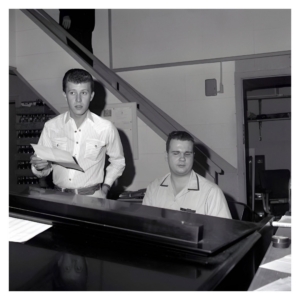
Dominique ‘Imperial’ Anglares writes from “across the pond” in France: “Thanks for that new publication and for the care given to my words about Hayden Thompson. For today here is a nice picture showing Darrell McCall in studio with Pig. I don’t know who owns the copyright. Sorry.”
Donald Ewert writes, “Remembering my friend Penny DeHaven (May 17, 1948 – Feb 23, 2014). Hit records ‘Mama Lou,’ ‘The First Love,’ ‘Down in the Boondocks,’ ‘I Feel Fine,’ ‘Landmark Tavern’ with Del Reeves. Porter Wagoner’s last duet partner on the Grand Ole Opry.”
Sherwin Linton says, “Thanks for your newsletter. Hope to see you at the SD State Fair.”
Diane: Okay, I’ll be there.
Bob Jennings writes, “In response to Ron Wood’s questions: Yes, I am a Pedal Steel Player–I learned on a well-used SHO-BUD and after visiting the Steel Guitar Show in St. Louis, I ordered a Williams Single Neck on a Double Frame Body. The Pedal Steel Guitar is endless in what can be done with it–I am still a Wannabe Pedal Steel Player after about twenty years. My Wife and I visited Bud Issacs in September of 2000 when we went on a Camping Trip to Arizona. Knowing that Bud Issacs was originally from Bedford, Indiana (about 30 miles from where we lived), I found some Issacs in the telephone book and called one. A lady answered and I asked if she knew Bud Issacs and she responded, ‘Yes I do; I’m his sister.’ In our conversation, I found that Bud Issacs and his Wife live in Yuma and got his phone number. That is when my Wife and I decided to go to Arizona. I called Bud Issacs and said we’d be coming there and would like to visit. Bud and his Wife came to the RV Park where we were staying–it was 108 degrees–we had the A/C going and drank Iced Tea and had a Very Pleasant Visit where Bud told many Tales of his Touring and playing the Pedal Steel. He told me. ‘Ya only need the A and B Pedals on the Pedal Steel to do Fine Music.’ And who’s to argue with the guy who drove many thousands of Pedal Steel Players bananas when he played The Pedal Steel on Webb Pierce’s ‘Slowly’? I took several pictures and when I had the film developed, it was all blank–the battery in the camera was dead.”
VIDEO OF THE WEEK
A press release by 117 Entertainment announces Dillon Weldon’s recent “Drifting Cowboy Podcast” with Bobby Bare, age 90, who agreed to the hour-plus interview at his home outside of Nashville to discuss his career and country music friends. The interviewer made a point of letting Bobby do the talking; he asked a few leading questions and then stayed out of the way. Although I knew most of the stories Bobby told, I was surprised to learn the depth of his influence throughout the years, especially concerning producing his own music. His 1973 concept album, Bobby Bare: Lullabys, legends and lies, came two years before Willie Nelson’s Red Headed Stranger. He and Tom T. Hall were on the road, with Bobby behind the wheel, when they were arrested by local law enforcement for “speeding through their town.” They didn’t spend a week in a country jail, but the experience gave Tom T. a number one song in 1969.
BOOK REVIEWS ON MY WEBSITE
I’m proud to announce my new webpage that serves as a permanent spot to display the book reviews I’ve been writing since 2008. My thanks to Jeff Hunter of Fishnet Marketing, LLC, for designing such a beautiful page.
IN THEIR OWN WORDS
Jerry Kennedy was one of the first people I talked to when beginning my research on Faron Young. He produced all of Faron’s Mercury albums, and he readily shared his memories during our telephone conversation on November 2, 2000. I’ve been trying recently to contact him for an interview about Hargus Robbins, and I knew Jerry was dealing with Parkinson’s disease. I was shocked to learn on February 11 that he’d died. He was 85 years old.
I was such a Faron Young fan, from the time I knew he was a singer. He had a record called “Foolish Pride.” I was twelve years old. That was when I became a diehard Faron Young fan. He came down to J&S Music Store in Shreveport. That’s my first memory of Faron. I was taking lessons from Tillman Franks at that time, and I remember this vividly. He said, “Hey, come here. I want you to hear something.” He had an acetate of “Foolish Pride,” and he took me in a booth and played me “Foolish Pride.” That’s just as vivid as if it had happened yesterday.
Another time I ran into Faron, he was friends with somebody who lived in my neighborhood. Bobby Wooley and Faron had made a contraption with four wheels, and a motor on the back. I guess it was one of the first go-carts I ever saw, I didn’t know what it was at that time. They were riding that thing around my neighborhood.
He always treated me great, when I was a little kid, that was one thing I really did appreciate. It was never, get out of the way, kid, or whatever. He always tried to make me feel at home, when we would show up to play at the same place. I came to Nashville when I was a senior in high school, and he really tried to show us a good time up here. Faron was never one to curb his language. I think from the very first time I saw him I thought he had a real healthy appetite for using the colorful language.
Shelby Singleton signed Faron to Mercury in ’63, if I’m not mistaken. When Faron came over to Mercury from Capitol, I think I was just coming back to Mercury. After Shelby produced a couple of albums on Faron, he assigned Faron to me. I started doing his product, probably in ’66-67, or maybe earlier. Shelby did “Yellow Bandana.” I played on it. I played guitar on all the sessions he did, up to when I started producing him. After I started producing him, I would add guitar to some of the things.
Faron hated waltzes and wanted to change “It’s Four In the Morning” to four-four. I fought him–that was the one time we really did have a head-butting. If we had changed it, it would not have felt right. That was the one time we had a real difference of opinion on something. But he let me win. He did it as a waltz time. I knew it was a good record and I hoped that it did okay. I never thought it would be that huge, and it would be huge in England. Those things you kinda hope for, but you don’t set yourself up to take a big fall by thinking that’s what’s gonna happen. When I look at the clock, or when I’ve been made aware that it’s four o’clock, I say, “Well, it’s four in the morning.” That’s my line. And one of my favorite songs.
“This Little Girl of Mine,” it was the fact that he felt it the way that he did. You don’t run out there and say, “Just why are you feeling this song the way that you’re–” You don’t want to interrupt the feel, so I didn’t ask. I’ve never asked an artist when they’re performing the living daylights out of it, why are you crawling inside this song more so than any of the rest of them? You can tell, sure, by a look, or just by the way they’re performing it. A song’s like a script, for a singer. To me that’s the same analogy you would use if you say an actor really got into a part that he played. Well, a singer really crawls inside a song. We did an awful lot of records, a lot of cuts. I was looking through the glass at somebody that I was a big fan of. It just don’t get any better than that.
I don’t know why he left, unless Mercury felt like hey we don’t want to continue anymore because Faron’s not selling the way that he was, or what the deal was. I had an agreement with Mercury–I never negotiated contracts and they never told me how to produce records. I didn’t get involved in the legal aspects of any of the artists I was working with. Why Faron’s deal went away, I don’t remember. I remember how disappointed I was.
I have one classic thing I can tell you. It used to be that if you bought an ad in Billboard, it enhanced your chances of going to number one. He got a call one day, he was in my office when he took the call, and he just very adamantly told whoever was on the other end of the phone, no, by god, I won’t buy an ad. He said, “I’ll tell you what I’ll do. I’ll buy an ad thanking you for a number one record, but I’m not gonna buy an ad to make it number one.” That’s the way it was. And he had to buy an ad thanking them for a number one record a few weeks after that. I remember very well what he told them, but I can’t remember which record. It must have been “Four In the Morning,” but I wouldn’t swear to it. It was a call from Billboard, I remember that very well.
I worked with Roger Miller from ’64 until ’72. On some of Roger’s sessions Faron would show up, and vice versa. They would come in while they were recording. It would disrupt for five or ten minutes, but both of them were pro enough to not let it get in the way. They loved each other. They dropped by to pay their respect. If one artist showed up at another artist’s session, that meant you really did like that artist. It was not a thing where they meant to disrupt it, or whatever. It was just like, hey man, I wanted to come by and say hey, while you’re making your record.
The most important thing about Faron is how talented he was. I’m not sure we’ll ever have another person who’ll come along and sing like he did. And get as little credit for being a great singer as he did. I wouldn’t trade those number twos for a couple of number ones. Some of those things were great.
I’m trying to remember any special stories. You know what, the relationship with Faron was so good that that’s all I can remember. How good everything was. I know it sounds kinda weird, I’ve got wild stories about most of the people I worked with. He always treated me with a lot of respect, and I did the same with him. It was just a real good producer-artist relationship. There never were any problems. I could play him a song, and he didn’t care very much for it, he would say, “But if you like it, we’ll do it.” I did the same thing. If he’d play me something I really wasn’t in love with, I always did figure it doesn’t really matter, when he starts singing it, I’m gonna love it anyway. When I would be sitting there, a lot of times I’d go back to twelve years old and “Foolish Pride.” You’d think about it–this is just great, man, here I am a fan of this man, and I’m sitting here watching him through the glass, and I’m hearing this before anybody else is gonna hear it. He was special, man. He had that big ol’ wonderful voice. There were a hundred sides to Faron Young.
Get Hilda to tell you the story about the time she called me to tell me he couldn’t make a two o’clock session, because he’d had a fight with the hanging baskets in the carport. I think he came home a little party-pooped one night before a session, and stepped out of the car, and she had hung some hanging baskets in the carport. I think he walked into one of them and thought somebody’d jumped on him. That’s one of the funniest stories I’ve ever heard. He ended up hurting his hands, and he cracked a rib on the hood of the car. It was a pretty wild thing. He thought somebody’d jumped on him, so he was swinging at these things. It was dark. It ended up that he couldn’t even do his session the next afternoon. I can’t remember what time she said he got home, but I laughed myself to death about that. That was just typical Faron. If something bad happened to him, it was often real bad.
COUNTRY MUSIC DISC JOCKEY HALL OF FAME – 1993 and 1994
1993
Wayne Raney, born in Arkansas in 1921, became well known for his harmonica playing. He did much to establish the harmonica as an instrument accessible and popular everywhere. At age 13, performed on the powerful border radio station XEPN in Mexico. He moved on to Cincinnati’s WCKY and sold harmonicas via mail order to listeners who enjoyed what he played on the air. His deformed foot kept him out of the military during World War II. He teamed up with the Delmore Brothers and then had a solo hit when “Why Don’t You Haul Off and Love Me” topped country charts in 1949. In the late 1950s he worked as a DJ, opened a recording studio, and started a bluegrass-oriented record label. Health issues caused the loss of his voice box in the late 1980s. He published his autobiography, Life Has Not Been a Bed of Roses, in 1990. Wayne Raney died of cancer in 1993 at age 71.
Larry Scott, born in 1938 in Modesto, California, worked on the air at many legendary country radio stations during his lifetime. His first announcing job was in 1955 at KBTN in Neosho, Missouri, followed by WIL (St. Louis), KFDI (Wichita), KUZZ (Bakersfield), KBBQ and KLAC (Los Angeles), KBOX and KRLD (Dallas), and KWKH (Shreveport), where he hosted the Interstate Road Show beginning in 1982. In August 1996, he moved his show to KVOO (Tulsa). Larry earned numerous Disc Jockey of the Year awards and is a member of the Western Swing Hall of Fame. He died in 2016 in Oak Ridge, Texas, two months before his 78th birthday.
1994
Charlie Douglas, born Doug China in Georgia in 1933, began his radio career in 1953 at KLIC in Monroe, Louisiana, moving three years later to Oklahoma City to be a program director at KOCY. After working at radio stations around the country, he joined WWL in New Orleans in 1970. There he created the first all-night Country music show directed specifically at truck drivers: “Charlie Douglas and His Road Gang.” After thirteen years, in 1983, he moved to Nashville to replace Chuck Morgan as host of Music Country Radio. He hosted a television series on TNN and served two terms as President of the Country Radio Broadcasters. In 1995, he retired from radio when he left WSM to operate Compact Disk Xpress (CDX), the country music distribution business he established with business partner Paul Lovelace in 1991. Charlie died at age 78 in Covington, Los Angeles, in 2011.
Slim Willet, born Winston Lee Moore near Dublin, Texas, in 1919, is best remembered as the writer of “Don’t Let the Stars Get in Your Eyes,” a #1 hit for “Slim Willet and the Brush Cutters” in 1952. (Skeets McDonald and Perry Como also had #1 hits in 1952.) By then he was broadcasting on Abilene country station KRBC. As well as recording on the 4 Star label, he regularly appeared on The Big D Jamboree and the Louisiana Hayride in the early 1950s. In 1954, he became a fulltime air personality at KCAD in Abilene, where he was part owner. He stayed there until dying of a heart attack at age 46, in 1966.