Diane’s Country Music Newsletter — 4 March 2026
IN THE SPOTLIGHT – CHARLIE MCCOY
Country Music Hall of Fame member Charlie McCoy has been playing on Nashville recording sessions since 1961. He and Hargus “Pig” Robbins both belong to the original A-team of session sidemen. When I called him last week at his winter home in Florida, to talk about Hargus for my biography, Charlie had just returned home from running errands. He was sitting on the lanai of his home in a gated retirement community, enjoying his annual three months in Florida. He and his wife have been snowbirds for 28 years. “These people have more fun,” he says. They play cards, board games, mahjong, and eat at the many great restaurants. Still, he looks forward to returning to Nashville and performing on the Grand Ole Opry. In 2025, he did 40 Opry shows and 72 recording sessions. “I’m gonna be 85 next month,” he told me. “To still be working and still be able to, and to love it so much, what a blessing this is.” July will mark four years since his induction as an Opry member. “And, oh, that has been the icing on my cake. I just love that,” he says.
Charlie was born in Oak Hill, West Virginia, on March 28, 1941, and he grew up in Miami, Florida. He began playing harmonica at age eight and performing publicly in his teens. In 1959, Mel Tillis heard him sing a Chuck Berry song at a Florida show, after which Mel came up to him and said, “Boy, you come to Nashville, I’ll get you on records.” Charlie remembers that as being “like throwing a steak to a wolf.” He went to Nashville and was given auditions with Chet Atkins and Owen Bradley. “I had no idea who they even were,” Charlie explains. “I was a rock and roller. I was all into Chuck Berry.” Owen Bradley invited him to a session where he watched 13-year-old Brenda Lee record one of her first chart records. Charlie recalls, “When I heard the first playback, I said, ‘Uh, I don’t want to be a singer. I want to do this.’” A year later, he returned to Nashville after quitting college, which broke his father’s heart. “He finally forgave me when I introduced him to Dolly Parton,” Charlie says. “I did my first session in 1961. And I’m still working.” He marvels at how “that handful of great musicians that were doing all the work” accepted him as a 20-year-old harmonica player who wanted to be part of them. From the late 1960s throughout the 1980s, he played 300 sessions a year.
While playing on many hit songs during those years, Charlie has also recorded a number of his own albums. He has been music director and performer on numerous television shows, including 19 years as music director for Hee Haw. Although best known for the harmonica, he is a multi-instrumentalist who has played bass, trumpet, saxophone, guitar, and organ on various recordings.
In about 2002, Charlie told me, Harold Bradley had a meeting with the Country Music Hall of Fame committee and suggested that they induct the entire original A-team. The Hall of Fame committee declined his proposal but agreed to induct one musician every three years, in rotation with songwriters and non-performers. That system is still used today. Floyd Cramer was elected in 2003, Harold Bradley in 2006, Charlie in 2009, Pig Robbins in 2012, Grady Martin in 2015, and Johnny Gimble in 2018, to recognize the early A-team musicians.
When Charlie learned I live in South Dakota, he told me they vacationed here several years ago, visiting Mount Rushmore and the Badlands. This past summer they went to North Dakota, the only state they hadn’t yet visited. They were driving in Theodore Roosevelt National Park when the traffic suddenly stopped. As they crept up to where they could see around the mountain, there were thirty buffalo in the road. “Thirty buffalo go wherever they want to,” Charlie says.
We talked about the Bob Dylan recording sessions, as that was an important event in Pig’s life. It was also important for the Nashville recording industry. “After he came, it was like the floodgates opened,” Charlie says. “The folk-rock artists started pouring into Nashville. It was almost like Dylan said, ‘Okay, y’all, you got my stamp of approval on Nashville.’”
“None of us had ever been through anything like that,” Charlie says about the Dylan experience in February 1965. The first session was scheduled at the Quonset Hut for two o’clock. His flight was late, and the musicians were told to “just hang loose.” When they returned from their dinner break, the producer said, “He hasn’t finished writing the song yet.” They went downstairs to the break room, where they played ping pong, drank coffee, told stories, anything they could do to keep themselves awake. The session for “Sad Eyed Lady of the Lowlands” began at four in the morning. It was a fourteen-minute song, and they’d been awake all night. “Each one of us is like, ‘Oh, please don’t let me mess up,’” Charlie remembers. “We got out of there about a quarter to five in the morning. Fortunately, we didn’t have any sessions that day. We started back at six o’clock that night. After that, it went much better.” The good side of that first session was the overtime pay that came with it.
When I asked Charlie what he remembers most about Pig Robbins, he said, “Well, number one, I think Pig was the best studio musician I’ve ever worked with. When he was on a session, everybody else played better.”
He added, “And then, at the end of it all, I got the distinct honor of doing his induction at the Hall of Fame. I was so happy to do that. He and I were great friends, and I was just so proud.”
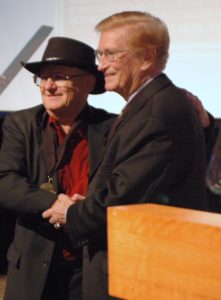
Charlie McCoy inducted by Harold Bradley into the Country Music Hall of Fame in 2009
NEWS
The East Tennessee Children’s Hospital in Knoxville, Tennessee, a free-standing, independent, not-for-profit pediatric health care system, is now Dolly Parton Children’s Hospital, reports Country Now. In a recent announcement, Dolly Parton said, “Being fortunate to have grown up in the mountains of East Tennessee, I learned early on what it means to take care of one another. Every child deserves world-class care, wrapped in kindness and love.” The 90-year-old hospital can now expand the reach of pediatric care across the region.
The El Paso District Attorney’s Office shared with PEOPLE the news that the driver who struck and killed Laura Lynch, founding member of The Dixie Chicks, has been sentenced. Domenick Chavez, 33, will serve 15 years in prison. As part of his plea bargain, he admitted driving recklessly and causing the wreck that killed Laura Lynch, 65, on December 22, 2023. Chavez was traveling faster than 106 MPH on U.S. Highway 62/180 near Cornudas, Texas, when he attempted to pass four vehicles on a two-lane highway. He collided head-on with Laura. Although his plea stated he was not under the influence of alcohol, his license had been suspended because of two earlier DWI convictions. Laura was the original vocalist and bass player of the Dixie Chicks; she left the group in 1993.
In a recent interview with Entertainment Tonight, Trace Adkins talks about his current 30th Anniversary Tour, which began in January and will continue all year. “I can’t believe I’m still around, maybe somewhat relevant,” he says. He knew ten years ago it was time to retire, but his accountant disagreed. “I’m just proud to be here and I’m glad that I have fans that have stuck with me all these decades and I’m going to give them another year.” He says this may be his last tour, joking, “I don’t have another thirty in me. I do not.”
Billboard announces that John Fogerty, who was inducted into the Songwriters Hall of Fame in 2005, will receive the organization’s top award when he is honored with the Johnny Mercer Award at the Songwriters Hall of Fame annual awards gala on June 11 in New York City. The Mercer Award goes to a songwriter or songwriting team already in the Hall and whose body of work upholds the high standards set by Johnny Mercer (lyricist on standards such as “Moon River,” “The Days of Wine and Roses,” and including “I’m an Old Cowhand from the Rio Grande”).
Opry 100 Honors Little Jimmy Dickens will take place on March 21, according to MusicRow. Brad Paisley, while celebrating his 25th Opry anniversary, will honor his longtime friend Little Jimmy Dickens, who invited him to join the Opry in 2001. Brad led Little Jimmy’s memorial service at the Grand Ole Opry House in 2015. Other friends who will perform include Bill Anderson, The Gatlin Brothers, The Oak Ridge Boys (inducted into the Opry by Little Jimmy in 2011), and Trace Adkins, whom Little Jimmy invited in 2003 while standing on a stepladder.
Dwight Yoakam took to social media to explain and apologize for a lengthy delay in his concert at the Buddy Holly Hall of Performing Arts and Sciences in Lubbock, Texas, on February 12. Country Now reports him as saying his flight was aborted when the pilots received a mechanical failure warning as the aircraft was about to lift off from the runway. Passengers were transferred to another plane, and Dwight reached “the show in Lubbock approximately an hour and thirty minutes after my scheduled 9:00PM stage time.” He learned several days later that audience members were upset at the delay because updates hadn’t been communicated clearly and only a “vague anonymous PA announcement” was made. He said he wanted to personally apologize that the information had not been communicated more clearly to the audience. This was Dwight’s first headline show of 2026. He will also be touring with ZZ Top for the Dos Amigos Tour, which begins March 26 in Brookings, South Dakota.
A Todd Snider Rules! tribute show will take place March 20 to honor songwriter Todd Daniel Snider, who died November 14 at the age of 59. Saving Country Music reports the event will be held at Willie Nelson’s Luck, Texas, the day after Willie’s annual Luck Reunion, and in conjunction with festivities surrounding SXSW in Austin. Born and raised in the Portland, Oregon, area, Todd moved to San Marcos, Texas, in the late 1980s. After seeing Jerry Jeff Walker perform, Todd decided he’d been placed on this earth to be a songwriter. He immediately bought a guitar and started writing songs.
The Texas Heritage Songwriters Association inducted George Strait, Miranda Lambert, Don Cook, and Keith Gattis into the Texas Songwriters Hall of Fame on February 21, reports MusicRow. Ronnie Dunn emceed the ceremony at ACL Live in Austin, Texas. Brooks & Dunn sang “Brand New Man,” “You’re Gonna Miss Me,” and “That Ain’t No Way to Go” to honor Don Cook. George Strait sang his 2013 hit, “I Got A Car,” which was co-written by Keith Gattis, who died in 2023. Other performances included a tribute to Miranda Lambert, who then joined Jack Ingram and Jon Randall for “Tin Man.” Jamey Johnson sang “Kicked Out of Country,” and Dean Dillon sang “Drinkin’ Man.” The celebration culminated with “Here for a Good Time,” featuring George Strait and son Bubba.
Jelly Roll has been named the 2026 recipient of the Artist Humanitarian Award by Country Radio Broadcasters (CRB), reports Country Now. The award, which recognizes country artists for major philanthropic efforts, will be presented during the Country Radio Seminar in Nashville, which takes place March 18–20. Jelly Roll has made giving back a central part of his mission, advocating for juveniles in detention centers in Nashville and across the country. He speaks with inmates nationwide, including at the Nashville facility where he was once incarcerated. He attended the groundbreaking ceremony for the new Nashville Juvenile Court and has pledged his support to help inspire youths and encourage them to chase their dreams.
Nashville songwriter Brett Jones, 69, died February 16 following a 10-month struggle with brain cancer. MusicRow reports his co-written hits include “You Won’t Ever Be Lonely” (Andy Griggs), “Crazy Town” (Jason Aldean), “Cover You in Kisses” (John Michael Montgomery), “What Do You Think About That” (Montgomery Gentry), “That’s How Country Boys Roll” (Billy Currington), and “Better Man, Better Off” (Tracy Lawrence). Born William Seaborn Jones in Annapolis, Maryland, he was raised near Manchester, Georgia, and played football for the University of Georgia, graduating in 1978. He moved to Nashville in 1991 at age 34. His first significant chart appearance as a songwriter was with Confederate Railroad’s “When and Where” in 1995. Daryle Singletary charted in 1996 with his co-written “Workin’ It Out,” and Neal McCoy recorded “You Gotta Love That.” During his 25-year songwriting career, Brett produced 300 recorded songs, 14 top 10 hits, and seven number ones. Paul Brandt, Chris LeDoux, Darryl Worley, Ricky Van Shelton, Darius Rucker, Reba McEntire, Lorrie Morgan, Trace Adkins, and Tracy Byrd were some of the dozens who recorded his songs.
Whiskey Riff reports that the Oklahoma Senate officially passed House Concurrent Resolution 1019, which will name the soon-to-be-built east-west connector turnpike “Toby Keith Expressway.” The Oklahoma City roadway will extend from Interstate 44 east to I-35 near Indian Hills Road, continuing east and north to I-40 at the Kickapoo Turnpike. I’d reported in January that Senator Lisa Standridge filed Senate Bill 1475, requesting that the bridge over I-35 and Indian Hills Road be named the Toby Keith Memorial Bridge. That bill didn’t pass.
LETTERS
Jim Fogle says, “I enjoyed reading your February 17 newsletter very much, especially your Jerry Kennedy interview. As an owner of a Wayne Raney mail order harmonica, I was pleased to learn he is a member of the Country Music Disc Jockey Hall of Fame.”
Aileen Arledge sends this correction: “Larry Scott dates somehow do not make sense. Either he wasn’t born in 1927 or he was 98 when he died in 2025. Just a thought. Love your letters as always.”
Diane: I can’t blame computer gremlins for that one. Larry was born in 1938 (on September 27, not in ‘27) and he died in 2016. Thanks for noticing the error.
Judy Cowart says, “So glad Randy’s book is finally in audio format. Can’t wait to read it.”
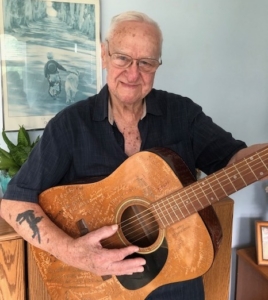
Bobby Fischer writes, “My magic guitar is a one of a kind music history: 266 music songwriters, producers, music greats I sat down with over my 90 years and they engraved their names and hit titles. The biggest country songs of all time. Gary Reamy, a great music man, now has it to get it on exhibit.”
Bob Jennings says, “Thank You for publishing my response to Ron Wood and the info on the Bud Isaacs visit. Your Country Music Newsletter is always filled with Excellent Information about all the Country Music Personalities–Fine Information of Interest and Sad Information of their Passing. You keep well up to date on all happenings in the Country Music Field.”
IN THEIR OWN WORDS
I called Jerry Kennedy on May 27, 2020, twenty years after our Faron Young conversation, when I was beginning my Randy Travis research. The COVID-19 pandemic was in full force at the time. We had another good conversation. As mentioned in my last newsletter, there was no response when I recently tried to contact Jerry about Hargus Robbins. He died February 11 at age 85.
Are you familiar with a lady named Ann Tant? She was Mercury’s first secretary here in town in 1961. Shelby Singleton hired her to be the secretary in our office that we opened here. Later on, Ann was back and forth to Atlanta—I think that’s where she was from. She was friends with Lib Hatcher. The next contact I had with her—there were a lot of years before that—she came in my office as I was leaving Mercury. I had already formed my production company. She brought me a tape and asked me to listen to it, and asked if I’d be interested in signing this act. Randy Traywick, I think was his name, and I said let’s listen. We listened to it, and I flipped out. I loved what I heard.
The guy coming in was Frank Jones; he took the reins of the company when I left. I went down to his office, and I said, “Frank, here is a tape I want you to listen to.” Cuz I had one foot out the door and was headed out. “You can do what you want to do with this, but I would be interested in working with him, since it’s an old friend of mine he’s associated with”–which would be Ann—”plus I like the way he sings.” He said, “I’ll take it home and listen to it.” Two days later, I went back down to his office and I asked him if he had listened to the tape. He said, “Oh, yeah, I meant to tell you. I’m going to take a pass. He sounds too much like John Anderson.” I just kinda threw my arms up and went back upstairs and finished packing and got out of there.
And then we know what happened. I would love to have worked with him, but hey, boy, did it work out well for him that I didn’t get to. We may not have had the success that Kyle had with him, though, because boy what a great combination they made. Frank wasn’t worse than anyone else in town who turned him down. But to sound like John Anderson? I never could figure that one out.
I’m comfortable not doing very much. I do a lot of reading, I hang out with grandkids, I stay in touch with the people—those of us who are left. It’s a nice day when I can call Pig Robbins to see how he’s doing, or Billy Sanford, some of the musicians that I worked with. Little things like that. Nothing that would be earth-shaking in the business world, but mean a lot to me, in whatever time I have left. I’m 79, I’ll be 80 in August, sure will.
I speak to Don Reid often, one of the Statlers. Those guys are good friends, plus we just lost Harold. That hurt; we’re dealing with that. I’ve only spoken to him once, and that was a hard conversation. We’ll talk again later when we can both do that, comfortably. I heard from one of Harold’s daughters this afternoon, and that was hard, too. I’ve known all those kids since they were knee-high. It will be a month this coming Friday, and we’re just now being able to talk about it with some folks. We’re not going to do a big memorial service, because Harold didn’t want it. He was very adamant about that. I had a good conversation with him, a short conversation, about two weeks before he passed. We told each other goodbye. We didn’t come out and say that, but we both knew that’s what it was.
Tom T. Hall I spoke to not long ago. I understand Johnny Rodriguez was looking for me, and I didn’t get the message, and I don’t know if I can get back in touch with him or not. He’s one of the ones I worked with that’s left. Dickey Lee, I’m in a Bible study with Dickey once a week. Dickey Lee’s been a friend for, gosh, sixty years, I guess. Those are more important to me than trying to find a great song or come up with a session to do. We had good luck with Johnny. He got to be one of the best singers to come along during that time. That was a good run he had. I think we had 14 or 15 top ten records in a row there. He was a great kid to work with.
All three of my boys are in the business. Two of them are working with Garth Brooks. Bryan has been working with Garth for years; Bryan is my middle son. The oldest, Gordon, Garth called him and wanted to know if he would do three years of these stadium dates with him, to play guitar for him. Gordon is an excellent guitar player, and he said yes. What’s really strange is now they’re all kind of sitting around and wondering what’s going to happen. I spoke to Bryan yesterday–he’s the road manager–and he said he had not heard from anybody except they’re moving this date back and that date back. Shelby works with an operation called TuneCore, are you familiar with that? Whatever goes on in the digital world, as far as collecting, and making sure product gets out there by artists who want to put their product on the internet, it’s done through that company, and it’s a worldwide company. He’s having a lot of fun with it. He’s more business-oriented than the other two. He’s the youngest. He was the third one in the line; he’s the first one I had the chance to name for Shelby.
I hate to leave people with the impression I don’t care and don’t do anything anymore. I’m busy enough; I’m as busy as I’m able to be. I’m dealing with Parkinson’s and that’s something I’m in a heck of a fight with right now. There’s a fun thing—the fun part of that—there is a Rock Steady Boxing. It’s a class that you go into, and it’s the training that a boxer would do, excepting it helps stem the Parkinson’s—it holds it back. It does not cure it, but it can help. You don’t spar with anybody, you do punch a bag, and footwork a boxer would do to train, different things—like cognitive things, like two lefts and a right. All those things that probably help to keep it at bay, sort of, this horrible disease. My tremors are not good, so it’s something I’m dealing with. We’re trying to deal with the tremors with medication now. These other things help my balance, and different things you do with your hands, but the tremors—those things aren’t really helped, except they aren’t present while you’re boxing. While I’m punching a bag, I don’t have them. They’re becoming more constant. They started off kinda light, and they’ve sneaked up on me. Some people get a little wobbly, and I noticed that was happening with me, and boy, it really has been helped with the boxing thing.
COUNTRY MUSIC DISC JOCKEY HALL OF FAME – 1995
If you listened to the Grand Ole Opry between 1972 and 2007, you heard Hairl Hensley announcing the performers. His 35-year tenure was eclipsed only by Grant Turner at 47 years in the role of Grand Ole Opry announcer. Born Charles Hairl Hensley in 1936 in Madisonville, Tennessee, he started his musical career with the dream of being a singer but realized his skill was as a broadcaster. By the late 1950s, he was handling the overnight shift on WKDA Nashville. He served as announcer on the Porter Wagoner Show on television and as WLAC Program Director. While at WSM, he hosted a daily bluegrass show called The Orange Possum Special. In February 2004, he left WSM to join the Roadhouse Channel on Sirius Satellite Radio, while continuing as Opry announcer. Hairl Hensley died Dec. 31, 2017, in Mt. Juliet, Tennessee, shortly after his 81st birthday.
Born Trulan Charles Wilder in 1909 in Kansas, Hiram Higsby got his start in 1924 while still in high school, performing on KFBI in Milford, Kansas. He joined Topeka’s WIBW, the National Barn Dance on WLS Chicago, and spent 15 years at KMBC Kansas City as part of the “Brush Creek Follies.” He served as announcer, singer, guitarist, harmonica player, and Follies staff writer. During World War II, he was a yeoman in the U.S. Navy. He joined the “Bluff Creek Roundup” on Oklahoma City’s KOMA, before returning to KMBC and the Brush Creek Follies in the 1950s. For the next 20 years he worked at country radio stations from Kansas to Canada, which included hosting a kids’ TV show in Tulsa as Uncle Hiram. He celebrated his 50th year in country music in 1974 and died in 1975 at age 66, in Faribault, Minnesota.
Mike Hoyer began his 45-year broadcasting career in 1945, when he joined KEVE Minneapolis after graduating from high school. He then played country music for eight years at KMA Shenandoah (Iowa), where he is credited with initiating charter bus tours to Nashville. He co-wrote the Del Reeves hit “Lookin’ at the World Through a Windshield.” On Labor Day 1965, he originated “Country Music USA” on 50,000 watt WHO Des Moines (Iowa), which made him a major force in country music. He opened his show each night by saying it reached “from coast to coast and border to border and then some.” In 1971, he moved to KWMT Fort Dodge (Iowa) as Program Director. He also worked at KBUL Wichita (Kansas) and KFGO Fargo (North Dakota) before retiring in 1990. He died February 1, 1999.