
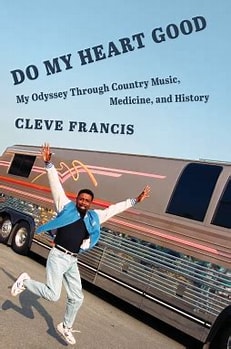
Do My Heart Good: My Odyssey Through Country Music, Medicine, and History
By Cleve Francis
Cleve Francis is a famous country singer you may have never heard of. And it wasn’t for lack of trying. Growing up in the Jim Crow South in Jennings, Louisiana, he faced discrimination at every turn. The town’s Carnegie library, the oldest established library in the state, stood as a bulwark of segregation. It was off limits to black residents except to clean it. The one black professor who tried to check out a book was arrested. Textbooks were passed down from the white schools to the black schools. Living in poverty with a supportive mother and physically abusive stepfather, Francis graduated from high school as salutatorian in 1963. He obtained a National Defense Student Loan to attend the historically black Southern University in Baton Rouge.
Do My Heart Good: My Odyssey Through Country Music, Medicine, and History is a new autobiography by 81-year-old country music recording artist and cardiologist Cleve Francis. That the Country Music Foundation Press and the University of Illinois Press have co-published this provocative story tells me these presses are striving for an accurate portrayal of country music history.
With a singular focus on higher education throughout several decades, Francis followed his own path and disregarded unhelpful advice, while always quick to credit those who helped him along the way. The tone of this well-written memoir can best be described as that of an educated physician having a personal conversation with a lay person. I found myself cheering as he pushed through the mistreatment and disappointments, onward to success. Serendipitous doors seemed to open for him. The three items he took with him to college–guitar, Bible, and biology textbook–represented his three passions: music, religion, and science.
A visit to the Southern University infirmary changed the course of his life. “I had never been to a doctor’s office before, never been treated by a single doctor over the course of my childhood,” he writes. “Whatever doctoring we received came from home remedies only.” He was stunned when a black doctor entered the exam room. It had never crossed his mind that he could become a physician. The next day, he changed his major from biology to premedical biology.
Coursework wasn’t the only thing that occupied Francis’s time as a student. Music had been his solace as an abused child sitting under a willow tree. While in college, he formed a guitar-playing duo and made extra money by singing music he describes as “the soul of Sam Cooke, the clarity of Nat King Cole, the spirit of Mahalia Jackson, the smoothness of Johnny Mathis, and the country honesty of Hank Williams and Merle Haggard.” Playing to mostly white audiences, he combined the styles and called his music “soulfolk.”
His religious faith and his mother’s advice sustained him through the years of bigotry he endured. He made a conscious choice to attend white universities and do his part to desegregate them through his example. “I would pave the way for others and demolish the notions that Black applicants were somehow not academically equal,” he writes. “At the same time, I rejected the kneejerk impulse to match me with a Black institution, as if it were the only game in town.” This philosophy carried him all the way to becoming a cardiologist and establishing his own successful cardiology practice when no one would hire him into theirs.
His musical career followed a parallel path as he completed his education and built his career in cardiology. Over the years he developed a multicultural fan base and recorded several albums. His video of “Love Light” was in heavy rotation on Country Music Television in 1991 when he was offered a recording contract by producer Jimmy Bowen of Capitol Records Nashville.
Three years in Nashville. Three albums, each costing up to $250,000 to make. Three years of concert tours, media appearances, and visits to radio stations. But no hit records and few sales. There was no radio play. Before the internet changed the rules, radio was the gateway to get to number one. And country disc jockeys refused to play his records. I listened to country radio during all those decades and don’t recall hearing of Cleve Francis until this book.
Country music is usually considered white, due to its black roots being ignored and black singers being shut out. Francis researched that history, and what he learned confirms what I’ve also learned over the years. As a major example, A.P. Carter preserved the music of the Appalachian Mountains in the early 1900s by traveling with a black companion, Esley Riddle, to document the lyrics and music in the local populations, both white and black. Carter copyrighted all the songs in his name, with no references to sources or to his assistant. In more than a hundred years, only two black men and no black women have been Grand Ole Opry members or inducted into the Country Music Hall of Fame. DeFord Bailey and Charley Pride stand alone.
Francis returned to his cardiology practice in Mount Vernon, Virginia, in 1994. Before leaving Nashville, he led the founding of the Black Country Music Association, which still publicizes the history of black artists and supports musician showcases across the nation. Within this past month, Cleve Francis had his Grand Ole Opry debut and celebrated book release events for Do My Heart Good.