
USS South Dakota: Protector of the Seas
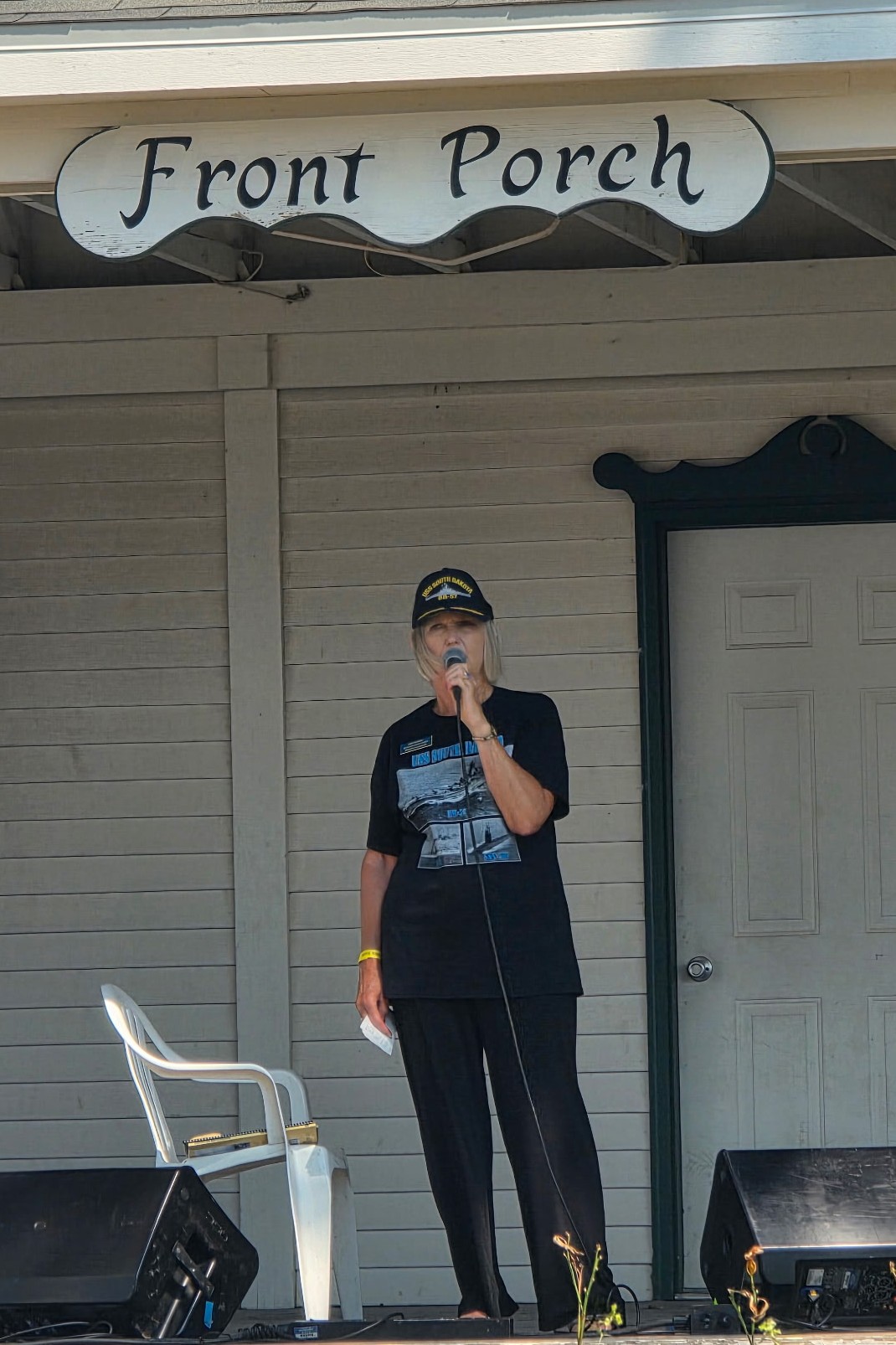
Here’s the speech I recently gave at the Sioux Empire Fair on August 1, 2026.
Good afternoon. Welcome to the Sioux Empire Fair on this beautiful summer day. I am Diane Diekman, U.S. Navy captain, retired, and president of the Battleship South Dakota Memorial here in Sioux Falls. Have any of you visited the Battleship Memorial up the street at Kiwanis Avenue and Twelfth Street? How many of you have driven by it? I’m sure most everybody has.
I’m delighted to have the opportunity to talk about the history of the ships that have been named for our state of South Dakota. I welcome you to ask questions as we go along. The first USS South Dakota was ACR-9, an armored cruiser. Armored cruisers back then were rather controversial. They cost as much and were as big as battleships, but they couldn’t stand against a battleship. They were good at—they had a lot of speed and distance. Well, you can’t win a naval battle if you run away from your enemy.
South Dakota spent its twenty years—it was commissioned in 1908 and spent most of its time in the Pacific Fleet doing patrols and being flagships. During World War I, it was transferred to the Atlantic Fleet and escorted convoys to and from Europe. In 1919, it took a group of Marines to Russia and rescued American citizens there. In 1920 its name was changed to USS Huron, and it was decommissioned in 1927. If any of you have seen the ship’s bell at the Codington County Courthouse in Watertown, that came from the South Dakota.
The reason the name was changed is because the Navy was building a South Dakota class of large battleships. There would be six of them. They started building them in 1920, battleships 49 through 54, because they were competing with Great Britain and Japan. And then in 1922, the Washington Naval Treaty was signed to stop the arms race. There was a ratio of ships to be built, 5/5/3. The U.S. and Great Britain had the number five, and Japan had the number three, and Italy and France had one point seven five. All the ships had to be in that ratio. And they cut down the size. The largest one was 35,000 long tons, and the South Dakota class was 43,000 long tons, so they all got stricken. The hulls that were under construction were sold off.
And then the world changed. Adolph Hitler started building his navy, and it was time for the other countries to start building large ships again. The U.S. designed the North Carolina class in 1930, hoping that the treaty would soon be gone. It took until 1941 before the two ships in that class, the Washington and the North Carolina, were commissioned.
As an interesting sidenote, those were the two ships that the South Dakota has always had a contentious relationship with. With the Washington, and I’ll talk about this battle later, Savo Island at Guadalcanal. The Washington sailors thought the South Dakota ran away from the battle and then had such great publicity in all the newspapers. Whereas the South Dakota sailors felt like the Washington had not been there to help them out when they were being hammered by Japanese fire. So whenever those ships were in port together, after that, they had to keep the crews separate because otherwise they would be beating up on each other.
The North Carolina story is more about the museums than about the ships. The North Carolina ended World War II with fifteen battle stars, and it’s always called itself the most decorated battleship of World War II. The South Dakota also calls itself the most decorated battleship of World War II. Although it had thirteen battle stars, it had a unit commendation that outranked the battle star. The issue is, the most medals or the highest medal. The two museums still argue about which is the most decorated battleship of World War II.
A new class of South Dakota battleships was designed in 1937 when nations were getting ready for war at some point. The original model is on display at our Battleship Memorial here in Sioux Falls. The Navy still owns it, but it’s been here ever since the Battleship Memorial was built.
The South Dakota [BB 57] was commissioned March 20, 1942, and three other battleships in the class—Indiana, Massachusetts, and Alabama—were all commissioned that summer. Battleship South Dakota was assigned to the Pacific Fleet. It went through the Panama Canal for the first time and barely made it because it was almost as wide as the canal. It headed toward Guadalcanal where the Marines had landed on the island, and they were trying desperately to hang onto it. The Japanese were trying desperately to drive them off. When the South Dakota was on its way over there, it stopped at an island to load stores and extra ammunition. As it was leaving, it hit an uncharted reef and tore a hole in the hull below the waterline. Divers patched the hole, and the ship went to Pearl Harbor and was put in drydock for repairs.
This turned out to be fortuitous because while they were there in drydock, they replaced all the 1.1” antiaircraft guns with the brand new 40-millimeter Bofors quads. That gave them top-of-the-line antiaircraft fire. Captain Gatch, the commanding officer, was most focused on gunnery. He didn’t care whether anything looked shipshape or what the sailors looked like, he cared that the guns—the big 16-inch guns and the antiaircraft guns—that his crews were proficient. They were escorting the USS Enterprise aircraft carrier. That was their mission—to protect the Enterprise. While they were traveling to Guadalcanal, they had gunnery practice. Airplanes pulled targets, and sailors on both the South Dakota and the Enterprise, and the supporting ships, would all shoot at those.
Their skill was put to the test October 26, 1942, during the Battle of Santa Cruz. It was a daytime air battle. The two fleets never saw each other. They were miles apart, but the aircraft found the opposite fleet, and they tried to sink them, of course. The South Dakota was given credit for helping to save the Enterprise because of their marksmanship and all the planes they shot down. Unlike the USS Hornet, which was sunk that day because it did not have a battleship protecting it.
There were three waves of Japanese planes that came in. The first two they shot down, and on the third wave, a Japanese bomber came in the clouds and dropped a 500-pound bomb on top of the turret of one of the 16-inch guns. It didn’t damage the turret, but there was shrapnel damage and a lot of other damage. They had their first combat casualty because one of the petty officers was killed by shrapnel. Captain Gatch was also hit. He was outside of the bridge watching the Enterprise to make sure he didn’t get too close, and a piece of shrapnel hit him in the jugular vein. He was carried below, and the doctors saved his life.
The ships went to Noumea for repairs, and then in mid-November, they headed back to Guadalcanal. This time the South Dakota hooked up with the Washington, which was the flagship because the admiral was on the Washington. They were sent to find the Japanese fleet. They were going through the narrow strait between islands. One of the lieutenants on the ship, Sargent Shriver, maybe you remember he started the Peace Corps and he was a brother-in-law of John F. Kennedy. He was a gunnery officer, and he said that capital ships—such as battleships—never wanted to get close to land because their sixteen-inch guns could fire twenty miles, and they didn’t want to get close enough that anybody could fire at them.
But most of the cruisers had been either sunk or badly damaged in the battles the previous two nights, so there were no cruisers and the battleships themselves went into the strait to find the Japanese. And they found them—a battleship and several cruisers and destroyers. During the battle that night, the Washington never got touched, but Japanese spotlights came on the South Dakota, and they shot up the superstructure of the ship. Thirty-eight sailors were killed that night. They lost communication with the Washington. Like I mentioned earlier, the South Dakota thought they were left alone, that the Washington was not supporting them. Captain Gatch, once there was no more firing, he headed southwest to get out of there and on the way back to Noumea. The Washington, who had no damage whatsoever–they couldn’t find the South Dakota and assumed the South Dakota had run from the battle. So that battle was the source of the acrimony between those two ships.
The South Dakota went to New York for battle damage repair. Oh, I forgot to mention, while they were at Pearl Harbor, they got 200 new crew members on the 4th of October in 1942. One of them was 12-year-old Calvin Graham, who became the youngest combat veteran of World War II. He boarded the ship that day, and while I was researching his biography, I got in touch with a sailor who had also gone aboard that day. He was seventeen years old when he boarded the South Dakota, and he was a hundred years old when I talked to him. It’s a piece of history to talk to somebody like that. Calvin’s story is in this book—Calvin Graham: Combat Veteran at Age Twelve.
The South Dakota was repaired at the Brooklyn Naval Yard and had radar installed. They went to the North Atlantic with the Alabama. The goal there was to somehow fool the German battleship Tirpitz to come out from the Norwegian fjord so the battleships could destroy it. Well, Tirpitz didn’t play that game, so after about a month, the ships went back to the U.S. The South Dakota went back over to the South Pacific, where it stayed for the rest of the war. It supported carrier airstrikes from ’43 to ’45 and was at battles like Leyte in the Philippines, and Okinawa, supporting the Enterprise. South Dakota also was the first ship to fire on the homeland of Japan.
When the war ended, the South Dakota sailed into Tokyo Bay on August 29, one of the first ships there. The sailors expected that the surrender document would be signed on the South Dakota. They’d been the flagship, they’d been in combat the whole time, and they were there. Something that angered those sailors until the day they died was the fact that, back in Washington D.C., somebody in the executive branch decided—oh, we have this nice new battleship called the Missouri, and that’s where the President is from, so we’ll sign the surrender on the Missouri. The South Dakota was next to the Missouri, and they got to watch the ceremony, but it wasn’t on their ship.
Admiral Halsey had used the South Dakota as his flagship, and he transferred to the Missouri while it was there, and then he came back to the South Dakota, and they led Halsey’s Third Fleet home, back to the United States. They went under the Golden Gate bridge on October 15, 1945. There were celebrations in San Francisco because their victorious Navy was coming home.
Then the South Dakota made its last trip through the Panama Canal and sailed up the coast to Philadelphia, where it went into the reserve fleet, the mothball fleet, and was decommissioned and sold for scrap in 1962. A young Navy officer from Sioux Falls was living in Washington D.C. at the time, and he saw a notice in the Washington Post that the ship was being sold for scrap, so he called here to Sioux Falls to the Chamber of Commerce, and they sent a group to Philadelphia. They made a long list of pieces of the ship that they wanted shipped to Sioux Falls so they could build a memorial. They started a non-profit, a 501(3)c, called the Battleship South Dakota Memorial Foundation, which is what I am the president of now, and they got an appropriation from the South Dakota legislature, and built the Battleship Memorial next to Sherman Park, where it still remains today.
They quickly found out that it was cost-prohibitive to bring all those items home from the battleship. Some of them were pretty heavy. So they chose a selection of things that they wanted to come here. One is that mast that you see at the Memorial; that actually came from the ship. The items that did ship here, they didn’t have any place to store them. They were farmed out to garages all over Sioux Falls. This would have been in the mid-Sixties. They also didn’t have an inventory list. Because a lot of that stuff never came back. I’ve heard stories that twenty-thirty years later, some components were found next to the Sioux River, that apparently somebody had gotten tired of having these big things in their garage, so they hauled them out to get rid of them. I don’t know what all is out there or was thrown away. I posted on the Battleship Memorial Facebook page several years ago that story, and I said if you have anything in your garage from your grandparents that looks like it might possibly be a part a ship, let us know because maybe it is.
The Battleship Memorial was dedicated and opened for business in September 1969. In 1970 they started having crew members reunions. Those crew member reunions continue to this day. They were usually two years apart. We have one crew member who last year we celebrated his hundredth birthday. Leon Gee comes from California, and he will be here in a few days for this year’s ceremony.
All those years the Battleship Memorial was a low-key tourist attraction and pretty much a reunion site for all the sailors. They’d come here and tell stories and bring more stuff. Eventually it go full, so an addition was built on the east end in the early ‘90s. By this time they had already put the concrete outline—in case you weren’t aware, the concrete outline is the actual size of the battleship. When you wander out there, you get a sense of how big the ship is.
The new addition got filled, so they built another addition on the west side. The way this works is, the foundation has to come up with the money to do the building, and then it’s gifted to the city, and then the city owns the building and maintains it and maintains the grounds. And hires the employees who work inside during the summer when it’s open. The foundation is responsible for making changes and for running it and making the rules and all that kind of thing. It’s kind of a handshake agreement, but it’s been working for sixty years, and we continue with that.
When I moved back home to South Dakota in 2010, somebody asked me if I would be willing to be the president of the Battleship Memorial. He said the current president is 85 years old, and he wants to retire, and they’re looking for a new Navy captain to take charge. I said, well, I’m an aviation maintenance officer, but if you’re willing to have an airdale running your blackshoe battleship, I said I guess I can do that. I’ve been president ever since about 2012 or so.
And in 2012, the Secretary of the Navy and the Governor and Lieutenant Governor came to Sioux Falls to announce at the Memorial in a ceremony that they were naming a new submarine as USS South Dakota. A Virginia class submarine, SSN-790, would be commissioned in 2019. For the next several years, we would have sailors from the pre-commissioning crew come out for visits, and we had re-enlistment ceremonies and things like that. The submarine was commissioned in 2019, and once again we have the South Dakota protecting the seas and probably will for the next thirty years or so until that submarine is decommissioned.
I want to tell you about our USS South Dakota Day of Honor that’s next Saturday. This is an annual event where we remember the ships and crew members and have a reunion. The descendants come. It starts at ten o’clock. We’ll have a quintet from the Sioux Falls Municipal Band. At eleven we have a ceremony with Jeremiah Schneider, the South Dakota Secretary of Veterans Affairs, as our guest speaker. And then at twelve o’clock, we will have a book release party for the two books that the Battleship Memorial has published.
Let me tell you about those. The first is the biography Calvin Graham: Combat Veteran at Age Twelve. I wrote this book and we published it several months ago. And then God on a Battlewagon is reissued. It was written by Chaplain James Claypool in 1943. He was the first chaplain on the ship, from the time it was commissioned and for twenty months. We thought it would be great to have this book back in print so people could read those stories and find out what it was like to be a crew member on the battleship during wartime. He talked a lot to the families of the sailors in the stories he wrote. That turned out to be a pretty interesting thing.
The Battleship Memorial is open every day through the end of September from 9:30 to 5:30. It’s free admission. We close the end of September and open again in May. We’re open for the summer. So if you haven’t been there, or if you have, we hope you get out there for a visit. I hope you can come to our USS South Dakota Day of Honor next Saturday, August 8.