
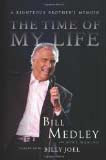
The Time Of My Life: A Righteous Brother’s Memoir
By Bill Medley, with Mike Marino
In 1963, Bill Medley and Bobby Hatfield were singing together in southern California. They decided to record a few songs and they needed a name. “At that time, Orange County was about the whitest place in the country,” recalls Bill Medley in The Time Of My Life: A Righteous Brother’s Memoir, “but all these black Marines from El Toro Marine Base heard that there were these two guys singing rhythm and blues, so they came down to hear us.” They used “righteous” to describe things they liked, and “brother” when referring to friends. The Marines would yell, “That’s righteous, brother!” at the end of a song. So Medley and Hatfield decided to call themselves the Righteous Brothers.
The pair came from different backgrounds. Medley says Hatfield “was the button-down president of his high school class, and I was the Levis and T-shirt, greaser, motorcycle racing guy who absolutely hated school.” Medley describes his youthful environment as similar to that of TV show Happy Days. He was Fonzie.
The Righteous Brothers had a two-part career. They split in 1968, largely due to outside influences and solo work. They came back together in the early 1970s, staying as a unit until Hatfield’s death in 2003. “The last fifteen years I had with Bobby were the best fifteen years with Bobby,” Medley writes. “We were working all the time, the band was great, and the show was fun.” They were inducted into the Rock and Roll Hall of Fame in March 2003, eight months before Hatfield died in his sleep at age 63. An overdose of cocaine had precipitated a fatal heart attack.
“It was a shock but it wasn’t a surprise to any of us,” Medley writes. “Bobby was just wrung out. After each show he’d virtually collapse offstage. We had a chair there for him and I’d stay with him until I was sure he was OK. Looking back I thought about the times I’d told Bobby to get to a doctor because I knew something was wrong.” He adds, “None of us knew Bobby had used cocaine, and that may have triggered the heart attack, but the truth is Bobby Hatfield just didn’t work at staying alive.”
When author and musician Mike Marino approached Medley and his staff with the idea of writing a memoir, they told him they’d “had multiple offers to write his memoir in the past but never found someone they thought could get it right.” This time, they did.
Marino and Medley hit it off, and the resulting book is a conversational and easily readable story. Family members and friends, including singer Connie Stevens, contributed asides to round out Medley’s memories. The overall tone is one of gratitude. In spite of major life difficulties, such as his father’s rejection and his first wife’s murder, Medley acknowledges his successful career and the blessings of being surrounded by family and friends.
Medley explains in the preface: “My last hit record was ‘(I’ve Had) The Time Of My Life.’ I chose that for the title of this book because I really have had an incredible life filled with a lot of joy, deep friendships, and some big-time, lesson-learning pain. . . . Thanks for investing a piece of your life in learning about mine.”
In the foreword, Billy Joel writes, “I still remember the first time I heard Bill Medley’s deep, soulful baritone booming through my little Zenith 500 transistor radio. It was the summer of 1964 and I was fifteen years old, checking out the girls with my friends on Jones Beach, Long Island. ‘You’ve Lost That Lovin’ Feeling’ was about to explode into the sonic boom heard around the world.”
There were three movies, Medley recalls, “that really kept me and the Righteous Brothers going for decades. The first was Top Gun. When Tom Cruise started singing ‘Lovin’ Feelin’’ in the bar scene, I knew it was going to be a great thing for us. . . . It opened up a new generation of fans.” Medley recorded with Jennifer Warnes for Dirty Dancing, and that song became a number one international hit. In 1990 the Righteous Brothers rerecorded “Unchained Melody” for Ghost. Medley writes, “Then a weird thing happened. Two separate versions of ‘Unchained Melody,’ the original and our ‘reunion’ version, hit the Billboard top 15 at the same time.”
The Time Of My Life adds to the archives of music history and should be on the shelves of Righteous Brothers fans and anyone else interested in the music of the period. Structurally, the memoir contains an index and descriptive chapter titles. These somewhat compensate for the lack of dates and chronology, which can result in choppy reading. The back-and-forth events would be more easily understood if anchored by specific dates. For example, the Hall of Fame induction date is not mentioned, although the date of Bobby’s death is a chapter title: “November 3, 2003.”
At age 74, Bill Medley is still performing. His daughter, McKenna Medley, tours with him. Medley concludes, “Every time I go on stage it’s like a first date. I put on my best clothes, shave, and get as handsome as I can. . . . I think that’s part of what keeps me young, I’m always looking ahead to my next first date—how cool is that?”