
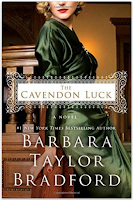
The Cavendon Luck
By Barbara Taylor Bradford
The Cavendon Luck, which opens in 1938, rounds out the three-book Cavendon Hall series of Barbara Taylor Bradford novels. Cavendon Hall covered the Great War of 1914-18, and The Cavendon Women took place in the mid-1920s. The fictional Cavendon Hall in Yorkshire, England, is home to the aristocratic family of Lord Charles Ingham, the Sixth Earl of Mowbray. Since the earldom was created in the mid-1770s, Swann family members have taken the oath, “Loyalty binds me,” and have served the Inghams faithfully. In The Cavendon Women, Ingham men finally began to marry Swann women instead of having affairs with them.
The main character in The Cavendon Luck is Cecily Swann Ingham, along with sister-in-law Diedre Ingham. The other three Ingham daughters, Daphne, DeLacy, and Dulcie, are less prominent than in the previous books.
As World War II begins, Diedre is in the secret service and Cecily runs a clothing design and manufacturing operation. The plot hinges on Diedre arranging the rescue of a Jewish family from Germany–because they are the family of Cecily’s maid, not because of any political or military need. The maid and her family aren’t characters in the book; they exist as a story element. The second book ended with all six Cavendon women happily married, and Diedre’s husband died between books to allow for a new romance in The Cavendon Luck. Because a story about such a life-enveloping war must include death and damage to be realistic, Bradford inserts moments of sorrow for Cavendon Hall residents near the end of the story.
All the Ingham and Swann characters are perfect people, children and adults alike. They are beautiful, talented, successful, and with happy marriages. The syrupy compliments get quickly old: “Mama is the best,” Charlie announced. “The magical mother. Who does everything perfectly.”
Fans of Bradford’s writing style may appreciate how point of view bounces from one character to the next, allowing readers inside the heads of every character, from maid to footman to lords and ladies. Dialogue between family members feeds information to the reader, with comments such as “my wife, Ria,” “as you know,” and “You and Miles have three beautiful, healthy children, David, Walter, and Venetia.” The often repeated dialogue tag, “she shot back,” is used for normal conversation.
Although the characters lack depth, the historical aspects of The Cavendon Luck make it worthwhile for readers who enjoy learning about actual happenings through fictional characters. In the Acknowledgments section, Bradford described her research, and I looked forward to reading this historical novel. We experienced the evacuation of Dunkirk, the Battle of Britain, and D-Day. We heard from Winston Churchill, visited Hollywood, and got acquainted with Clark Gable. We also visited historic restaurants. With such a large cast of characters, it was difficult keep the names straight. Bradford also illustrated the role played by the Women’s Institutes in producing food and clothing during the war.
The Cavendon Luck rounds out this series of light historical romances about British life during the two World Wars. Bradford fans will be pleased.