
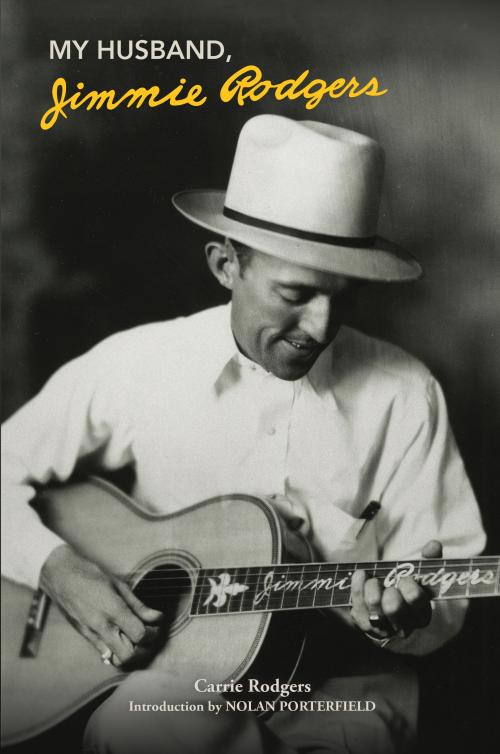
My Husband, Jimmie Rodgers
By Carrie Rodgers
Jimmie Rodgers, the Singing Brakeman, died in 1933 at age 35, following years of suffering from tuberculosis. In 1935, his wife, Carrie, kept her promise to write his biography. She privately published My Husband, Jimmie Rodgers, which was republished by Ernest Tubb in 1953 and the Country Music Foundation Press in 1975 and 1995. It is one of four out-of-books recently republished in a cooperative effort by the CMF Press and the University of Illinois Press.
This is mostly a story of how Carrie felt—her pride in Jimmie, her fears for his health, her fears of having no money to live on, worrying about how hard he was working and how long he might have left in life. She repeats these thoughts throughout the book, in a basic timeline of his life, with no attention paid to the facts one would look for in a biography.
The new edition contains an introduction by Noah Porterfield, who wrote a Rodgers biography in 1979. He says for many years there was a void in documenting Jimmy’s life, during which Carrie’s book “stands as a supremely important, if somewhat curious document.” He calls her story “at once informative and evasive, honest and fanciful, profound and trivial, a subjective personal memoir and an effort toward straight biography.”
The reader waits with Carrie as she experiences joys, fears, and misgivings. In the summer of 1927, when they traveled to Bristol to be recorded by Ralph Peer, they were destitute. A year later, Jimmie’s royalty payments increased from $27 to $2,000 a month. They adjusted to fame and wealth, with both of them worrying whether Jimmy would be alive the following year.
Known as “The Father of Country Music,” Jimmie Rodgers was inducted with the first group in the Country Music Hall of Fame in 1961 and the first group in the Nashville Songwriters Hall of Fame in 1970.