
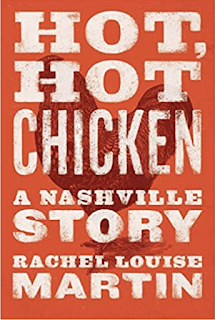
Hot, Hot Chicken: A Nashville Story
By Rachel Louise Martin
Rachel Louise Martin grew up in Nashville, Tennessee, with roots three generations deep. When she returned home in 2013 after an eight-year absence, she was surprised to hear about a culinary dish that had become internationally famous—Nashville-style hot chicken. How had she never heard of it? Hot, Hot Chicken: A Nashville Story tells of Martin’s search to learn the history of hot chicken and the family who created it.
Thornton Prince III is credited with the origin of hot chicken. The legend is that he came home one Sunday morning after a night of carousing, probably in the 1930s, and told his woman—whose identity has been lost to history—that he wanted his standard Sunday breakfast of fried chicken. With revenge in mind, she complied. “Nobody knows what went into that first hot chicken as she layered on whatever she had on hand,” Martin writes. “[She] was sure she had spiced it up beyond edibility.” Prince surprised her by asking for seconds. Although she disappeared from his life, her recipe stayed. He perfected it and opened a café to sell hot chicken. His brothers helped run the operation and passed it down to their descendants. Andre’ Prince Jefferies has been in charge since 1980.
Martin asked herself, “Was hot chicken a part of the city’s history that had been invisible to me as a white woman?” The answer was yes. Martin, who holds a doctorate in women’s and gender history from the University of North Carolina, uses the story of hot chicken to recount the history of Nashville as a segregated city from the Civil War through decades of urban renewal and racism.
Each of the eight chapters of Hot, Hot Chicken covers an era of Nashville history and how the Prince family fit into it. Chapter titles refer to steps in the process of making hot chicken. Chapter One is “Brine with Hot Sauce: The Princes Move to Nashville, 1860-1924.” Chapter Six is “Fry Again: Black Nashville Fights Back, 1968-1973.” The book concludes with “Plate on White Bread: Hot Chicken Goes Global, 1998-2020.”
Martin’s efforts to research the Prince family genealogy were hampered by lack of documentation. She began with an 1860 slave schedule that listed sex and age but no names. She writes, “…one of the best ways to deny a people citizenship and even humanity is to refuse to record their names and hence their existence.” This lack of acknowledgement extended through the years to businesses as well as persons. In 1940, for example, when a newspaper published a list of Nashville’s 41 black-owned restaurants, only one of them was listed in the city directory.
“The first definite, irrefutable, unmistakable, unequivocal reference to the business that we now know as Prince’s Hot Chicken Shack,” Martin writes with the excitement of a researcher making a major discovery, appeared in the 1953 city directory. It was a popular hangout where black people in segregated Nashville could get good food, good service, and be treated with welcome and respect. Then Grand Ole Opry star George Morgan discovered the Chicken Shack in the mid-1950s and started bringing his friends there. “In the Jim Crow South,” Martin writes, “Thornton Prince III couldn’t serve white and black customers in the same room, yet he didn’t want to turn away his new star-studded white clientele.” He built a separate room at the back for his white customers, who walked through the main dining room to reach it. As Andre’ Prince Jefferies puts it, “Black people have never been segregated from the Caucasians. . .. As far as segregation is concerned, that is a Caucasian problem.”
Martin describes her search for records of the Prince family’s movements around the city in conjunction with Nashville’s attempts at slum clearance and urban renewal, which perpetuated rather than diminished segregation, especially with interstate highways being built through black neighborhoods. She points to similarities in other cities: “And while this is a tale about Nashville history and Nashville food, this is also the story of the nation. The same forces, the same policies, and the same motivations played out in cities across America in roughly a similar way.” She concludes, “This is that story, told through the history of a piece of chicken and the family who made it famous.”
I highly recommend this well-researched and educational history, written with humor and intrigue. Martin’s desire to tell an accurate story and her joy in finding the details shine through. Her exhaustive research, notes, bibliography, and index will help anyone who wants to learn more about these tumultuous times and longstanding problems.