
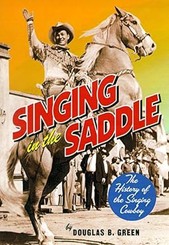
Singing In The Saddle: The History Of The Singing Cowboy
By Douglas B. Green
Gene Autry. Roy Rogers. Tex Ritter. These are the three most famous singing cowboys from the western movies of the 1930s-1950s. But there were hundreds more. Most of them are documented in Singing in the Saddle: The History of the Singing Cowboy, an exhaustive research project by music historian Douglas Green, whose personal zeal shines throughout the book. Not only does Green hold a master’s degree in literature from Vanderbilt University in Nashville, Tennessee, he is a singing cowboy himself. Known professionally as Ranger Doug of the western singing group Riders in the Sky, he is possibly the world’s foremost expert on this topic.
The 324-page narrative held my attention throughout, from the historical overview of the western frontier and the rise of the mythological cowboy, through the decades of singers and western movies. Although most of the musicians and movies were unknown to me, I enjoyed learning about them and hearing more about familiar ones. The book is filled with photos, mostly from the collections of the Country Music Hall of Fame & Museum and the author himself. Green obviously spent untold hours watching old western movies and listening to obscure, scratchy records to be able to categorize and describe them.
Gene Autry, of course, rates his own chapter, as well as being discussed throughout the book. He had 91 starring roles, from his first movie in 1934, In Old Santa Fe, to his last in 1953, Last of the Pony Riders. He also had a lucrative recording career, with numerous non-western hits such as “Rudolph, the Red-Nosed Reindeer,” “That Silver-Haired Daddy of Mine,” and his number one recording of “At Mail Call Today.” He took time out from making movies to fly C-109 transport supply planes in the Army Air Corps during World War II.
While Autry was off to war, Roy Rogers became the top singing cowboy. Known as King of the Cowboys, he starred in movies from 1938 through 1952, before moving to television with The Roy Rogers Show. His wife, Dale Evans, Queen of the West, wrote their signature song, “Happy Trails.” Rogers, who also gets his own chapter, played a dual role in the rise of singing cowboys. Before changing his name and making movies, he was Leonard Slye, co-founder of the Sons of the Pioneers trio in 1932, with singer/songwriters Bob Nolan and Tim Spencer.
“Surely no other group had as profound an effect on the history of western music,” Green writes about the Sons of the Pioneers. They “raised the bar in terms of musicianship, harmony singing, and especially songwriting, where their lyrical musical portraits virtually define the romanticized West . . . painting its colors as no one had done before or has done since.” The trio increased to five and, as members changed, continued to perform for the next seventy years. The Pioneers and numerous similar groups provided harmony vocals and musical instrumentation in the singing cowboy movies. Western swing bands such as those of Bill Boyd and Spade Cooley also participated.
As movie studios attempted to capitalize on Autry’s popularity, their singing cowboys ranged from professional actors and singers dressed as cowboys to true western singers such as Tex Ritter and Rex Allen. During the 1930s, cowboys were romanticized figures for moviegoers trying to escape the realities of the Great Depression. World War II changed the culture to add realism and violence, with less music. Television replaced movies in the 1950s, with westerns no longer containing music.
Green, now 79, was introduced to “the joys of live western harmony singing” by a group that performed at Knott’s Berry Farm in Los Angeles during his childhood. His passion for western music led him to research its history and performers while pursuing his own touring and recording career in the 1980s. He formed Riders in the Sky in 1977 and still leads the band that is today known as the premier western singing group of the modern era.
Singing in the Saddle was originally published in 2002 by the Vanderbilt University Press and reissued in 2024 by the Country Music Foundation Press in cooperation with the University of Illinois Press. In a new preface, Green writes, “It seems very hard to comprehend that it has been nearly a quarter of a century since this history was first published, and perhaps harder to comprehend that I had been at work at it for about that long preparing and researching for it.” The book is chronologically structured, with titles such as “Western Music Rides to the Big Screen” and “Riding into the Celluloid Sunset.” Characters who fit into more than one time period appear in multiple chapters.
“By the early 1970s,” Green explains, “cowboy music was largely a historical curiosity, a piece of nostalgia, an antique music redolent of another time.” The book’s last chapter, titled “Revival,” describes the resurgence of interest in the following 25 years. Riders in the Sky can take partial credit, as can other modern western/cowboy singers such as Michael Martin Murphey, Don Edwards, and Sons of the San Joaquin. Annual western music festivals are held around the nation.
As a biographer myself, I appreciate the research and skill that brought all this musical history together. I highly recommend Singing in the Saddle, both as history and as a tool to find recorded western music from the past and live performers in the present.