
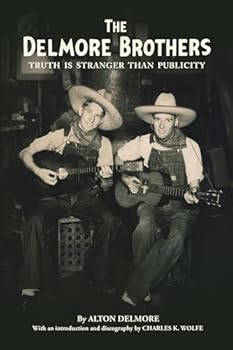
The Delmore Brothers: Truth Is Stranger than Publicity
By Alton Delmore
The first time I remember hearing of the Delmore Brothers was when the Country Music Hall of Fame inducted them during its catch-up year of 2001. More recently, I mentioned them in my newsletter in 2022 as Nashville Songwriters Hall of Fame inductees in 1971. Alton and his youngest brother, Rabon, performed as a duo from 1926-1952, when Rabon died of lung cancer at age 36.
They grew up as two of ten children in a highly musical family of tenant farmers in northern Alabama and joined the Grand Ole Opry in 1933. They wrote and recorded such classics as “Brown’s Ferry Blues” and “Blues Stay Away from Me.” They left the Opry in 1938 and later formed a gospel quartet, the Brown’s Ferry Four, with Grandpa Jones and Merle Travis.
Alton began writing his autobiography in the early 1960s. He outlined his chapters and gave it the title of Truth Is Stranger than Publicity. He’d only reached the year of 1945 when he died in 1964 at age 56. Years later, his son, Lionel Delmore, delivered the manuscript pages to historian Charles Wolfe, who edited them and added a chapter to cover the remaining years of the brothers’ lives. In 1977, the Country Music Foundation published Truth Is Stranger than Publicity: Alton Delmore’s Autobiography.
The current version, The Delmore Brothers: Truth Is Stranger than Publicity, is the third out-of-print biography being republished in the cooperative effort between the CMF Press and the University of Illinois Press. Published word-for-word as Alton wrote it, the book spends much time on how impoverished and mistreated they were during their years on the Opry, and how difficult life was on the road. Alton was an expert on reading and writing music, and the brothers were perfectionists in their harmony and guitar work. Alton wasn’t a businessman, though, often cheated out of their rightful due by radio stations, record labels, and promoters.
Because DeFord Bailey emphasized in his autobiography how much he admired and appreciated the Delmores, I was surprised Alton didn’t mention traveling with DeFord. All in all, both DeFord and Alton provide voices from the past, giving us insight into the early days of country music and the Grand Ole Opry.