Diane’s Country Music Newsletter — 14 October 2026
IN THE SPOTLIGHT – EDDIE BAYERS
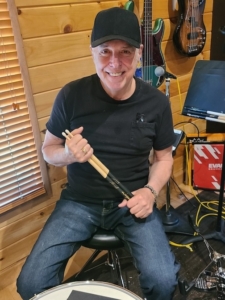
When Nashville session drummer Eddie Bayers was called to the office of Country Music Association CEO Sarah Trahern in 2021, he expected a meeting to discuss voting criteria for Musician of the Year. Instead, Sarah informed him he had been elected to the Country Music Hall of Fame. That was a double shock–he didn’t expect to ever see a drummer inducted, and why him? This was during the disruptions of the COVID-19 pandemic. Instead of an in-person gathering, Reba McEntire announced the 2021 Country Music Hall of Fame inductees during a Zoom conference. Ray Charles was the Veterans Era Artist, and The Judds (Naomi and Wynonna) were the Modern Era Artists. Voting for the Recording and/or Touring Musician category had resulted in a tie. Pete Drake became the first steel guitarist and Eddie Bayers the first drummer in the Country Music Hall of Fame.
Eddie especially appreciated being inducted with the Judds because he’d played on every one of their sessions since the beginning. He has been recording since the mid-1970s, and I called him several weeks ago to ask about his memories of Pig Robbins. I enjoyed learning about Eddie’s life. He’s the son of a U.S. Navy fighter pilot who flew off carriers during major battles in the South Pacific and was awarded the Navy Cross during World War II.
Eddie was born in 1949 while his dad was a jet test pilot at NAS Patuxent River, Maryland. In 1955, the family transferred to Port Lyautey, Morocco. That’s where Eddie began his classical music training. His father commissioned a Russian professor to give him lessons every week. Father and son also flew together. “He’d get me up in the morning, hey, you want to fly to Gibraltar?” Eddie recalls. “We’d get in either the R-4D or the Grumman Goose, and we would fly to Gibraltar. Just being in the plane with him, I was inspired to fly.”
His father retired in 1958 as a Navy captain with thirty years of service, and the family moved to Nashville, his mother’s hometown. “My mother found a professor at Belmont to further my teaching,” he says. “So at thirteen-fourteen, I became pretty accomplished.” In 1966, Eddie’s mother and sister died in a tragic accident. His parents were by then divorced, with his mother having custody of both children. Her death left Eddie a ward of the court. “I was sixteen years old,” he says, “and the only thing I knew was I’m not gonna be a ward of the court, I’m not going to be anybody’s foster child. My mother’s side of the family wanted to take my custody. I didn’t want to go with them.” His father was remarried with a new family. Edward Sr. agreed to take custody of Edward Jr. and let him go free. A close friend in high school told Eddie about a band in New Jersey that needed a keyboard player, and Eddie moved to New Jersey.
He turned eighteen while living in New Jersey and reported to the Philadelphia draft board. The physician declared him 4-F for a problem in his spine, and that ended any ideas of a military career. “I wanted to be drafted,” he says. “My father was a warrior. In ’67, I didn’t know about the political aspects. All I knew was military, yes, I’m ready to go.” He returned to Nashville in 1973 as a keyboard player.
Eddie started educating himself on the country genre, listening to the music and hearing the musicians, the productions, and the artists. “As I transcended from piano to drums, professionally, probably in ’75-76,” he says, “I got into a production studio and became known from the things I had been playing on. Musicians outside of the production company got to know me.” The first number one record Eddie played on was Mickey Gilley’s “True Love Ways.” His next big break came in 1980 when “a great bass player named Leland Sklar” recommended him for a project. It was Dolly Parton’s 9 to 5 album. Beginning in 1981 he worked regularly with Pig Robbins, and they became friends. “From that point on, there were many sessions I did with him,” he tells me. “There were so many, it would be hard to mention them all. Certainly all the Alan Jackson stuff.”
Around 1978, he took flying lessons and became both VFR and IFR certified. “I couldn’t wait to take him up,” he says about his dad. “I had I think a Cessna 175. I’m flying around Nashville, and I said what do you think, Dad? And he goes, does it go any faster? That was a joke, y’know.” Eddie explains, “Once I took my father up, that was it. That’s all I wanted to do. I wasn’t a person who was going to take a plane and fly around.”
By the early 1990s, Eddie was divorced and raising his son, Eddie. When Wynonna wanted him to go on tour as their drummer, he said he couldn’t travel by bus, due to his heavy session schedule and raising Eddie. She agreed to his suggestion that the Judds commission an aircraft for him to fly to their show dates. “They embraced Eddie, of course,” he says. Naomi called him “Chosen.” She considered him chosen because he was an outgoing child who always had a gift for everyone. In 1995, he was riding a motorbike when a sixteen-year-old driver cut him off and hit him head-on. He died instantly. Eddie put Naomi’s words–“Eddie always had a gift to give us, for he was chosen”—on his son’s tombstone.
I asked Eddie if he still flies, and he said he doesn’t. He has been married to Lane Brody (whose duet with Johnny Lee, “The Yellow Rose,” reached number one in 1984) for thirty-four years. Lane took him to Stevens Aircraft to “pick up a Baron aircraft or anything like that, fly myself there, fly myself back” while he was working with the Judds. When that gig ended, Lane asked that he stop flying. Since he didn’t intend to “go to the airport and go fly around,” he says, “I just let it go.”
Eddie continues a heavy recording schedule but with a new twist. “I’ve had people courting me because of the AI issues,” he says. “A lot of artists I work with now are using AI. There are a few who are getting their records created by Suno.” He explains that Suno Records uses cutting-edge AI technology to allow singers to create professional-sounding records. If they want to change an AI lick, such as on the drums or guitar solo, it has to be replaced by a live musician.
At the AI onset, Kyle Lehning—whom he’s frequently worked with over the years–booked Eddie for a session but couldn’t tell him who it was. Warner Bros. required the musicians to sign a nondisclosure agreement. “I wondered who the heck could that be,” Eddie says. “We all signed it and we got to the studio, and I saw Randy Travis and his wife Mary.” It was the recording of “Where That Came From,” the Randy Travis AI song that Kyle told me about in Randy Travis: Storms of Life.
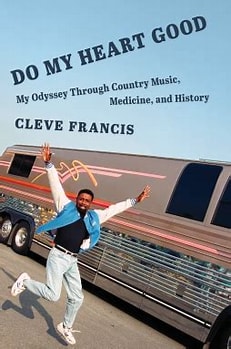
In our conversation, Eddie mentioned the recent Grand Ole Opry debut of Cleve Francis, whose autobiography I reviewed in my last newsletter. “A great artist I worked with early on,” Eddie says. He played on Cleve’s original albums produced by Jimmy Bowen. Jim Ed Norman arranged the Opry debut in conjunction with the release of Do My Heart Good.
For now, Eddie is enjoying his work playing on the Opry and recording sessions. “I’m also doing some home studio recording,” he says. “People send me their songs and, depending on if they want drums, keyboard etc., I can do either or both. Lane is still writing great songs and sings as great as ever. I’ve been recording her and we release her music on several formats.”
You can learn more about Eddie Bayers on his website at: http://www.eddiebayers.com. He concludes with, “At 77, I’m still working/creating every week…. I love it as I always have.”
NEWS
American Songwriter honored Lloyd Lamar Green with an article on his 89th birthday, October 4. It listed Tammy Wynette’s “D-I-V-O-R-C-E” Charlie Rich’s “Behind Closed Doors,” The Oak Ridge Boys’ “Elvira,” and Alan Jackson’s “Remember When” as a few of the 116 number one country music hits Lloyd helped create with his pedal steel guitar. Lloyd was born in Leaf, Mississippi, and spent much of his childhood in Mobile, Alabama. He began taking music lessons at age four. He was seven when he applied for the Oahu Music Company’s music education program that taught Hawaiian guitar. He performed his “test lesson” well enough to earn an exception to the no-students-under-14 rule. Lloyd was playing pop music in Mobile nightclubs at age 10. While attending Mississippi Southern College in 1956, he told his parents he was putting his education on pause and would finish his degree after getting music “out of his system.” The day he arrived in Nashville, the 18-year-old steel player found a job with Faron Young’s band.
Nashville Songwriters Hall of Fame member Rory Bourke, 84, died Saturday, October 10. A native of Cleveland, Ohio, and born in 1942, he moved to Nashville in 1969 to be a record promoter for Mercury Records. He decided to pursue songwriting as a career and was a staff songwriter at Chappell Music and PolyGram Music before forming his own song publishing company in 1994. “The Most Beautiful Girl,” which he co-wrote with Billy Sherrill and Norro Wilson, became a massive hit for Charlie Rich in 1973. He and songwriter Charlie Black co-wrote many hits, including “Little Red Rodeo,” “Come Next Monday,” “Do You Love as Good as You Look,” “Shadows in the Moonlight,” and “A Little Good News.” He also co-wrote “You Look So Good in Love” and “Your Place or Mine,” as well as hits for numerous country and pop stars. He was inducted into the Nashville Songwriters Hall of Fame in 1989.
Travis Tritt, 63, continues to battle pneumonia and has rescheduled several shows, reports Country Now. A show in Richmond, Virginia, was moved from October 3 to November 12, and the Charleston, South Carolina, show will take place November 14. Two shows with his daughter, Tyler Reese Tritt, in Macon, Georgia, have been moved to April 22, 2027. Travis said the pneumonia was present for two weeks before he knew it, because “I’ve never had it before. I just knew I felt a bit weak and sluggish.”
In a new cover story with PEOPLE, Wynonna Judd, 62, talks about her relationship with daughter Grace Kelley, 30. “I miss her desperately, and I’ve missed out on a lot of years because of the drug addiction,” she says. Wynonna has legally adopted Grace’s 4½-year-old daughter Kaliyah. and she and husband Cactus Moser, 69, are raising her at their home near Franklin, Tennessee. “I’ve spent half a million dollars on programs trying to do the next right thing. And meth is a bitch,” she says. “As a mother of an addict, I can tell you this: When the money stops, they usually cut you off because there’s no more money. And I’ve done everything I can do.” Grace cut off contact about a year ago. When news broke in August that Grace was in jail in Virginia and was denied temporary release to give birth at a hospital, Wynonna found out along with the rest of the world. “I learned about it on TikTok,” she says. “Isn’t that crazy? I lay there, and I was shocked, just like you would imagine. I cried and cried and cried and cried, because I have another grandbaby, I think.”
PEOPLE reports Wynonna Judd is setting the record straight on Rosie O’Donnell’s comments that Wynonna is the only Trump supporter in her life. “I’m in shock, just so you know,” Wynonna says. “I’ve never spoken to her about politics in my life. She doesn’t know anything about my stuff. I’m an independent.” Wynonna makes it a point to not discuss politics, saying, “There’s so much going on right now in the world. Can we just love each other?” According to Whiskey Riff, Rosie responded by apologizing on social media: “I was wrong to assume Wy was a Trump supporter just because she performed at Mar-a-Lago – but as she told me she has sung for seven presidents on both sides of the aisle. My apologies here publicly (as I first made them privately).”
Eight days after celebrating his 91st birthday, singer Ronnie Dove died on September 15. WMAR 2 in Baltimore reports he was in the U.S. Coast Guard in the 1950s, stationed near Baltimore, when he began his career by performing at clubs in the city. His breakthrough song was “Say You,” which hit No. 40 on the Billboard charts. “Right Or Wrong” followed in 1965. He released 14 albums during his career, with From the Soul being released earlier this year.
For 40 years, Dolly Parton dreamed of turning her famous “cup of ambition” lyric into a coffee brand, reports Country Now. Her vision officially became a reality on September 29 with the nationwide launch of Cup of Ambition, created in partnership with family-owned Community Coffee.
Dolly filmed three commercials for the brand in July, prior to her death on August 25. “I thought the cup of ambition would be a fantastic name for a coffee brand,” she says in the video. “I think you won’t be able to find a better cup of coffee out there and shoot, who couldn’t use some more ambition.” Here’s the commercial.
Saving Country Music reports that Cheyenne Dalton Meyer, former acoustic guitar player and harmony singer with Zach Top, is now on tour with Texas country traditionalist David Lewis. She was let go from Zach’s band in March, as was her husband, bass player Jimmy Meyer. Zach now plays acoustic guitar and William Bagby plays lead guitar. Keys/fiddle player David Meyer (Jimmy’s brother) remains in the band. Cheyenne and Zach met as youths and played the bluegrass circuit together.
FBI Director Kash Patel, 46, and country singer Alexis Wilkins, 27, have announced their engagement, PEOPLE reports. They met at an event at a friend’s house in Nashville and have been together since 2023. She graduated from Belmont University in 2020 with a bachelor’s degree in business administration and has been a country recording artist since 2007. I earlier printed a New York Times report about Patel diverting Nashville’s FBI agents from SWAT team duties to provide security for her, causing concern that agents might be unavailable should a crisis arise.
A landmark ruling in the U.S. Court of Appeals for the Third Circuit has determined that using copyrighted material to train AI platforms does not qualify as “fair use” under U.S. copyright law. According to The Tennessean, the ruling may have implications “for the future of AI music generation platforms like Suno, Udio and others, which have acknowledged training on copyrighted music in the past.” The ruling stems from a 2020 case not involving music, in which the AI-generation defendant appealed the decision that it had violated copyright law. “This is the kind of news we’ve dreamed of,” says Bart Herbison, executive director of Nashville Songwriters Association International (NSAI), on behalf of songwriters and music-rights holders seeking compensation for their work. The ruling may still be appealed.
Carly Pearce, 36, provides a health update to PEOPLE about her recurrent pericarditis, which was diagnosed in 2024 after stabbing chest pain sent her to the hospital. RP is inflammation of the pericardium, the thin sac around the heart, and an elevated heart rate can worsen inflammation. She was forced to slow down her shows and her life as she worked with her doctors for a treatment plan tailored to her needs. She’s learned that bending over eases her discomfort, and she slows down instead of pushing through. “I feel totally great,” she says. “I now have a healthy balance, understanding that you don’t always have to go 100%. I’ve changed my mindset.” She recognizes and controls her pericarditis flare-ups, saying, “I don’t think about pericarditis unless pericarditis is talking to me.”
Longtime writer, editor and curator Michael McCall will retire from the Country Music Hall of Fame and Museum on December 31, after more than two decades with the organization. MusicRow reports he joined the museum in 2006 and currently serves as Associate Director of Editorial. He has curated or co-curated more than 20 exhibitions, including the recent Dolly Parton: Journey of a Seeker and Western Edge: The Roots and Reverberations of Los Angeles Country Rock. (I reviewed the books about those two exhibits.) He has hosted numerous museum programs and conducted interviews with Country Music Hall of Fame members. He was Senior Editor of Country Music magazine from 1999 to 2003, which is where I first communicated with him. In addition to writing articles for numerous publications, he worked as Senior Music Writer for the Nashville Banner from 1984 to 1990. He has long been a subscriber to my newsletter. We wish you the best in your future endeavors, Michael.
The inaugural Austin Steel Guitar Festival, organized by Ted Smouse of steelradio.org, took place the first weekend in October in Austin, Texas. Saving Country Music reports the event included the first inductions into the Steel Guitar Hall of Fame since 2016 when the Hall of Fame lost its permanent home in St. Louis, Missouri. The first inductee was Junior Brown, 74, who stood behind the guit-steel he invented and sang his hits such as “My Wife Thinks You’re Dead” and “Highway Patrol.” Lucky Oceans, 75, co-founder of Asleep at the Wheel and now a steel guitar legend in Australia, traveled from Australia for the ceremony. Ray Benson and current Asleep At The Wheel members joined him. The third honoree, David “Feet” Rogers, was a lap steel guitarist from Hawaii who died in 1983. Numerous nieces and nephews came from Hawaii to accept his award. Then came the announcement that the new home of the Steel Guitar Hall of Fame will be in Hawaii, at the Kekauluohi Building in Honolulu near the Hawaii State Capitol, as part of Hawaii’s state archives. The Steel Guitar Hall of Fame was established in 1978 and now contains 84 members.
Jennifer Nettles plays a country singer named Winnie Jo Lean in the new film, Heartland, coming to Netflix this fall. According to Taste of Country, the mystery features a reclusive country singer named Misty Jones who is played by Jessica Chastain (Tammy Wynette in George & Tammy and Tammy Faye Bakker in The Eyes of Tammy Faye). She does her own singing in all three roles. Nashville hotspots like Lower Broadway and the Bluebird Cafe can be seen in the production, which was filmed in Nashville and Atlanta. Heartland also features an original soundtrack.
Dolly Parton’s SongTeller Hotel and Dolly’s Life of Many Colors Museum are now officially open in downtown Nashville. MusicRow reports the ribbon-cutting ceremony featured children whose lives have been enriched by her Imagination Library. The museum occupies the third floor of the hotel. Dolly herself guides guests into the experience that opens on January 19, 1946, the night of her birth. Visitors then travel through the many chapters of her life, from her childhood in the Great Smoky Mountains through her evolution into a global superstar and Hollywood icon.
“Choosin’ Texas” by Ella Langley got bumped out of the No. 1 spot on the all-genre Billboard Hot 100 chart after 24 weeks. Taylor Swift enters the chart this week with four songs in the top five, including “Patient Zero” in the number one position its very first week. “Choosin’ Texas” is now No. 2.
When Kacey Musgraves played a show in Dallas this past weekend, she introduced Texas Democratic U.S. Senate candidate James Talarico as a surprise guest. Whiskey Riff opines, “Kacey has never been shy about her political views and the fact that, much like Willie Nelson, she is very much a left-leaning Texan. She’s definitely not one of those artists who believes singers should just shut up and sing… and that’s her prerogative.” Talarico posted their photo on X and added the caption, “Thank you for having me last night, Kacey Musgraves.” Kristi Noem retweeted his post and said, “I’ll take @ellalangleymsic over Kacey Musgraves any day. And if I’m choosin’ Texas, I’ll take Ken Paxton over James Talarico.” Ella Langley untagged herself from the post. Kacey responded to the U.S. Special Envoy for the Shield of the Americas with this: “I don’t think you have a dog in this fight but if you did you would have shot it.”
LETTERS
Cleve Francis writes, “Thank you for this most wonderful review of Do My Heart Good. It is my honest attempt to let my fans and the world know more about me and the odyssey I traveled to realize my dreams. This book is not only about me but also about all of us who travel uncertain paths to joy. I hope the readers can see themselves in these pages. Again, you are one of the first to review this book and thank you for giving it a ‘thumbs up.’ Your review captured everything I wanted to convey to the readers. I never give up! I was sure of my talent and it will become obvious that I was denied the opportunity to present my music to the public. Now, the book will do it. I was also ignored by the folk community. Now an album, Beyond the Willow Tree, is receiving world-wide acclaim after 50 years. Thank you again for this wonderful start to my book.”
Carol Smith says, “Thank you for writing about Cleve. I met him some years ago at a fan fair. So nice and above all he was a very good performer. I often wondered what happened to him. Glad to know there is a book on him. I will have to get one. Again thank you for writing about him. Of course, I will never forget you writing about Marty Robbins and it was so nice to meet you at the book signing. You are a treasure to those of us who enjoy country music.”
In response to my birthday greeting, Lloyd Green writes, “Even now, at age 89, the music is starting again for me. Great moment to be alive! Your newsletter each week provides food for the soul to the many country music fans around the world who have few informational sources of the music you love and I love. Much I was fortunate to have played a role in. When all was said and done, I want you to know I grew to love the music of Faron Young. Of the many recordings we did together over the years, He showed great respect for me in the studios, and I him, unlike my contentious 1 1/2 years on the road with him. Perhaps we both matured a bit. I did. He was truly one of the best country singers I recorded with in a long career, and many of those records from the 1960s-1970s are among the best to come out of Nashville. I miss him.”
Jackie Allen Thomas says, “Wow, a really great newsletter! I loved the book review on Cleve Francis, very interesting. So good to hear all the latest news in country music. Thanks so much.”
Ron Wood writes, “Thanks so much for the posting in your latest newsletter about Carl Smith, the video of his singing, and the photo of you with the Smiths. I just pulled up a part of a Country Music USA show with Carl Smith and noted his steel guitar player is Johnny Sibert. I’m always interested in who plays the steel guitar since it’s my favorite instrument. Keep the ‘good stuff’ coming.”
Gary Blurton says, “More stories and pictures on Carl Smith. Thanks.”
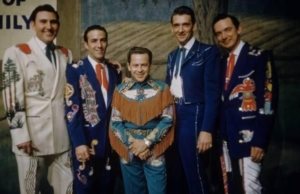
Diane: Here’s a 1960ish photo of Webb Pierce, Faron Young, Little Jimmie Dickens, Carl Smith, and Ray Price.
Carol Grace Anderson says, “Another newsletter filled with interesting information!”
Donald Ewert writes from Milwaukee, Wisconsin, “I recently found an LP on eBay by Denver Duke & Jeffery Null aka The Hardin County Boys. They were well known in the ‘50s and ‘60s, appearing on shows across the country including the Grand Ole Opry and WWVA Jamboree. Hits include ‘Rock N Roll Blues’ and ‘Hank Williams That Alabama Boy.’ They had a unique country/bluegrass sound. I became pen pals with Denver Duke for a few years before he passed away. He was an American Indian whose real name was Johnny Eagle Feather. One year he sent me a box of his cassettes to give away at Milwaukee’s Indian Fest that I had told him about. Their music can be found on YouTube. Both singers have passed away.”
Bobby Fischer writes, “I got to write this idea I had with Rick Giles and Steve Bogard. I pitched it for Conway Twitty and he cut it. They got everything out of the thought.”
Diane: Here is Conway singing “Not Enough Love To Go ‘Round” from his 1987 Borderline album.
Frank Gerard says, “Thanks again for your help in connecting me to Jenny Webb at the Legends of Country Music Museum. Our podcast Voices of Country Legends is off to a great start, and we visit with at least one new guest every week. We’ve already been so fortunate to visit with some terrific folks including William Lee Golden, David Frizzell, Donna Fargo, Sylvia, Bobby Goldsboro, Debby Boone, Deborah Allen, Patsy Cline’s daughter Julie, and many others. I’ve already wrapped up 20 interviews, and we’re booked thru the end of this year. I invite readers of your newsletter to give it a listen on Apple Podcasts, Spotify or at VoicesOfCountryLegends.com. We are now booking guests for early 2027. If you know of a country music legend, or those connected with the history of Country Music in any way that would like to be considered as a guest for a visit on our show, or even if you just want to share an idea, email me at Fr***@********************ds.com.”
Dave Sichak writes from Modesto, California, “A fan wrote you in your latest newsletter, mentioning John Trimble. I got introduced and knew him very late in his career having stumbled across his show while I was doing research on Asher Sizemore and Little Jimmie. I got to talk to him in his studio one day for a short bit. He wanted us to do an interview of sorts talking about Asher. But sadly, I logged on one day and found he had passed away. He had a great personality and could tell a tale or two while keeping the music flowing. Country music needs more disc jockeys like this to give fans a bit more than just the latest spin of a new song. Asher Sizemore was an Opry star from an early era who latched onto a way of peddling his songbooks for a quarter or a dime or whatever. He had his family opening and counting those coins in a basement office. Some of their old radio shows survive today and you can hear that old time harmony. My research has taken me back to the west coast where I now reside. A female vocalist by the name of Anita Cross and a guy that gave Buck Owens and Merle Haggard a start, Billy Mize. Nashville was not the only place generating country music – the west coast did its part in more than one way.”
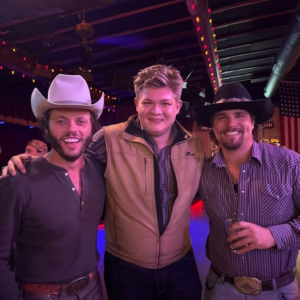
Martha Moore so much MOORE media says, “Skinny Dennis is definitely the best Honky Tonk Hang in East Nashville. Traditional Country lovers Charley Crockett, Alex Miller, and Gavin Adcock pose for a quick — peaceful — photo.”
COUNTRY MUSIC DISC JOCKEY HALL OF FAME – 2011 and 2012
2011
Dale Carter began his Country radio career in 1979 at WROZ in his hometown of Evansville, Indiana. By 1995, he had settled into his current position as morning host and program director at country radio station KFKF-FM in Kansas City, Missouri. He served from 2009-2025 as the “Voice of Arrowhead Stadium,” the Kansas City Chiefs’ official Arrowhead Stadium PA announcer. He resigned in September 2025, citing significant changes that made his role less enjoyable. In addition to radio and podcasting, he is currently running for the Jackson County Legislature in District 5. He is 62 years old.
A native of West Terre Haute, Indiana, Barry Kent began his radio career at WWVR in 1969. After stints at other local stations, he moved to HI‑99/WTHI in Terre Haute in 1982 and remained there until his retirement in 2015. In 1989, the station bought WWVR, and he became operations manager of both stations. After close to 45 years on the radio in the Wabash Valley, he retired from HI-99/WTHI on August 19, 2015.
Lee Rogers worked in the radio business for more than 50 years, beginning in 1970 at KBAM in Longview, Washington. In 1998 he became operations manager and morning show host at Portland, Oregon’s KUPL. He toured and performed with artists such as Ernest Tubb, Hank Snow, Don Gibson, Keith Whitley, Minnie Pearl, Dwight Yoakam, and Charlie Daniels. LinkedIn has an “In Remembrance” page that says he died in Surprise, Arizona.
2012
The career of air personality Moby, born James Carney in 1954, began in his hometown of Crossville, Tennessee, where he played Sunday morning gospel music at the age of 15. He became a major force in the Rock format every morning in Houston, Texas, known to his loyal Houston radio rock fans as “Moby” on 97 Rock KSRR and 101 KLOL through the 1980s. In the early 1990s, Moby moved to Kicks 101.5 WKHX in Atlanta, Georgia, where he won a major morning battle in the Country format and enjoyed success for the next decade. He retired from his syndicated country morning show in 2016 and died in 2023, at age 69, after battling stage 4 stomach cancer.
Recognized nationally for his vast knowledge of the history of Country music, Eddie Stubbs served 25 years as a WSM 650 radio personality and Grand Ole Opry announcer. Born in Montgomery County, Maryland, in 1961, he graduated from Gaithersburg High School and became a fiddle player with a traditional bluegrass band. In 1984, he was hired by 88.5 WAMU in Washington D.C. and given his own show in 1990. I listened to The Eddie Stubbs Show every Sunday afternoon after moving to the area and was so disappointed when he left Washington, D.C, to move to Nashville in 1995. Never did I dream I would someday write country music biographies and have Eddie invite me to be a guest on his WSM radio show for both Live Fast, Love Hard; The Faron Young Story and Twentieth Century Drifter: The Life of Marty Robbins. Kitty Wells and Johnnie Wright convinced him to move to Nashville in 1995 and join their band. But within two weeks, he was hired by The Grand Ole Opry as a regular announcer. Eddie was a dedicated reader of my newsletter for many years, and we occasionally corresponded. In July 2020, many of us in the country music world were saddened when Eddie Stubbs announced his retirement from WSM and the Grand Ole Opry. He dropped out of sight and went off to live on the seashore, if I remember correctly. I hope he’s doing well. He will be celebrating his 65th birthday next month.
Bill Whyte is originally from the St Louis area and, since age sixteen, has been writing songs, entertaining, and making people laugh. He has performed at corporate events, casinos, fairs, comedy clubs and more. He worked on air at 650AM WSM in Nashville and was the most frequent guest host for the Bob Kingsley Top 40 Countdown Show. He hosted “live” syndicated world premieres for Patty Loveless and Jo Dee Messina, among others. As a syndicated writer for both United Stations and Premiere in New York, Bill provides comedy bits for production and distribution to morning radio shows across the country. He has a website at https://billwhytecomedy.com/.